Detailed Explanation of Larch Planting Techniques and Cultivation Management Methods
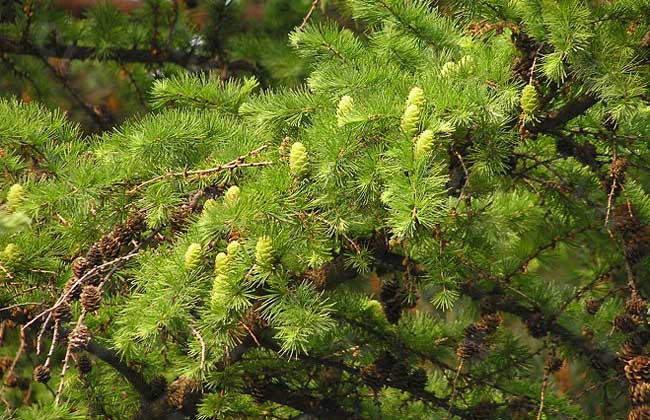
Larch is a type of pine, a deciduous tree of the genus Larix in the family Pinaceae. It is a major forest component species in the forest regions of Northeast China and Inner Mongolia, and one of the three major coniferous timber forest species in Northeast China. It has a very wide natural distribution and is the most cold-tolerant among coniferous species, with its vertical distribution reaching the uppermost limit of forest distribution. Let's take a look at larch planting techniques below!
Cultivation Value of Larch
Larch wood is heavy and solid, with high compressive and bending strength, and is resistant to decay. It has high technological value and is an excellent timber for utility poles, railway sleepers, bridges, mine props, vehicles, and construction. The tree is tall and upright with a beautiful crown shape, a very well-developed root system, and strong resistance to smoke, making it an excellent landscaping tree species as well. Larch arabinogalactan is obtained by extracting larch genus wood with water or dilute alkali solution, and is a low-viscosity, highly dispersible gum mainly used in medicine, food, and other fields.
Growth Habits of Larch
Larch is a light-demanding, strongly heliophilous tree species with strong adaptability and a very wide tolerance range for soil moisture and nutrient conditions. It grows best under moist, well-drained, well-aerated, deep and fertile soil conditions. It can also grow on dry and barren sunny mountain slopes or in waterlogged wetlands or low-lying areas, but its growth is poor. It is tolerant of low temperatures and cold, generally growing normally even at minimum temperatures of -50°C. It is distributed across the Greater and Lesser Khingan Mountains, Laoyeling, Changbai Mountains in Northeast China, northwestern Liaoning, northern Hebei, Shanxi, the Qinling Mountains in Shaanxi, southern Gansu, northern and western and southwestern Sichuan, northwestern Yunnan, southern and eastern Tibet, **the Altai Mountains and eastern Tianshan Mountains. It often forms large pure forests or grows mixed with other coniferous and broadleaf tree species.
Larch Seedling Cultivation
1. Nursery site selection: Choose a site with convenient transportation, flat terrain, good drainage and irrigation, deep soil layers, loose soil texture, and relatively fertile neutral or slightly acidic sandy loam or light loam for seedling cultivation. Prepare the land in winter, apply 750 kg of organic fertilizer per mu, and deep-plow 30 cm. Before sowing, evenly spray a 1:10 dilution of ferrous sulfate solution. After it dries, rake level and make beds. Bed height 15 cm, width 1 m, bed spacing 25 cm.
2. Seed treatment: Before sowing larch seeds, soak the seeds in a 0.5% potassium permanganate solution for 4 hours for disinfection. Rinse with clean water, then place them in 45°C warm water and soak for 24 hours. Remove and air-dry slightly, then mix with river sand three times the volume of the seeds, and place in a germination pit to promote germination. The germination pit should be dug in a sheltered, sunny location, 50 cm deep and 50 cm wide, covered with plastic film on top, and covered with straw mats at night. Turn the seeds evenly once a day. Once 30% of the seeds have cracked open, they are ready for sowing.
3. Sowing techniques: Sowing can begin when the surface temperature is above 10°C. The sowing rate is 4-4.5 kg/sq m. Before sowing, the seedbed should be thoroughly watered. Use furrow sowing, with furrow spacing of 10-15 cm and furrow depth of 1 cm. After sowing, cover with 1 cm of fine sandy loam and a layer of rice straw. After covering with straw, the ground should be barely visible. Spray water immediately, then spray water in small amounts multiple times daily, keeping the bed surface moist at all times. When 30-50% of seedlings have emerged, begin removing the straw. Once all seedlings have emerged, remove all the straw. Straw removal should be done on cloudy days or in the evening, and water promptly after removal.
4. Seedling stage management: After emergence, water timely in small amounts multiple times to keep the seedbed moist. Pay attention to loosening the soil and weeding. Weeding should be combined with soil loosening. A shade frame must be built above the seedbed to maintain a light transmittance of 60-70%. The main disease of larch seedlings is damping-off disease, and the pests are white grubs and mole crickets. Attention should be paid to their control during the seedling cultivation process.
Larch Planting Techniques
1. Site selection and land preparation: Generally, pit-shaped, fish-scale pit, and horizontal trench land preparation methods are used. On newly cut sites and abandoned farmland with fewer weeds, and sites with sparse shrubs, use pit-shaped preparation with dimensions of 40 cm × 40 cm × 30 cm. On barren hills and old cutting sites with dense shrubs and weeds, first clear the shrubs and then prepare the land. Fish-scale pit preparation dimensions are 50 cm × 50 cm × 40 cm, or use horizontal trench preparation with trench length of 70-100 cm, width of 40-50 cm, and depth of 30-40 cm.
2. Planting density: Use 2-year-old grade 1-2 qualified seedlings for afforestation. On sites with better site conditions, the planting density should be 1600-1700 trees per hectare, with a spacing of 2 × 3 m. On sites with relatively poorer conditions, the planting density should be 2500 trees per hectare, using either 2 × 2 m spacing or 1.6 × 2.5 m spacing.
3. Fertilizer and water management: After planting larch, water twice within one week. After that, loosen the soil and conserve moisture. Water once more in early May. After that, do not water unless the weather is dry. Apply fertilizer once in June and ferrous sulfate once in August. Dig pits beside the plants and apply at points. For soil loosening and weeding, carry out once every 20 days, requiring careful and thorough work, generally to a depth of 4 to 5 cm. The hoeing should be even, the soil loose without clods, and the weeds thoroughly hoed and picked clean.
4. Disease control: Before the peak period of ascospore release in spring and summer, spray 1:1:100 Bordeaux mixture, 50% Tuijunte 500-800 times dilution, 70% Dikson 500-800 times dilution, 65% Zineb 500 times dilution, or 45% Amobam 200-300 times dilution. For closed young forests or severely diseased mature forests, apply 621 smoke agent, chlorothalonil smoke agent, or sulfur smoke agent.