How to make a pine bonsai? A detailed full-process guide to get you started easily
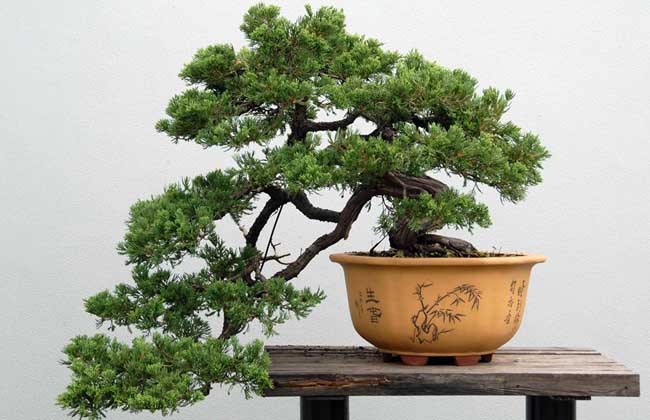
There are nearly 80 species of pine in the world. With majestic, vigorous tree forms, tall and long-lived bodies, they have important ornamental value. Although the vast majority are tall trees, a very few are shrub-like, such as the dwarf pine and the ground pine. People often make small pines into bonsai for appreciation. Let's take a look at the process of making a pine bonsai below!
The process of making a pine bonsai
1. Material selection: For making a pine bonsai, Buddhist pine (Podocarpus macrophyllus) is generally the main choice. Buddhist pine bonsai material is usually obtained through artificial propagation, and can be propagated by sowing or cuttings. Wild Buddhist pines from the mountains and fields can also be selected; choose those growing in rock crevices that are short in stature, with ancient and elegant branches and beautiful forms, and dig them up. First cultivate them in the open ground for 1-2 years, then transplant them into pots and shape them.
2. Pot selection: A pine bonsai has an ancient, elegant and refined posture, so purple clay pottery pots or glazed pottery pots are commonly used. The pot shape depends on the tree shape: for the cascade style use a tall, deep cylindrical pot; for the slanting-trunk style and the lying-trunk style use a medium-deep rectangular or oval pot; for the exposed-root style and the rock-clinging style use a relatively shallow pot.
3. Soil: A pine bonsai should use fertile, moist, loose-textured, well-draining, slightly acidic sandy loam. Fill the bottom of the pot with a layer of coarse sandy soil to facilitate drainage.
4. Planting: For transplanting a pine bonsai into a pot, it is best to do so before it sprouts in spring. Large seedlings should be kept with their original soil, and dead roots and overly long roots should be cut off so that the fibrous roots spread out in the pot soil. Press the soil firm so it connects closely with the root system, which benefits growth and survival.
5. Shaping: The shaping of a pine bonsai must not be done carelessly. For shaping after potting, wiring is the main method, combined with appropriate pruning. Wiring is best done during the dormant period, using palm fiber, and the palm fiber must not be left exposed. The trunk should be crooked and the branches twisted, with a natural posture. Small branches and leaves are pruned into layered sheets or hemispherical shapes, arranged in staggered layers.
Care and management of pine bonsai
1. Environment: Pines are cold-resistant and drought-resistant, and can be placed year-round on courtyard terraces and slopes, balconies, and flat rooftops, in places with ample light and air movement. But small bonsai should not be exposed to strong sunlight in midsummer. In winter they can overwinter in the open ground; it is best to bury the whole pot in a sunny, wind-sheltered spot. If overwintering indoors, the room temperature should not be too high, and they can be moved outdoors at Qingming Festival.
2. Watering: Pines like dryness and dislike waterlogging, so watering must not be excessive. Water only when the soil is dry, and water thoroughly when you do. Appropriately controlling water during the growing season can make the trunk thicker and shorter and the needles shorter and smaller, adding ornamental value. In high summer temperatures, you can often spray water on the leaves, which benefits growth.
3. Fertilizing: Pines tolerate poor soil and can grow normally even when the soil lacks fertilizer, and this also promotes a shorter trunk, denser branches and shorter needles. However, applying 1-2 times of dilute, well-rotted cake fertilizer water appropriately during the growing season is beneficial for healthy growth and increases resistance to pests and diseases.
4. Pruning: To maintain its beautiful, ancient and elegant tree shape, a pine bonsai needs appropriate pruning. During the growing season, pruning is mainly bud pinching, 3-4 times a year. When new buds have elongated but have not yet produced needles, about 1/2 of each terminal bud can be pinched off. If the bonsai does not need to grow more branches, all terminal buds can be pinched off. For branches that affect the beauty of the tree shape, prune during the dormant period.
5. Repotting: A pine bonsai is generally repotted once every 3-5 years, preferably in February to March. When repotting, keep the original pot soil intact and tip it out, remove 1/2 of the old soil, cut off overly long roots as well as dead and rotten roots, and at the same time prune some unnecessary branches and leaves to maintain the balance between the upper and lower parts of the pot soil. If the original pot's capacity is insufficient, switch to a slightly larger new pot; the planting method is the same as for potting.
6. Pests and diseases: Common diseases of pines include leaf rust, needle-cast disease, twist disease and pine gall disease. For pine needle rust and pine gall disease, spray 65% wettable ferbam or ziram at 300 times dilution; for needle-cast disease, spray 0.5 degree Baume lime sulfur mixture. Common pests include aphids, scale insects, red spider mites and pine tip borers. For red spider mites and pine tip borers, spray 50% fenitrothion emulsifiable concentrate at 1000-1500 times dilution, or 40% dimethoate emulsifiable concentrate at 2000 times dilution.
Common types of pine bonsai
1. Forest style: The forest-style bonsai is a miniature version of a forest. A forest-style bonsai is formed by combining multiple trees, making a bonsai rich in layers.
2. Slanting-trunk style: In the slanting-trunk style bonsai, the trunk leans to one side, and some trunks are slightly curved, with branches extending beyond the pot. The overall shape appears rather steep yet stable. The slanting-trunk style bonsai can express the complete artistic effect of the tree's momentum and the balance of dynamic and static changes.
3. Lying-trunk style: The trunk base of a lying-trunk style bonsai can be divided into three types: the flat-lying style bonsai, the supine style bonsai and the semi-lying style bonsai. In the flat-lying style bonsai, the entire trunk base lies horizontally, and the treetop tip must not exceed the height of the trunk itself. In the supine style bonsai, one fifth of the upper part of the trunk base is slanted or upright, while four fifths of the lower part lies flat or lies slightly tilted upward. In the semi-lying style bonsai, the lower half of the stem of the trunk base lies horizontally or lies tilted upward.
4. Cascade style: The cascade style bonsai is divided into two types: the large cascade style bonsai and the bonsai whose trunk extends beyond the bottom of the pot. The semi-cascade style bonsai is also called the small-ground style bonsai. The trunk of the bonsai extends beyond the pot, and the trunk hangs down but must not go beyond the bottom of the pot.
5. Exposed-root style: The exposed-root style bonsai exposes the root area above the soil. The roots are like a coiling dragon, or like eagle claws suspended high. The exposed-root style bonsai reveals an elegant feeling.
6. Split-trunk style: The trunk of a split-trunk style bonsai must undergo decades or even hundreds of years of external natural forces. After it becomes deadwood-like, the bark is peeled off, leaving only part of the tree's xylem and a layer of epidermis attached to it. In some parts the life of the bark and branches is not interrupted, and the twigs can still grow new branches and leaves, giving a sense of ancient age.
7. Epiphytic style: The trunk base of an epiphytic style bonsai appears in a deadwood state, also leaving only part of the xylem and cortex to support it.