Which Aquatic Plants Flower? A Roundup of Common Flowering Aquatic Plant Varieties
Aquatic plants drifting in ponds and aquariums are like a beautifully stunning oil painting, and they also serve as shelter and refuge for many aquatic animals, as well as food for many animals such as snails and ducks. Kept in a fish tank, they can increase the oxygen content of the water, and many aquatic plants also produce flowers with great ornamental value. Let's take a look below at which aquatic plants flower!
Bowl Lotus
The lotus, also known as white lotus and furong, is a perennial aquatic herbaceous plant of the genus Nelumbo in the family Nymphaeaceae. Its underground stem is long and thick, with long nodes, and its leaves are shield-shaped and round. The flowering period is from June to September, with flowers borne singly at the top of the pedicel. The petals are numerous and embedded in the receptacles, in colors such as red, pink, white, purple-yellow, and green, sometimes with colored patterns or fringed edges. The nut is elliptical, and the seed is ovate. It is distributed throughout China, with the most famous produced in Suzhou.
Water Lily
The water lily is a perennial aquatic herbaceous plant of the genus Nymphaea in the family Nymphaeaceae. It likes sunlight and good ventilation, so tropical and hardy water lilies that bloom during the day close their flowers at night and open again in the morning. It is not strict about soil quality and can grow normally at a pH of 6 to 8. The most suitable water depth is 25 to 30 cm, and it must not exceed 80 cm at the deepest. It prefers loam rich in organic matter. In the Yangtze River basin, it sprouts from late March to early April, forms buds in late April or early May, has its peak flowering period from June to August, its yellow-leaf period from January to November, and enters dormancy after November. It is cultivated as an ornamental plant in many park water bodies.
Japanese Lotus Root
The Japanese lotus root is a perennial aquatic herbaceous plant of the family Nymphaeaceae, generally growing in shaded ponds or swamps. It is 25 to 80 cm tall. Its roots, buried deep in the water, look and are colored like white bones. The rhizome is thick and large, with roots and leaves growing from its front end. The underwater leaves are pale green, with slightly transparent leaf margins adorning the elliptical leaf surface, a radiating base, and cracks. It can exist in the water for many years with beautiful underwater leaves, and algae are not prone to appear on the leaves. Providing nutrient-rich base fertilizer will make it grow well.
Anubias
Anubias is a type of aquatic plant in the family Araceae distributed in the West Africa region. Compared with other aquatic plants, it can be said to be very tough and easy to plant, but if it is planted arbitrarily and carelessly, rhizome rot and dwarfing will gradually appear, eventually leading to withering. It likes ample sunlight, water hardness should be slightly higher, nitrate content should be low, and the substrate should have sufficient base fertilizer. The suitable growth temperature is 22 to 30°C.
Amazon Sword
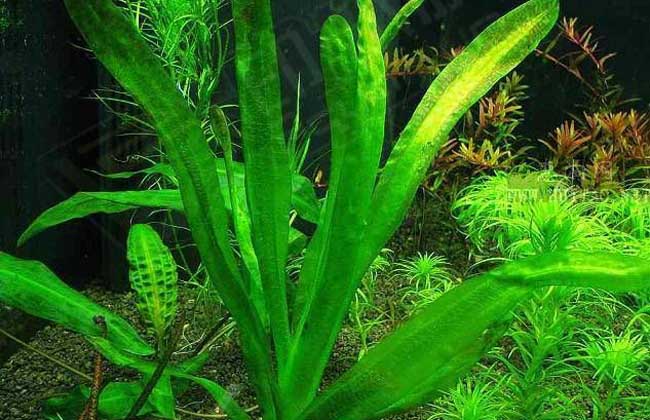
Amazon sword, also known as Amazon sword plant and crown grass, is a large aquatic plant of the genus Echinodorus in the family Alismataceae. Its leaf stalks are thick and strong, its leaves are broad and large, and its leaf shape is graceful. The largest Amazon sword can grow nearly a hundred leaves, with a maximum leaf length of up to 50 cm and a maximum leaf width of up to 8 cm. It is called the king of aquatic plants. It is suitable for growing in weakly acidic and neutral water, likes warmth and light, and the water temperature must be above 24°C, with 26 to 28°C being most suitable. Its flowering period is from June to September.
Dragon's Tongue
Dragon's tongue is a perennial monocotyledonous submerged plant of the family Amaryllidaceae. Except when flowering, it grows submerged in water. Its small bulbs are dark green, and its leaves can reach more than 1 m in length. When flowering, the flower stem grows above the water surface, with white umbel-like inflorescences, but it is not easy to flower when cultivated in an aquarium. It has a considerable decorative effect in a monotonous aquarium, so it is quite popular among ordinary people. It is not difficult to grow, but to grow it beautifully still requires much careful attention. It is divided into two types: small-leaf dragon's tongue and large-leaf dragon's tongue.