Why does an osmanthus tree not bloom?
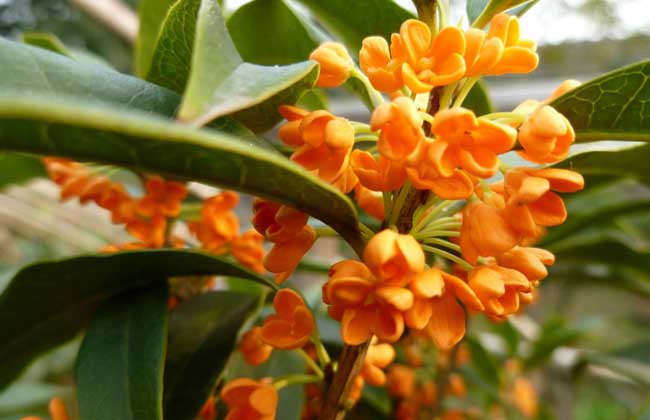
The osmanthus tree has an elegant bearing, with green branches and leaves, evergreen through all four seasons, and relatively slender branches. Its fragrance is delightful. The flowers grow in clusters of 3 to 5 at the leaf axils, with an extremely strong fragrance, gathered in large umbel-like clusters, and are very aromatic. Seeing such beautiful osmanthus, one cannot help but want to pick a flower, but some osmanthus trees never show a single bloom. Let's take a look below at why an osmanthus tree does not bloom!
When does the osmanthus tree bloom?
Common cultivated varieties of osmanthus include Dan Gui, Jin Gui, Yin Gui and Siji Gui. Different varieties bloom at different times, and the colors of their flowers also differ. Jin Gui blooms from September to October, and its flowers are usually golden yellow. Yin Gui blooms from September to October, with white or yellowish-white flowers. Dan Gui blooms in October, with flowers mostly orange-red or orange-yellow. Siji Gui blooms in all four seasons, with a small number of flowers every month, and the flowers are white.
Why does an osmanthus tree not bloom?
1. Improper seedling selection: There is a type of purple osmanthus that can only bloom after it has grown into a tree. If purple osmanthus is mistakenly propagated as cuttings or seedling plants, it will be very difficult for it to bloom. Osmanthus seedlings should be grafted seedlings using mature branches of good varieties as scions, or seedlings obtained by air layering from flowering branches or even the base, which are not only good in quality but also easy to bloom after surviving. This point is very important. Only when good osmanthus seedlings are selected will cultivation be more convenient, and there will be no need to worry about why the osmanthus tree does not bloom.
2. Improper cultivation: The osmanthus tree likes sandy soil best, and in soil with relatively high alkalinity it often blooms very little. If the roots are damaged or frozen during transplanting, the growth vigor will inevitably be weakened, and it will not bloom for 3 to 5 years. The osmanthus tree likes light and avoids warmth, and long-term insufficient light may prevent blooming. Soil that is too wet and causes root rot, or long-term high temperature and dryness, will also affect flower bud differentiation. This is also a point that cannot be ignored among the reasons why an osmanthus tree does not bloom.
3. Fertilizer imbalance: The osmanthus tree is a fertilizer-loving plant, but fertilizer is not always better in greater amounts. Every plant has a required balance ratio of fertilizer components such as nitrogen, phosphorus and potassium. If there is too much nitrogen fertilizer, the branches and leaves flourish and the branches and leaves grow excessively, but it simply does not bloom. If there is too little, the leaves turn yellow and the branches become thin, which affects the absorption of phosphorus and potassium fertilizers, and it also does not bloom. Therefore, as much as possible do not use chemical fertilizers in planning, and use more farmyard manure. The osmanthus tree especially likes pig manure fertilizer. As the proverb says, “If you want osmanthus to be fragrant, smash the pig manure vat.”
4. Caused by diseases: The osmanthus tree is afraid of chlorine gas and is not tolerant of oil fumes. If there is a lot of oil fume, growth will be poor, the leaves will become smaller and fall off, and it cannot bloom. The osmanthus tree is also susceptible to damage from pests and diseases such as anthracnose and scale insects. If not treated in time, this will likewise affect blooming. In addition, mistakenly pruning spring shoots will affect blooming that year. If there are too many blooming osmanthus branches, the growth vigor will be weakened, affecting future blooming.
How can osmanthus be made to bloom more?
1. Choose good potting soil: Osmanthus likes slightly acidic soil. For pot cultivation, you can use a mixture of 5 parts mountain soil, 3 parts humus soil and 2 parts sandy soil, or use half leaf mold and half sandy loam as the growing medium. If the soil is too acidic, growth will be slow and the leaves will wither and turn yellow. If alkaline soil is used, after 2 to 3 months the leaves can wither and the plant may even die.
2. Water at the right time: For watering osmanthus, master the rule of “two less and one more,” that is, water less before new shoots emerge, water less on cloudy and rainy days, and water more during dry weather in summer and autumn. Ordinarily, watering should keep the potting soil at about 50% water content. On cloudy and rainy days, drain promptly to prevent water accumulation in the pot from causing root rot, otherwise it is easy for the plant to be “drowned.”
3. Apply topdressing skillfully: Osmanthus likes pig manure. There is a floral proverb, “If you want osmanthus to be fragrant, prepare more pig manure vats.” If, after the osmanthus is brought out of the room in early spring, you apply fully decomposed diluted pig manure liquid, applying it about once every 10 to 15 days from April to May, once every 7 to 10 days from June to July, and applying it for the last time in early August, then the osmanthus will grow luxuriantly, bloom abundantly and smell fragrant. If there is no pig manure in the city, fully decomposed cake fertilizer liquid can be used. If fertilization is insufficient, there will be few branches, few flowers, and no fragrance.
4. Prune appropriately: The osmanthus tree has a well-developed root system and strong sprouting ability. An adult osmanthus tree produces new shoots twice each year. Therefore, to make the osmanthus bloom profusely and have lush leaves, it needs appropriate pruning to maintain the physiological balance between reproductive growth and vegetative growth. Generally, excessive growth branches, thin and weak branches, and diseased and pest-damaged branches should be cut off to facilitate ventilation and light penetration and concentrate nutrients, prompting the osmanthus to develop more and fuller flower buds, so that it blooms profusely.