Where is osmanthus native to? A detailed introduction to the distribution of its main production areas
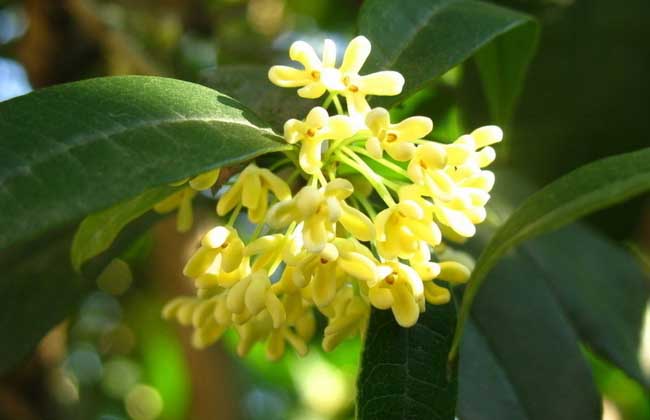
Osmanthus is the collective name for many trees of the genus Osmanthus in the family Oleaceae, also known as rock osmanthus, nine-mile fragrance, golden millet, etc. It is one of China's ten traditional famous flowers, an excellent garden tree species that combines greening, beautification and fragrance, with both ornamental and practical value. It is pure enough to remove dust, and its rich fragrance can carry far. Since ancient times it has been deeply loved by Chinese people. Let us take a look below at where osmanthus is native to!
Where is osmanthus native to?
Osmanthus is native to the eastern section of the Himalayas in southwestern China, and is also distributed in India, Nepal and Cambodia. Wild osmanthus grows in southwestern China, Sichuan, southern Shaanxi, Yunnan, Guangxi, Guangdong, Hunan, Hubei, Jiangxi, Anhui, Henan and other places. It is now widely planted in the Huai River basin and areas to its south. Its suitable growing area reaches as far north as the lower reaches of the Yellow River, and as far south as Guangdong, Guangxi and Hainan, etc., and it has formed several nationally famous osmanthus commercial production bases in Lu'an, Anhui; Xianning, Hubei; Taoyuan, Hunan; Suzhou, Jiangsu; Guilin, Guangxi; Wuhan, Hubei; Hangzhou, Zhejiang and Chengdu, Sichuan.
The production environment of osmanthus
Osmanthus is adapted to subtropical climate regions, and by nature prefers warmth and moisture. The average temperature in growing areas is 14-28°C, the average July temperature is 24-28°C, the average January temperature is above 0°C, it can withstand a minimum temperature of -13°C, and the most suitable growing temperature is 15-28°C. Humidity is extremely important to the growth and development of osmanthus, requiring an annual average humidity of 75-85% and annual precipitation of about 1000 mm. Especially in the young stage and when adult trees bloom, more water is needed. If drought occurs, it will affect flowering. Strong sunlight and shade are unfavorable to its growth, and generally 6-8 hours of light per day are required. It has strong stress resistance, tolerating both high temperatures and relatively cold conditions, and can overwinter outdoors in areas south of the Qinling Mountains and the Huai River in China.
The four major cultivar groups of osmanthus
1. Fragrant osmanthus (Siji Gui) cultivars: Siji Gui is a clustered shrub, with a low tree form, short and dense branches, and a round spherical crown. New leaves are dark red, and mature leaves are green or yellow-green. The leaves are elliptical and broadly ovate, and the angle between the main vein and lateral veins is very large, approaching vertical. Flower buds are usually solitary or 2-3 stacked together, blooming in batches from September each year to the following March, and the floral fragrance is not as rich as that of silver osmanthus, golden osmanthus or red osmanthus. Common cultivars include large-leaf Siji Gui and small-leaf Siji Gui. Cultivars that bloom in all four seasons include Yueyue Gui, Rixiang Gui, large-leaf Foding Zhu, and toothed-leaf Siji Gui.
2. Red osmanthus (Dan Gui) cultivar group: Dan Gui is dioecious, with a round spherical crown, light gray bark that is relatively smooth, and sparse lenticels. Leaves are leathery, long elliptical or elliptical, with a relatively flat leaf surface, recurved leaf margins, entire margins, occasionally with sparse teeth at the apex, a broad wedge-shaped base, an obtuse or short-pointed apex, 8-10 pairs of lateral veins, obvious reticulate veins on both sides, and petioles 8-10 mm long. The flower color is orange-red, the corolla is slightly incurved, the fragrance is light, and the flowering period is from late September to early October. Cultivars include large-flowered Dan Gui, toothed Dan Gui, cinnabar Dan Gui, and broad-leaf red.
3. Golden osmanthus (Jin Gui) cultivar group: Jin Gui has a round spherical crown, strong tree vigor, upright branches, and is very dense. The bark is gray, the lenticels are round or elliptical, and the spring shoots are relatively stout. The leaf color is dark green, the leaves are elliptical, the leaf surface is uneven, and the leaf margins are slightly wavy. The flower color is yellow, with a rich fragrance, and it does not set fruit. It blooms in autumn, with flowers from lemon yellow to pale golden yellow. Cultivars include large-flowered Jin Gui, large-leaf yellow, Huangchuan Jin Gui, late Jin Gui, round-leaf Jin Gui, Xianning late Gui, ball Gui, round-petal Jin Gui, willow-leaf Su Gui, Jinshi Gui, and wave-leaf Jin Gui.
4. Silver osmanthus (Yin Gui) cultivar group: Yin Gui has a round spherical crown, spreading large branches, dense branches and leaves, and good growth. The bark is light gray, and the lenticels are numerous and large, shaped like snowflakes and very obvious. The leaves are green or dark green, long elliptical or elliptical, relatively broad and thick, and the leaf surface is relatively flat and spreading. It blooms in early to mid-September, with flower colors from creamy yellow to lemon yellow, a rich fragrance, and it does not set fruit after flowering. It blooms in autumn. Cultivars include broad-leaf seed Yin Gui, willow-leaf Yin Gui, hard-leaf Yin Gui, seed Yin Gui, Jiulong Gui, early Yin Gui, late Yin Gui, Baijie, pure white Yin Gui, and Qingshan Yin Gui.