What are the characteristics of the osmanthus tree? A comprehensive analysis of its main features
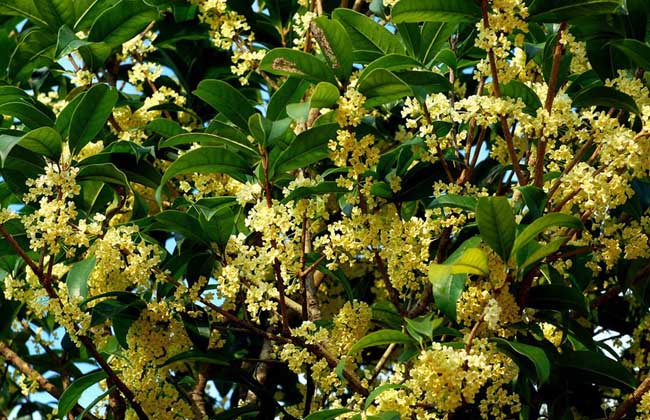
Osmanthus is the collective name for many trees in the genus Osmanthus of the family Oleaceae, also known as rock osmanthus, jiulixiang, jinsu, and others. The cultivation history of osmanthus trees in China spans more than 2,500 years, and they are now widely grown in gardens for ornamental purposes. There are numerous horticultural cultivars, with the most representative being Jingu (golden osmanthus), Yingu (silver osmanthus), Dangui (red osmanthus), and Yuegui (monthly osmanthus). Let us now take a look at what characteristics the osmanthus tree has!
Extremely fragrant flowers
Osmanthus usually blooms from September to October, with cymose inflorescences clustered in the leaf axils. The corolla is yellow-white, pale yellow, yellow, or orange-red, and the flowers are fragrant - so pure they seem to transcend the dust, and so rich they carry far and wide, truly unmatched. Especially in mid-autumn, when the clustered osmanthus blooms in full glory, on a quiet night with a full moon, drinking wine and admiring the osmanthus, with its aged fragrance greeting the nose, leaves one feeling refreshed and invigorated. Among ancient Chinese poems praising flowers, the number of works praising osmanthus is also quite considerable, and it has been deeply loved by the Chinese people since ancient times.
Strong adaptability
Osmanthus is adapted to subtropical climate regions, preferring warmth and moisture. In cultivation areas, the average temperature is 14-28°C, the average July temperature is 24-28°C, and the average January temperature is above 0°C. It can withstand a minimum temperature of -13°C, and the optimal growth temperature is 15-28°C. Humidity is extremely important for the growth and development of osmanthus, requiring an annual average humidity of 75-85% and annual precipitation of around 1,000 mm. Especially during the young stage and when mature trees are blooming, more water is needed. If drought occurs, it will affect flowering. Strong sunlight and shade are both unfavorable for its growth, and generally 6-8 hours of light per day is required.
Wide distribution
Osmanthus is native to the eastern section of the Himalayas in southwestern China, and is also distributed in India, Nepal, and Cambodia. Wild osmanthus grows in southwestern China, Sichuan, southern Shaanxi, Yunnan, Guangxi, Guangdong, Hunan, Hubei, Jiangxi, Anhui, Henan, and other places. It is now widely planted in the Huai River basin and areas to the south. Its suitable growing area extends north to the lower reaches of the Yellow River and south to Guangdong, Guangxi, Hainan, and other places, and has formed several nationally famous osmanthus commercial production bases in Lu'an, Anhui; Xianning, Hubei; Taoyuan, Hunan; Suzhou, Jiangsu; Guilin, Guangxi; Wuhan, Hubei; Hangzhou, Zhejiang; and Chengdu, Sichuan.
Many cultivars
Through long-term cultivation, natural hybridization, and artificial selection, osmanthus has produced many cultivated varieties. Through further investigation and sorting, 32 osmanthus cultivars have been preliminarily identified. By flower color, there are Jingu, Yingu, and Dangui. By leaf type, there are Liuyegui, Jinshangui, Dishuihuang, Kuihuaye, and Chaibinghuang. By flowering period, there are Bayuegui, Sijigui, Yueyuejia, and others.
Wide range of uses
Osmanthus is evergreen year-round, with luxuriant branches and leaves, blooms in autumn, and is rich in fragrance, making it widely used in gardens. The flowers can be used in food and cosmetics, can be made into pastries and candies, and can also be used to brew wine. The flowers, fruits, and roots can also be used as medicine. The flowers are pungent in taste and warm in nature, with the effects of dispelling cold and breaking stagnation, and resolving phlegm and relieving cough, used for toothache, cough and asthma with excessive phlegm, amenorrhea, and abdominal pain. The fruit is pungent and sweet in taste and warm in nature, with the effects of warming the stomach, calming the liver, and dispelling cold, used for deficiency-cold stomach pain. The root is sweet and slightly astringent in taste and neutral in nature, with the effects of dispelling wind-dampness and dispelling cold, used for rheumatic muscle and bone pain, waist pain, and kidney-deficiency toothache.