How long is the flowering period of blue salvia?
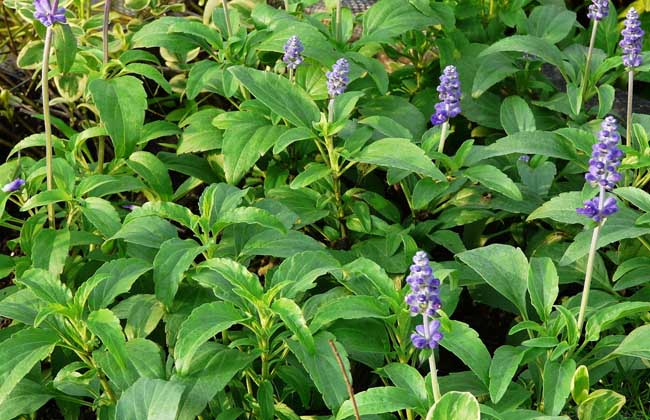
Blue salvia, also known as pink-calyx salvia, blue spires, blue silk thread and so on, is a perennial herbaceous plant of the genus Salvia in the Lamiaceae family. It grows 30-60 cm tall, has a clumping habit, and the plant is covered with soft hairs. As a potted plant it is suitable for flower beds, flower borders and garden landscape arrangements, and can also be used to accent areas beside rocks and gaps at forest edges. Now let us take a look at how long blue salvia blooms!
How long does blue salvia bloom?
The flowering period of blue salvia is generally from spring to summer, roughly May to October. It usually blooms 70-100 days after sowing. It has long spike-like inflorescences with many densely packed flowers, and a tubular bell-shaped calyx. The flower colors are powder blue or powder purple, about 12 cm long. It is mostly used for flower beds, flower borders, mass planting, cut flowers, potted flowers and so on. After flowering, removing the inflorescence still allows it to send out shoots and continue blooming.
Blue salvia growth habits
Blue salvia is native to the southern region of North America. It prefers a warm, humid environment with plenty of sunlight. It is strongly cold-tolerant but afraid of heat and dryness. It is best grown in loose, fertile, well-drained sandy loam with a pH (acidity-alkalinity) of 5.5-5.8. The soil temperature for germination during cultivation is 20-23°C, and the suitable growing temperature is 18-23°C. When potted, it must be kept dry to prevent disease.
How to grow blue salvia?
1. Seed propagation: Blue salvia has about 920 seeds per gram. Generally, 200- or 288-cell plug trays are chosen for sowing, and the medium is best imported seedling peat moss and sterilized domestic seedling peat moss. After sowing, a thin layer of vermiculite needs to be covered on the surface, then covered with plastic film. The suitable temperature for seed germination is 20-23°C, and the germination period is generally 5-8 days.
2. Management during the sprouting stage: During the germination stage, blue salvia will continue to root and stems will appear with the cotyledons already unfolded. At this time, proper humidity needs to be maintained and excessive moisture prevented. For fertilizer, a nitrogen-phosphorus-potassium water-soluble fertilizer is generally used, with a ratio of 20:10:20. After growing for a while longer, the roots will insert into the cells of the plug tray and several true leaves will appear. At this point, increase the fertilizer concentration and control humidity and temperature well to prevent the seedlings from becoming leggy at this stage.
3. Temperature conditions: When the blue salvia plant has 2-3 true leaves, it can be transplanted into pots. Generally, 12-13 cm pots are chosen for transplanting. The substrate needs loose, well-aerated garden soil plus organic fertilizer and compound fertilizer. After the potted plants enter the courtyard, the temperature will drop to 18°C, and after a month it may drop to 15°C. Note that if the temperature is below 15°C, the leaves will turn yellow or fall off, and if it is above 30°C, the plant may stop growing.
4. Reasonable fertilization: During the growing period, blue salvia needs diluted 1500-fold ammonium sulfate to change leaf color, and the effect is quite good. Remember not to apply urea at low temperatures. Continuous fertilization can keep the root system robust and the branches and leaves lush. It likes to grow in places with plenty of sunlight. Generally, apply a compound fertilizer containing calcium and magnesium once every half month. In the hot summer, appropriate shading is needed, and during the seedling stage, light should be increased.
5. Pest and disease control: Common pests of blue salvia include whiteflies, aphids and so on, and common diseases include downy mildew, leaf spot and so on, which need active control. Usually, spray 700-fold carbendazim or chlorothalonil once every 7-10 days for sterilization, and spray 2000-fold decis or 1000-fold dichlorvos once every 10-15 days for pest control.