What are the planting methods for Salvia farinacea?
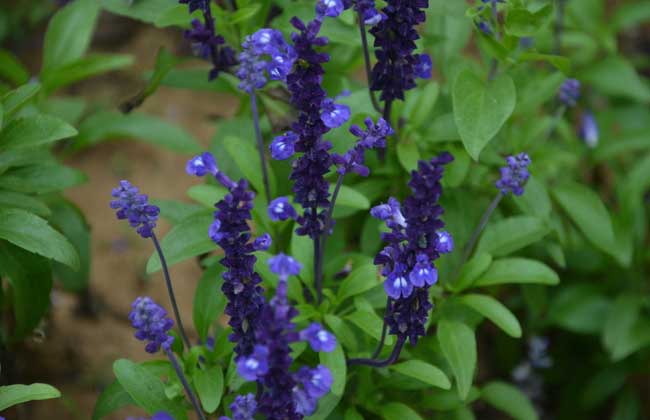
Salvia farinacea is a perennial herbaceous plant in the Lamiaceae family, genus Salvia, but it is mostly grown as an annual. Its verticillasters are terminal, and the flowers are powder blue or powder purple. The flowering period is from spring to summer. In landscaping it is used for flower beds, flower borders, group planting, cut flowers, and potted flowering cultivation, and it has very high ornamental value. Let us take a look together at how to plant Salvia farinacea!
Growth habits of Salvia farinacea
Salvia farinacea prefers a warm, humid environment with plenty of sunlight. It is strongly cold-tolerant but afraid of heat and dryness. It is best grown in loose, fertile, well-drained sandy loam. The optimum growth temperature is 18-23°C. It flowers 70-100 days after sowing. The soil temperature for germination is 20-23°C, and the seeds germinate in 5-8 days. The suitable soil pH is 5.5-5.8. Keeping the soil slightly dry is very important. Try to keep the leaf surface dry to prevent disease.
Sowing and seedling raising of Salvia farinacea
Salvia farinacea is usually propagated by sowing, suitable for spring and summer sowing, and it can also be sown at any time as needed. The substrate is best made of peat and perlite, though leaf mold can also be used. Sieve the growing medium and place it in a seedling tray, soak it thoroughly with a 500-600 times diluted carbendazim solution, and after it dries slightly, broadcast sow at about 1000 seeds per square meter. After sowing, thin the seedlings 1-2 times. When the seedlings are 15 cm tall, they can be planted out.
Planting management of Salvia farinacea
1. Transplanting and potting up: When Salvia farinacea has 2 to 3 true leaves, begin transplanting into pots. Generally, 12 cm to 13 cm nutritional pots are chosen for transplanting, and the substrate is garden soil with good looseness and aeration plus organic fertilizer and compound fertilizer. For pinching treatment, when the plant grows 4 pairs of true leaves, keep 2 pairs of true leaves and pinch off the rest to encourage side branches.
2. Temperature management: After potting up Salvia farinacea, lower the temperature to 18°C, and after one month it can be lowered to 15°C. If the temperature is below 15°C, the leaves will turn yellow or drop, and if the temperature is above 30°C, the flowers will be small and the plant will stop growing.
3. Fertilization management: During the growth period of Salvia farinacea, apply 1500 times diluted ammonium sulfate to change the leaf color, with good results. Do not apply urea at low temperatures. To make the root system robust and the branches and leaves lush, continuous fertilization is very important. Apply a compound fertilizer containing calcium and magnesium at 100 ppm once every half month, and apply phosphorus and potassium fertilizer once more before flowering.
4. Light management: Salvia farinacea prefers an environment with plenty of sunlight. In hot summers, appropriate shading is needed. During the seedling stage, strengthen light exposure to prevent leggy growth.
5. Pest and disease control: Common pests of Salvia farinacea include whiteflies, aphids, and others, which need active control. Common diseases include downy mildew, leaf spot, and others. When diseases occur, spray 50% thiophanate wettable powder at 500 times dilution for control.