When does the elephant ear (Alocasia) bloom?
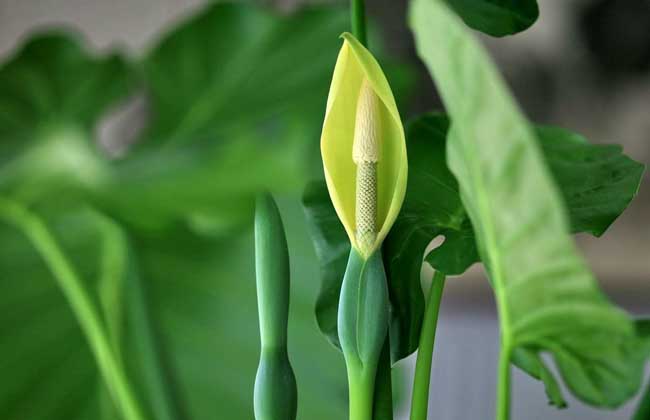
The elephant ear (Alocasia macrorrhizos) is a large evergreen herbaceous plant of the genus Alocasia in the family Araceae, also known as wolfsbane, tianyu, guanyin lotus, xiutiancao, gupoyu and so on. When the air is warm and humid and the soil has sufficient moisture, water will drip down from the tips or edges of its leaves, and its flowers resemble Guanyin, which is why it is called "dripping-water Guanyin". Let us take a look below at when the elephant ear blooms!
Does the elephant ear bloom?
The elephant ear does bloom. The elephant ear is a foliage plant that loves hot and humid conditions, and it generally blooms only when both temperature and humidity reach the required levels. It does not bloom easily in the north. Some gardening enthusiasts ask how many years it takes for the elephant ear to bloom; based on the care experience of enthusiasts, the elephant ear can bloom in the second year, but the time of blooming mostly depends on whether the soil is fertile or not.
When does the elephant ear bloom?
The elephant ear likes to grow in a hot and humid environment, and generally blooms in winter and spring after October, with the peak blooming period from February to April, and the dormant blooming period from November to May or June of the following year. In the north, because the ambient temperature and humidity do not easily reach the requirements for the elephant ear to bloom, the elephant ear generally does not bloom in the north. However, if the temperature and humidity in the home reach the blooming requirements of the elephant ear, then it will occasionally bloom as well.
How do you grow the elephant ear in a pot?
1. Substrate: Use a nutrient soil made by mixing loose, well-drained and well-aerated domestic peat, a 2:2:1 mixture of pond mud, peat soil and coarse sand, plus a small amount of thoroughly composted cake fertilizer. Add water to the peat and mix well; after mixing with water, a handful of peat squeezed tightly should let water seep out between the fingers.
2. Potting: For old pots that are reused, they must be soaked in a 2000-times dilution of potassium permanganate for more than half an hour, then rinsed with clean water and dried for later use. Large plants are generally grown in pots of 20 cm size. When planting, first place about 4 cm of substrate at the bottom of the pot, then move the screened seedlings into the pot. Small seedlings should not be planted too deep, and it is best to keep them level with the base of the plant. The substrate should be moderately firm, filled to 8/10 of the pot, with 2 to 3 plants per pot.
3. Misting: The elephant ear is especially fond of moisture. During the growing season it not only requires moist potting soil, but also requires air humidity of no less than 60%. During high summer temperatures, misting should be increased to create a relatively cool and humid environment for it. If it is placed in an indoor air-conditioned hall, it is necessary both to keep the potting soil moist and to mist the leaf surfaces from time to time. If the indoor temperature in winter cannot reach 15°C, watering should be controlled, otherwise the plant is prone to root rot. Generally, misting once a week with warm water is enough to keep its leaves a deep green.
4. Fertilizing: The elephant ear is rather fond of fertilizer. From March to October, a liquid fertilizer should be applied once every half month, and the proportion of nitrogen can be appropriately increased. If a little ferrous sulfate can be added, so much the better; the leaves will then grow as large as lotus leaves and be smooth and lovely. Fertilizing should stop when the temperature is below 15°C.
5. Pruning: The elephant ear is a foliage plant. If planting and care are improper, the largest leaves may turn yellow and dry up. At this time they should be cut off together with the stem using a knife, otherwise it will affect the growth and ornamental value of the other leaves.
6. Repotting: The elephant ear is usually repotted once every spring, and the soil can be loosened once a month to keep the potting soil in a well-aerated state.