What plant is Alocasia? Detailed introduction to its plant characteristics
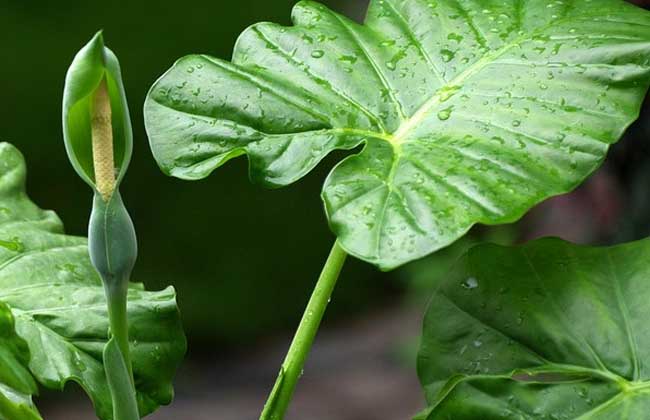
Alocasia is a large evergreen herbaceous plant of the genus Alocasia in the Araceae family, native to South America, and a common ornamental plant in tropical and subtropical regions. It is commonly known as hen yam, wolfsbane, wild taro, mountain taro, big root taro, big worm taro, tian yu, tian meng, and so on. When used as an ornamental plant, it is called Alocasia. Under conditions of warm, humid air and sufficient soil moisture, it drips water from the leaf tips or leaf edges, and its flowers resemble Guanyin, hence the name Alocasia.
Alocasia has creeping rhizomes and upright aboveground stems, with adventitious buds and shoots growing from the base. The leaves are numerous, with petioles green or dirty purple, arranged in a spiral. The petioles and midribs turn black, brown, or white. The inflorescence stalks are 2 to 3 in a cluster, cylindrical, usually green, sometimes dirty purple. The spathe tube is green, ovate or shortly elliptical. The spadix is fragrant, with the female inflorescence white, the sterile male inflorescence greenish white, and the fertile male inflorescence pale yellow. The berries are red, ovate. It flowers in all seasons, but often does not flower under dense shade in forests.
The growing temperature for Alocasia is 20 to 30 °C, and it can tolerate a minimum low of 8 °C. In summer high temperatures, as long as the soil is kept moist, water is sprayed frequently, and shade is provided, it can still grow normally. In winter, the room temperature must not be lower than 5 °C. It is an understory plant of tropical rainforests, so its growth requires high humidity, and scattered light is best. As a shade-tolerant plant, it likes a semi-shaded environment and should be placed in an environment that is both shaded and ventilated.
Alocasia is produced in tropical and subtropical areas of Jiangxi, Fujian, Taiwan, China, Hunan, Guangdong, Guangxi, Sichuan, Guizhou, Yunnan, and other places, below 1700 m elevation, often growing in patches at the edges of tropical rainforests or under wild banana forests in river valleys. Abroad, it is also cultivated from Bangladesh and northeastern India to the Malay Peninsula, Indochina, as well as the Philippines and Indonesia.
The rhizome of Alocasia is used medicinally and has good effects on abdominal pain, cholera, hernia, and so on. It can also treat pulmonary tuberculosis, rheumatoid arthritis, bronchitis, influenza, typhoid, and rheumatic heart disease. Externally, it is used to treat sores, swellings, and toxins, snake and insect bites, and burns. Mixed with kerosene for external use, it treats neurodermatitis. It is toxic. After the sap of the fresh plant contacts the skin, it causes itching. If it accidentally enters the eyes, it can cause blindness. If the stems and leaves are eaten by mistake, they cause itching and swelling of the throat and tongue, drooling, burning pain in the stomach and intestines, nausea, diarrhea, convulsions, and in severe cases suffocation and death from cardiac paralysis. Folk remedies use vinegar with a little ginger juice boiled together and taken orally or gargled to neutralize the poison. The rhizome is rich in starch and can be used as an industrial substitute, but it cannot be eaten.