How to propagate Podocarpus? A few common methods
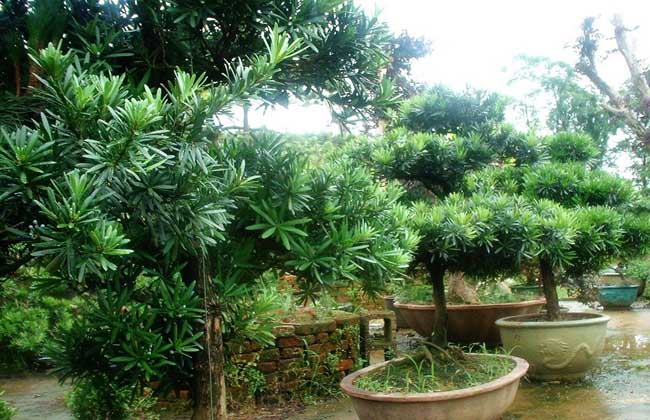
Podocarpus is also known as Luohanshan, Evergreen Luohanshan, Tushan, Money Pine, etc. It is an evergreen coniferous tree of the genus Podocarpus in the family Podocarpaceae. It prefers a warm and humid climate and has weak cold tolerance. In North China it is grown in pots for ornamental purposes, and it has extremely high ornamental value. In China it is distributed in Jiangsu, Zhejiang, Fujian, Anhui and other places. Now let us take a look at how to propagate Podocarpus!
Podocarpus propagation by seed
Podocarpus begins to bear fruit at around 10 years of age, and the alternate bearing phenomenon is not obvious. It is best to sow the seeds immediately after collection; they cannot be stored through the summer. Before sowing, soak the seeds for several days first, and once the seeds have fully absorbed water and swollen, sow them in rows or in holes. The sowing depth should be just enough to cover the seeds. After sowing, cover with grass to retain moisture and spray water once a day. If sown in the open field, in the southwestern region it also needs to be covered with grass for protection through the winter. In other regions it must be sown in pots, and after sowing moved into a low-temperature greenhouse to overwinter. The seedlings emerge in 8 to 10 days. After emergence, remove the covering grass and shade them immediately; never expose them to strong sunlight. For plants used for pot cultivation, the terminal bud can be pinched off at 1 year old to encourage the growth of multiple branches. Generally, 1.5- to 2-year-old seedlings can be potted and planted, and branch bending and shaping can begin. For field-planted plants, generally only 3-4-year-old large seedlings are suitable for being lifted from the nursery with a soil ball.
Podocarpus propagation by layering
Podocarpus layering should be done around the Jingzhe solar term in spring (that is, early March). Using a dwarf Podocarpus ball, select a branch near the ground that is slightly smaller than a chopstick, and on the side of the base facing the ground use a small knife to make a diagonal cut one-half of the way through the branch. Take a prepared 1-cun-long bamboo strip, insert it crosswise into the cut, and beside it insert a small wooden stick to support the branch. Bind it gently with a plastic strip, then cover the cut with loose soil, press it gently and firmly, and cover with dry grass to keep it moist. After March, the branch will take root at the cut. After the Autumn Equinox solar term, cut it off from the base of the branch with pruning shears and transplant it.
Podocarpus propagation by cuttings
1. Softwood cuttings: For Podocarpus softwood cuttings, in the first half of the year carry them out from mid-to-late May to early July, and in the second half of the year from mid-to-late August to mid-to-late September. For cuttings taken in the first half of the year, attention must be paid to preventing high-temperature scorching and disease. For cuttings taken in the second half of the year, attention must be paid to heat preservation and frost protection in the middle and later stages. The time to remove the shade net is late November; in dry years the time to remove the shade net can be postponed to late December.
2. Hardwood cuttings: Hardwood cuttings refer to the method of taking stout, fully lignified branches from the previous year during the dormant period in early spring from February to March, before the sap begins to flow, and using them for cuttings. For early spring hardwood cuttings, attention must be paid to raising the soil temperature and controlling the air temperature inside the shed. In short, whether softwood cuttings or hardwood cuttings, the sterilization of cuttings and soil must be done well, and the temperature, humidity and light of the seedbed must also be well regulated. In addition, in order to increase the survival rate of cuttings, some measures to promote rooting should also be appropriately adopted.