Methods and Technical Key Points for Making Podocarpus Bonsai
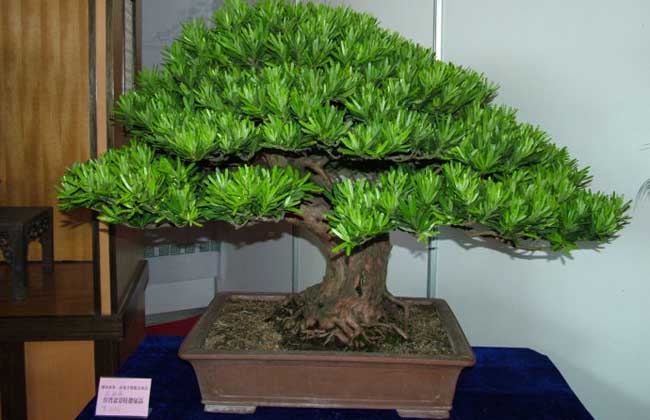
Podocarpus (Podocarpus macrophyllus, Buddhist pine) is a highly valuable plant species. It is an evergreen tree of the genus Podocarpus in the family Podocarpaceae, with a broadly ovate crown and strip-shaped lanceolate leaves. It has the powerful, vigorous root system typical of conifers and evergreen foliage that stays green all year round, and its branches are soft and flexible, making it extremely suitable for growing as a bonsai for viewing. Let us take a look below at how to make a Podocarpus bonsai!
Growth Habits of Podocarpus
Podocarpus prefers a warm, humid climate, has weak cold tolerance and strong shade tolerance, and favors well-drained, moist sandy loam. It adapts strongly to soil and can even survive on saline-alkaline soil. It is fairly resistant to various polluting gases such as sulfur dioxide, hydrogen sulfide and nitrogen oxides, and has strong resistance to pests and diseases. In China it is produced in Jiangsu, Zhejiang, Fujian, Anhui, Jiangxi, Hunan, Sichuan, Yunnan, Guizhou, Guangxi, Guangdong and other places, and is cultivated in courtyards as an ornamental tree; wild trees are very few.
Propagation of Podocarpus Bonsai
1. Sowing: Podocarpus can be propagated by sowing in August, usually in an open seedbed, sowing as soon as the seeds are collected, covering with rice straw, taking care to shade, and keeping the medium moist. In winter, cover with plastic film to protect against freezing.
2. Cuttings: Podocarpus can be propagated by cuttings in spring and autumn. For spring cuttings, in mid-March, select 1-year-old robust dormant branches as cuttings. For autumn cuttings, in July to August, select semi-lignified green branches as cuttings. The cuttings should all have a heel, and care should be taken to shade them; transplanting in March is most suitable.
Potting and Shaping of Podocarpus
1. Potting: Podocarpus is usually potted before it sprouts in spring, and the potting soil should be loose, well-drained, slightly acidic sandy loam. Because Podocarpus has a quaint and elegant posture, it is best to cultivate it in a purple clay pot or a glazed pottery pot, and the pot shape is determined by the tree shape.
2. Shaping: The shaping of Podocarpus is mostly carried out during the dormant period, mainly by wiring, with pruning as a supplement. Because Podocarpus branches are soft and easy to wire, and can also be pruned, its forms are diverse. Common forms include the curved-trunk style, slanting-trunk style, reclining-cloud style, cliff style and exposed-root style, and the branches and leaves can be pruned into flat layers or bun shapes.
Care of Podocarpus Bonsai
1. Location: In summer, Podocarpus should be placed in a warm, humid, well-ventilated place, and in winter it should be placed indoors above 5°C, but the temperature should not be too high, so as not to affect its dormancy. Household potted Podocarpus should be kept outdoors in a ventilated place all year round and should not be kept indoors for long periods, otherwise the leaves will turn yellow and drop, leading to death. In summer, it should not be exposed to strong sun during high temperatures and needs to be kept in a semi-shaded place.
2. Watering: Podocarpus likes moist soil. During the growing season it should be watered frequently to keep the potting soil moist, but water must not accumulate in the pot. In summer, spray water on the leaves or the ground frequently. Watering should be sufficient and thorough, which can keep the leaf color bright and attractive. In autumn and winter, the amount of water can be reduced appropriately.
3. Fertilizing: During the spring and autumn growing seasons, Podocarpus only needs 1 to 2 applications of a nitrogen-based topdressing; excessive phosphorus and potassium fertilizers are not needed. Podocarpus that has already been shaped should not be fertilized much. Usually during the growing season, apply a decomposed dilute liquid fertilizer once every 1 month, and stop fertilizing after the beginning of autumn.
4. Pruning: Podocarpus should be pruned frequently to maintain its tree shape. When it flowers, it is best to remove the flower buds promptly to avoid consuming nutrients. For bonsai that have already been shaped, attention must be paid to pinching and pruning to prevent the branches and leaves from growing excessively, so as to maintain the original posture. Pruning and pinching are best carried out during the spring and autumn growing periods.
5. Repotting: Podocarpus is usually repotted once every 2 to 3 years, generally in March to April.
6. Pests: Podocarpus is mainly harmed by leaf spot disease and anthracnose, which can be sprayed with a 500-fold dilution of 50% thiophanate-methyl wettable powder. Pests include scale insects, red spider mites and bagworms, which can be killed by spraying with a 1500-fold dilution of 40% omethoate emulsifiable concentrate.