Detailed Explanation of Key Points for Pest and Disease Control Techniques for Lacebark Pine
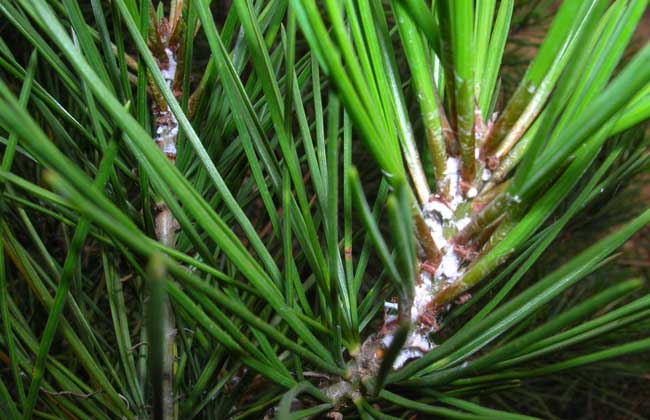
Lacebark pine, also known as white-bone pine, three-needle pine, white-fruit pine, tiger-skin pine, etc., is a tree species endemic to China, growing at elevations of 500 to 1800 m. Its wood is generally used for construction and for making furniture, stationery, etc. Its seeds can be eaten or pressed for oil, and its cones are used in medicine. It has relatively high cultivation value, and generally has relatively few pests and diseases. Let's take a look at the pest and disease control techniques for lacebark pine below!
Red Turpentine Beetle
[Damage]The galleries bored by the red turpentine beetle are filled with a mixture of reddish-brown granular frass and wood shavings. This mixture overflows from the entry holes along with pine resin, forming reddish-brown funnel-shaped or irregular resin masses with a hole in the center. The resin masses vary in size, and their color gradually lightens over time until it becomes grayish-white. When pest density is high and the damaged areas connect to form girdling, the entire tree can die.
[Control]When transplanting large lacebark pine saplings, select stands where the red turpentine beetle does not occur. When sporadic lacebark pine trees are found to be damaged in the forest, aluminum phosphide standing-tree fumigation can be used for control. If many trees are affected but symptoms are mild, plant-based attractants can be used for trapping and killing.
Pine Shoot Beetle
[Damage]The pine shoot beetle belongs to Coleoptera, Scolytidae. It is highly concealed and very destructive, and is a pioneer species among secondary pests. It lives concealed inside the trunk and new shoots for most of the year, causing weakened tree vigor, massive death of new shoots, and restricted crown expansion, making it difficult to train tree form. When pest density is high, it can cause pine trees to die.
[Control]Control should be timely: prune and remove damaged twigs and dead shoots. When overwintering adults and newly emerged adults cause shoot withering during supplemental feeding, prune and burn them promptly. Before adults invade new shoots, spray the crown with 80% dichlorvos emulsifiable concentrate at 1000 times dilution or 50% phosphamidon emulsifiable concentrate at 1000 to 1500 times dilution. Maintain good sanitation conditions in the nursery, and promptly fell dying trees and burn them.
Pine Aphid
[Damage]The pine aphid belongs to Homoptera, Aphididae. Its hosts are mainly pines and similar trees. It mainly damages needles, tender shoots, young trees, or trunks. When pest density is high, severely affected trees may die completely, or side branch growth may be seriously affected. In milder cases, pine needles turn yellow and dry at the tips, with severe loss of green color and no new shoot growth. In even milder cases, the needle color changes little, but new shoot growth is less than 50% of normal. Especially when tender branches are densely covered with aphids, they secrete large amounts of honeydew that flows down along the branches, inducing sooty mold and weakening growth.
[Control]Natural enemies such as hoverflies and ladybugs can be used for control. For chemical control, spray 10% imidacloprid at 1000 to 1500 times dilution in mid-April.
Reddish Pine Tip Moth
[Damage]Adults of the reddish pine tip moth rest quietly during the day and are active at night. They lay eggs on the needles of tender shoots or at the base of leaf sheaths, and may also scatter eggs in the grooves of withered yellow needles on shoots damaged in the current year, on damaged cones, and on bark wounds. First-instar larvae seek new shoots to damage. They first gnaw the shoot bark, forming a scar about the size of a fingertip. Pine resin coagulates at the gnawed site. Later they gradually bore into the pith. The borehole is round, with large amounts of boring dust and frass accumulating.
[Control]In winter, prune and remove damaged shoots and burn them in a centralized manner to eliminate overwintering larvae and pupae. During the adult egg-laying period, spray 50% fenpropathrin-killer emulsifiable concentrate at 1000 to 1500 times dilution or 2000 times wettable powder of Lindebao once every 10 days. For eggs, release Trichogramma wasps for control.
Pine Needle Cast
[Damage]Pine needle cast mostly overwinters as mycelium or apothecia on fallen needles, and some overwinters on needles still on the tree. The following year, between March and April, ascocarps form and mature. Between April and May, ascospores are produced. Under rainy or humid conditions, the ascocarps absorb water, swell, and release ascospores. They can spread by air currents and invade through stomata, with an incubation period of 1 to 2 months or more. They generally infect 2-year-old needles, and later can infect current-year needles. Lacebark pines of different ages can all be damaged, causing needles to turn yellow and fall early. In severe cases, trees are near death.
[Control]Strengthen water and fertilizer management in the nursery to enhance tree vigor, promptly control other pests and diseases, and fell weakened and dying trees. Before the peak period of ascospore release in spring and summer, spray Bordeaux mixture at 1:1:100, 50% Tuzet at 500 to 800 times dilution, 70% Dexon at 500 to 800 times dilution, 65% zineb at 500 times dilution, or 45% amobam at 200 to 300 times dilution. For closed young forests or severely diseased mature forests, 621 smoke agent or chlorothalonil smoke agent can be applied.
Pine Needle Red Blight
[Damage]Damaged pine needles first show yellow spots, which gradually turn brown and finally gray or dark gray. The lesions are slightly sunken, and there is often a dark red ring at the boundary with healthy tissue. Black dots are scattered on the diseased area, namely the pathogen's acervuli. Lesions can appear at different positions on the needles. The part above the lesion often dies and breaks off, mainly with death at the needle tip. In severe cases, affected trees look as if burned, shed needles early, and are seriously affected in growth and ornamental value. If the disease occurs for several consecutive years, it causes plant death.
[Control]Strengthen woodland management, enhance tree vigor, improve tree disease resistance, promptly remove weeds under the forest, enhance woodland drainage, and avoid excessive humidity in the woodland. For chemical control, spray 25% carbendazim or 75% chlorothalonil wettable powder at 500 times dilution.
Brown Spot Disease
[Damage]Diseased leaves first develop small faded spots, grass-yellow or pale yellow, mostly round or nearly round, later brown, slightly enlarged and merging into segmental spots. Soon afterward, grayish-black small blister-like structures appear at the lesions. On most diseased leaves, the lesions are clearly divided into 3 segments: the upper segment turns brown and dies, the middle segment alternates between brown lesions and green healthy tissue, and the lower segment remains green. On newly grown tender leaves, the needle tips rapidly turn brown and die. Sometimes below the dead part, the disease begins at the base of the crown and gradually spreads upward. In severely diseased pines, only part of the green leaves remain at the tips of the top two or three whorls of branches, and soon the whole plant dies.
[Control]Strengthen forest management, promptly remove diseased fallen leaves, and establish mixed forests. For chemical control, spray 25% carbendazim or 75% chlorothalonil at 500 times dilution multiple times.
Pine Red Needle Cast
[Damage]It mostly occurs on current-year needles and often occurs together with needle diseases such as red blight and needle cast. The symptoms are easily confused, and it is highly infectious. It can accelerate the development of physiological yellowing disease in pines, causing stagnant tree growth, progressively shorter and smaller new shoots and needles, and eventually gradual death.
[Control]Remove dead and severely diseased plants, strengthen tree management, and enhance tree vigor. For chemical control, spray Bordeaux mixture at 100 to 150 times dilution or 65% wettable zineb at 500 times dilution.
Sooty Mold
[Damage]Sooty mold damages leaves and sometimes also branches and trunks. Affected areas first show sticky honeydew droplets, then gradually develop loose small spots, which later join into patches and form a relatively hard black mold layer that is not easy to fall off. It is caused by infection by various sooty mold fungi. These fungi mainly live on the excrement and secretions of aphids, scale insects, and others. Therefore, when lacebark pine is affected by the above insect pests, it provides nutrients for sooty mold fungi, which is the direct cause of the disease. In addition, shade, high humidity, poor ventilation, and poor light penetration all make it more likely to occur.
[Control]The best measure is to control pests such as aphids, scale insects, and whiteflies. Proper pruning helps ventilation and light penetration, enhances tree vigor, and reduces disease occurrence. In severe cases, spray lime sulfur mixture at 0.3 degrees Baume.