Where is the origin of the lacebark pine? Introduction to the distribution of its main producing areas
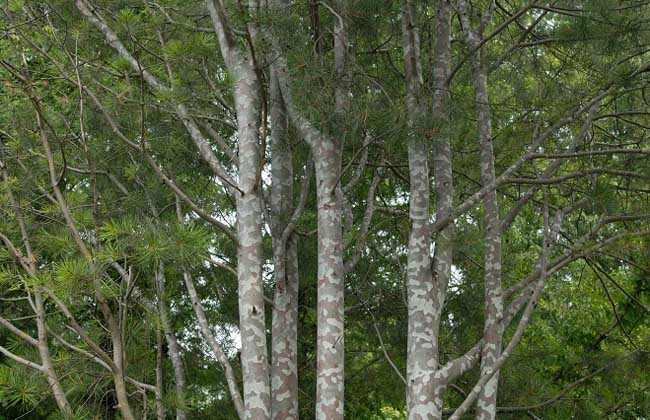
The lacebark pine, also known as the white-bark pine, three-needle pine, white-fruit pine, tiger-skin pine, and coiling-dragon pine, is an evergreen tree of the genus Pinus in the family Pinaceae. The bark of young trees is grayish-green, while the bark of old trees is grayish-brown or grayish-white, revealing pink inner bark after the flakes fall off. The wood is easy to process, has a beautiful grain, and is highly resistant to decay. It is generally used for construction and for making furniture, stationery, and so on. Now let us take a look at where the lacebark pine originates!
Where is the origin of the lacebark pine?
The lacebark pine is a tree species endemic to China, produced in Shanxi (Luliang Mountains, Zhongtiao Mountains, Taihang Mountains), western Henan, the Qinling Mountains in Shaanxi, southern Gansu and the Maiji Mountain in Tianshui, the Guanwu Mountain in Jiangyou, northern Sichuan, and western Hubei, among other places. Artificial cultivation extends across both sides of the Yangtze River, reaching as far north as south of Hohhot in Inner Mongolia and as far south as Nanjing, Changsha, Kunming, and other places.
The origin environment of the lacebark pine
The lacebark pine mostly grows in areas at an altitude of 500-1800 m. It is light-demanding and can also tolerate semi-shade, growing naturally in cool and dry regions. It has a deep root system, but can grow on shallow soil. It does not like high temperature and high humidity, and requires fertile, well-drained planting sites, with a pH adaptation range of 6-8. It has strong adaptability to temperature and can withstand low temperatures of -30°C and heat of 40°C. It is long-lived, grows slowly, and is resistant to sulfur dioxide and smoke and dust.
The cultivation value of the lacebark pine
The lacebark pine has a graceful tree form and peculiar bark, and can be used for ornamental purposes. It has a very broad range of uses in garden landscaping; it can be planted as a solitary specimen, in pairs, or in groups to form a grove, or used as a street tree, all with good results. Its wood can be used for house construction, furniture, stationery, and other materials. The grain is straight, light and soft, and after processing it has luster and a grain pattern, making it suitable for fine woodworking. The seeds are bitter in taste and warm in nature, and have the effects of relieving cough, reducing phlegm, and calming asthma, and are used for cough with phlegm and asthma.