Detailed Explanation of the Production Method and Steps for Lacebark Pine Bonsai
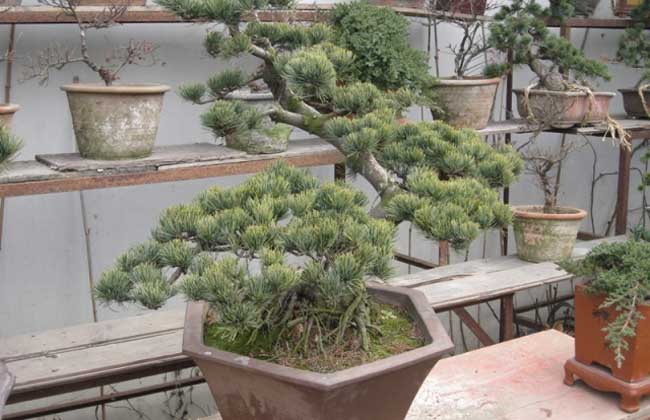
Lacebark pine bonsai is generally described with the four words old, green, vigorous, and unusual; the word "unusual" occupies a considerable proportion in the expressive forms of lacebark pine bonsai, because it adapts to the natural environment while also having strong resistance, overcoming interference from unfavorable external factors; as time passes, the tree's appearance gradually becomes aged, its form naturally beautiful, its spirit and charm complete, majestic and grand, like the virtue and bearing of a gentleman, extraordinary in demeanor, dignified and elegant.
Characteristics of Lacebark Pine Bonsai
Lacebark pine bonsai should be created mainly with expressive techniques of magnificence and masculine beauty; because of its physiological characteristics, it can only use existing branches for wiring and shaping to reflect the natural posture of layered, overlapping branches. At the same time, lacebark pine likes sunlight and tolerates drought, so it is suitable to use soil with good drainage and aeration and shallow purple clay pots.
Material Selection for Lacebark Pine Bonsai
1. Sowing: For lacebark pine sowing, collect seeds in late August, remove the seed receptacle, and sow immediately after collection, or dry in the shade and store in sand, then sow in March of the following spring, with drill sowing row spacing of 15 cm and covering soil thickness 3 times the seed diameter. After sowing, cover with rice straw; after seedlings emerge, remove the straw in time and build a shade frame. Spring-sown seedlings should be managed diligently, watered when dry, and given 1 application of dilute cake fertilizer water every 15-20 days; stop fertilizing in September. For autumn sowing, pay attention to cold protection when entering winter, and do not fertilize in that year. Sown seedlings are transplanted after one year and cultivated into large seedlings before being used for bonsai shaping.
2. Cuttings: For lacebark pine spring cuttings, carry out in early to mid-March, select robust one-year-old branches, cut into cuttings 8-12 cm long, remove the leaves from the lower half of the middle section, insert about 1/2 deep; to promote rapid rooting, treat the lower cut with 500*10PP concentration of the growth hormone naphthalene acetic acid. After inserting, build a shade frame and frequently spray water on the leaves, keep the soil moist, and roots can form in about 60-80 days. For autumn cuttings, carry out in August-September, take semi-lignified tender branches as cuttings, using the same method as spring cuttings; after entering winter, cover with plastic film and straw curtains for cold protection.
Shaping of Lacebark Pine Bonsai
1. The forms of lacebark pine in nature are ever-changing; most changes in the trunk posture of lacebark pine are caused by different growing environments, so handling the trunk is the key to shaping lacebark pine bonsai. Although lacebark pine trunks in nature present countless postures, in summary there are only two basic forms: straight trunk and curved trunk. Curved trunk can be a deformed treatment of an "S" shape and can also be divided into several bonsai forms, such as slanting trunk style, curved trunk style, cascade style, and so on.
2. Regardless of curved trunk or straight trunk, the trunk is required to taper gradually from bottom to top. If the change is fast, a short and sturdy lacebark pine bonsai can be made; if the change is slow, a "literati tree" bonsai can be made. Apart from straight trunk, all require the trunk line to have natural extension and just-right bending changes. If the material is multi-trunk from one base, in addition to paying attention to the above two points, also pay attention to changes in trunk height and size, primary and secondary relationships, and changes in density and gathering-scattering.
3. In lacebark pine bonsai, from the base of the trunk to the tip, there are constant changes, such as trunk thickness, curvature and straightness, the position of branches on the trunk, and the texture and color of the bark. Wherever it is thought that a section of the upper trunk lacks variation or is ordinary in expression, cut it there; if it is thought that the retained section is not tall enough, in pursuit of perfect coordination, the branch at the highest position should be established to replace the tip.
4. Lacebark pine bonsai often uses simple mechanical correction of the trunk's extending posture, making the trunk line more vigorous and vivid. Curved or straight are both innate; the only aim is for the trunk line to meet the beauty requirements of lacebark pine bonsai and to fully display its characteristics, so that there is a possibility of becoming a fine work. Generally, the trunk shaping is given appropriate bending to reflect vigor and sinuous curvature.
Potting of Lacebark Pine Bonsai
1. Pot selection: The lacebark pine bonsai posture is ancient and elegantly refined, and purple clay pottery pots or glazed pottery pots are commonly used; the pot shape depends on the tree shape. Cascade style uses a tall, deep cylindrical pot; slanting trunk style and lying trunk style use medium-deep rectangular or oval pots; raised-root style and root-on-rock style use relatively shallow pots.
2. Soil: The potting soil should be fertile and moist, loose in texture, well-drained, slightly acidic sandy loam; place a layer of coarse sandy soil at the bottom of the pot to facilitate drainage.
3. Planting: Transplanting into pots is best done before spring bud break. Large seedlings should retain original soil, and dead roots and overly long roots should be cut off, so that fibrous roots spread out in the potting soil; press the soil firm so it closely contacts the root system, which benefits growth and survival.
4. Maintenance: Maintenance and management are the continuation of lacebark pine bonsai shaping; the stage of perfecting the maintenance of a work may be as short as two or three years, or as long as ten, twenty years, or even longer. The main contents include potting soil preparation, fertilizer use, water control, site selection, reshaping and alteration, repotting and soil replacement, pest and disease control, and so on. Among these, shaping and alteration work is directly related to the creation of the work's image, while the other items promote the gradual perfection of the work from the perspective of the healthy growth of the lacebark pine bonsai.