What are the main uses and values of the lacebark pine?
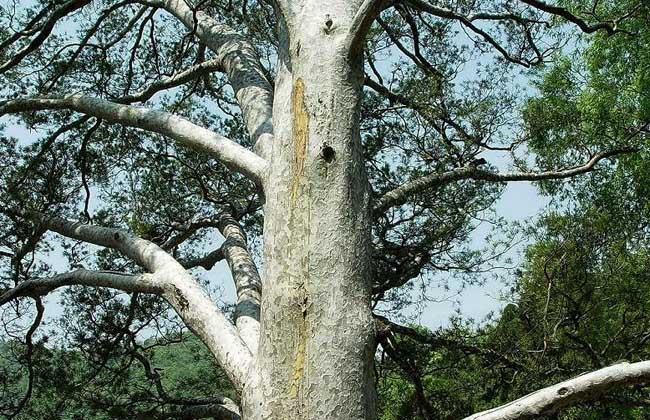
The lacebark pine, also known as white-bone pine, three-needle pine, white-fruit pine, tiger-skin pine, etc., is an evergreen tree of the genus Pinus in the family Pinaceae. It mostly grows at elevations of 500-1800 m and reaches up to 30 m tall. The bark of young trees is grayish-green, while that of mature trees is light brownish-gray, grayish-green-white where it peels off, gradually turning powdery white toward the upper part. Now let us take a look together at what uses the lacebark pine has!
Where does the lacebark pine originate?
The lacebark pine is a tree species endemic to China, found in Shanxi (Luliang Mountains, Zhongtiao Mountains, Taihang Mountains), western Henan, the Qinling Mountains in Shaanxi, southern Gansu and the Maijishan area of Tianshui, the Guanwu Mountain in Jiangyou, northern Sichuan, and western Hubei, among other places. It is cultivated artificially across the north and south of the country, from as far north as south of Hohhot in Inner Mongolia to as far south as Nanjing, Changsha, Kunming and other places.
What are the uses of the lacebark pine?
1. Medicinal value: The fruit of the lacebark pine is bitter in taste and warm in nature, with effects of relieving cough, reducing phlegm and calming asthma. It has a notable effect on people who often have throat discomfort, especially those with coughing and phlegm, and can be collected by oneself and taken after soaking in hot water.
2. Economic value: The trunk of the lacebark pine has a very good grain, and its wood is also of the light and soft type; wooden furniture made from it lasts a long time in use. If wooden houses are to be built in scenic areas, the wood characteristics of the lacebark pine also meet the requirements. After deep processing it shows a unique luster, and its grain is absolutely beautiful for joinery.
3. Landscape value: The lacebark pine has the tenacious character of a pine tree, and its white bark is a style of its own. Whether planted in large areas or as a single specimen along the sides of a road, it is the most beautiful scenery, and its chance of surviving in any soil is very high, so its ability to improve soil and purify the environment is in no way inferior.
Cultivation techniques for the lacebark pine
1. Nursery site selection: The seedling-raising site should be chosen as sandy loam or loam with good drainage, irrigation conditions, flat terrain and deep soil layers. Heavy clay soil, saline-alkali soil or low-lying waterlogged places must not be chosen as nursery sites.
2. Seed treatment: The seeds of the lacebark pine have a relatively long dormancy period, so they should be disinfected by soaking in Bordeaux mixture. Before sowing, soak the seeds in warm water (50°C to 60°C) to promote germination, or stratify them with sand to promote germination; sow when the number of split seeds reaches 50% of the total number of seeds. Alternating-year low-temperature stratification to promote germination and high-temperature germination promotion can also be carried out, sowing when 40% of the seeds have cracked seed coats.
3. Sowing method: Spring sowing is often used, and sowing within 10 days after the soil thaws is most suitable. The lacebark pine is afraid of waterlogging, so high beds or high ridges should be used for seedling raising. Water thoroughly before sowing, sow in drills, with a sowing rate of 70-100 kg/mu; after sowing, cover with soil 1-1.5 cm thick, and on top of that 1 cm of wet sawdust can be applied to keep warm and retain moisture.
4. Seedling management: After sowing, the seedlings emerge with the seed coat still attached and shed it after about 20 days; during this period, bird damage must be prevented. First-year seedlings should be earthed up for cold protection, and 2-year-old seedlings are transplanted bare-rooted, preferably dug and planted as you go, then trampled firm and watered after planting. Seedlings should be planted densely and large seedlings sparsely; after about 5 years, carry out a second transplanting with soil or lift them from the nursery for afforestation.