What is the flower language of the wild rose? Learn about its legends and stories
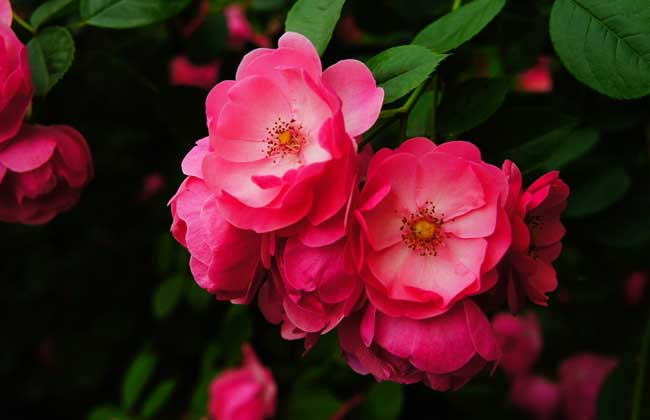
The wild rose, also known as the multiflora rose, prefers to grow in thickets along roadsides, field edges or hilly areas, and is distributed in East China, Central South China and other places. It usually blooms from May to June, and is not as eye-catching as other roses, only blooming silently. Its flower colors include white, light red, deep peach red, yellow, etc. Now let us take a look at the flower language and legends of the wild rose!
The flower language of the wild rose
Romantic love. Cultivated roses do not bear fruit, but the wild rose will grow delicate red fruits. Besides being comparable in beauty to other roses, the fruit is also edible. This flower has a poet-like temperament, so its flower language is romance. People born under the blessing of this flower have a romantic personality, are dream-loving children, yet have sharp judgment when handling matters, are suited to work in the arts, and are also perfectionists in matters of the heart.
The value of the wild rose
The wild rose blooms in early summer, with abundant flowers and lush leaves, a delicate fragrance, flower shapes in a thousand postures, and colors in a riot of hues. It is also extremely adaptable, has a wide cultivation range, and is easy to propagate, making it a good landscaping material. It can be planted beside streams, along roadsides, at garden edges, in corners, or used for greening flower columns, flower trellises, flower gates, hedges and fences, wall greening, rock greening, balconies, windowsills, and overpass greening, etc. It often grows in dense clusters, with branches in full bloom, creating a rather fine scene. When eaten, it has the effects of clearing summer heat and resolving dampness, regulating qi and harmonizing the stomach, and stopping bleeding.
The legend of the wild rose
In the prince's garden, every flower was raised with care, and every flower belonged to a different person. The little rose was born here, and from the time she was still a small bud, the one who looked after her was him. Under his meticulous care, she cautiously poked her head out of the green room, joyfully observing this world, observing him. He gazed at her with tender affection and a smile. In the instant she gazed at him, from his eyes she understood that her whole life belonged to him.
The little rose grew day by day, and every day she appeared before him in her most beautiful form. And he always smiled, watering her, adorning her, sheltering her from wind and rain.
The flowers in the garden were all in full bloom, for their own masters, for the hearts that cherished them. One night, the little rose was surprised to find that beside her there was an extra beautiful rosebud. The rose that had not yet been born was already so outstanding, so graceful——she was the flower that belonged to the prince, the one and only rose. The prince's deep affection opened the little rose's bud. Petal by petal she unfolded her beauty, her languid stamens rubbing against silk-like petals. She smiled faintly, so composed, so elegant. Her fragrance spread through the wind, and her petals rippled with happiness.
The little rose was captivated the moment she saw her——what a beautiful flower! The little rose also gazed sweetly at her new neighbor. The two flowers soon became close friends who shared everything.
When the prince came to the garden again, he was at once moved by the beauty of the rose in the morning light. But he knew that every flower belonged to a different person, and he did not covet her; he only possessed the little rose.
The rose still waited brilliantly for him, and he cared for her and cherished her as always. Only occasionally would he gaze for a long time at the rose beside the little rose; he would gently brush away the weeds beside her; he would be melancholy over her sighs; he would smile for her radiance.
Because of this, he did not notice that his rose was growing weaker day by day. The rose was a sentimental flower; she loved him, and she paid attention to his every movement. Her sensitivity quickly made her discover his feelings for the rose. Speechless, she soon grew weak. But apart from dressing herself even more carefully every day before he arrived, so that he would not discover her weakness, what else could the kind rose do? Gradually, the rose could no longer sleep peacefully.
At night, weak as she was, she always silently watched the innocent, pure rose, weeping alone in the night wind. The rose was not at fault; she bloomed for the prince. The rose was not at fault either; she blossomed for him. The prince was not at fault either; he still cared for her wholeheartedly, only occasionally glancing at the rose's figure. But perhaps he did not understand how sensitive and fragile the rose was. Only his complete love could sustain her whole life.
Her careful adornment could no longer conceal the withering of her life. That day, after she tenderly watched him leave, she turned around, looked at the rose in full bloom, and said softly: “Rose, I am leaving. He treats me very well, always so meticulously. He thinks he loves me and possesses me, but in his consciousness it is you he loves. Only I can see it. Without his complete love, I would not have lived to today. I only hope that in the days without me, he can be happy. Rose, bloom your beauty well, for the prince, and for me too, all right?”.
The rose wept, “But, but he is yours, and you are his, is that not enough? It is you he loves!” The rose did not finish, because she saw the rose fall, still with a faint smile and a touch of melancholy on her face.
The next day, when the prince came to the garden, all he saw was the fallen rose and the rose with tears in her eyes. Slowly, he said to her: “My rose, how can you be so foolish? I am yours, and you are mine. You should have understood, should have known!”