When is the planting time for morning glories?
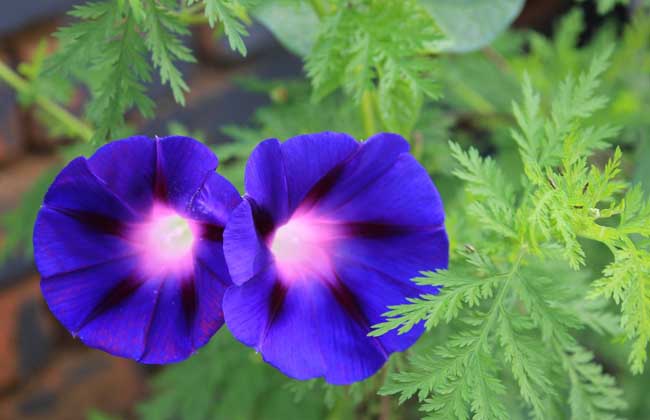
The morning glory is an annual twining herbaceous flowering plant in the genus Ipomoea of the family Convolvulaceae. It originated in tropical America and is widely cultivated throughout our country. It is a common twining herbaceous flower of summer and autumn, and can be used to provide shade in small courtyards and in front of windows, to beautify small trellises and hedges, and can also be planted as ground cover. Let us take a look together below at when morning glories should be planted!
Morning glory planting time
Morning glories are generally planted in spring and summer. Propagation is usually done by sowing seeds, which requires no germination stimulation and has no soil requirements. Of course, if you have nutrient soil or something similar, that works too, and ordinary flower soil is fine as well. When sowing, the seeds need to be soaked in warm water, and after 4 to 6 hours treated appropriately with sulfuric acid, then sprinkled onto the soil and covered with a thick layer of soil, about 1 cm or so. After sowing, covering with about 2 cm of soil is sufficient, then water thoroughly. They generally sprout in about 3 to 5 days and bloom in June to July. The most important thing is light; under sufficient light they bloom very easily.
Morning glory blooming time
The flowering period of morning glories is from June to October. They usually begin to bloom slowly at 4 to 5 o'clock in the early morning, and by around noon the flowers have withered. This is because the flowers of the morning glory are both large and thin, and the flowers contain abundant moisture. When the sun shines on them, the moisture in the flowers evaporates completely within a relatively short time. If in a cool, shaded place, the morning glory wilts more slowly, and sometimes the flowers are even still open in the afternoon.
Morning glory planting and care
1. Water and fertilizer: To grow morning glories, it is best to choose a well-draining potting soil and provide full sunlight and a well-ventilated environment. During the growing period, when the surface of the potting soil is slightly dry, water is needed, and apply diluted liquid fertilizer once every half month. Nitrogen fertilizer should not be too much, so as to avoid excessively lush stems and leaves. Potted plants need a support to hold them up.
2. Pinching: Once the potting soil has settled, insert a thin bamboo pole 1 m long straight into the center of the pot, then use about 3 m of galvanized wire, with one end wrapped around the bamboo pole level with the soil surface, then coil it upward from the rim of the pot to form an evenly shaped tower-like spiral frame that is large at the bottom and small at the top. The upper end of the wire is fixed to the tip of the bamboo pole. The morning glory is a left-twining plant, so the coiling direction of the galvanized wire must match the morning glory's habit of twining to the left. When the main vine climbs along the wire to the top of the pole, pinch off the growing tip, and pinch the side vines each time they grow to 6 to 7 leaves. This makes the flowers larger and keeps producing vines and flowers.
3. Pests and diseases: Morning glories are mainly susceptible to white rust. The affected parts are mainly the leaves, leaf stalks and tender stems. On affected leaves, small light green spots first appear on the leaf. When this happens, the diseased plants can be promptly pulled up and destroyed to reduce infection of the seeds. Select and keep disease-free seeds as propagation seed, disinfect the seeds before sowing, and avoid crop rotation with plants of the Convolvulaceae family. Spraying 1% Bordeaux mixture or 50% phosethyl-Al 500-fold solution at the early stage of the disease, once every 10 to 15 days, gives a relatively good control effect.