What information is there about morning glory? A comprehensive guide to morning glory
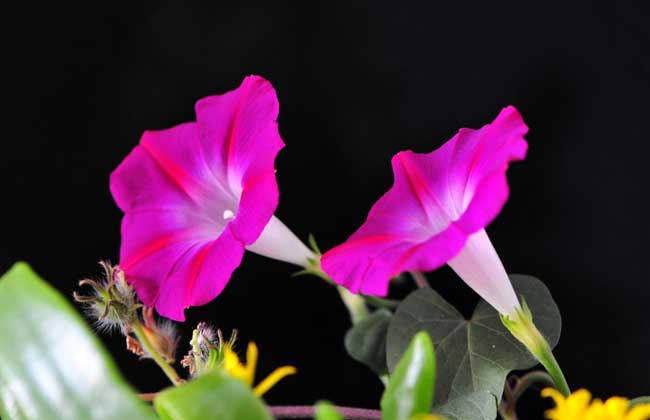
Morning glory, also known as trumpet flower, jinjiaolazi, large morning glory, qinniangzi, and so on, is an annual twining herbaceous flowering plant of the genus Ipomoea in the family Convolvulaceae. Its corolla is trumpet-shaped, and its flower colors are bright and beautiful. Besides being cultivated for ornamental purposes, its seeds are a commonly used traditional Chinese medicine. Let us take a look below at what information there is about morning glory!
Morphological characteristics
The stems of morning glory are covered with appressed short soft hairs mixed with appressed or spreading long stiff hairs. The leaves are broadly ovate or nearly round, and the petioles are 2-15 cm long. The flowers are axillary, solitary or usually 2 borne at the top of the peduncle, and the peduncles vary in length. The corolla is funnel-shaped, blue-purple or purplish-red, and the corolla tube is lighter in color. The stamens and style are included, the filaments are pubescent at the base, the ovary is hairless, and the stigma is capitate. The capsule is nearly spherical, and the seeds are ovate-trigonous, blackish-brown or cream-yellow, covered with short brown down.
Growth habits
Morning glory is native to tropical America and grows on mountain slopes in thickets, along roadsides in dry river valleys, by gardens and homes, and along mountain roads at altitudes of 100-1600 m, or is cultivated. It is robust by nature and prefers a mild climate, sufficient light, and moderate ventilation. It has strong adaptability to soil, is relatively tolerant of drought and salinity-alkali conditions, and is not afraid of high temperatures and summer heat. It is a deep-rooted plant, and when planted in the ground the soil should be deep. It is commonly cultivated throughout China for ornamental purposes, and is distributed in most areas except some provinces in the northwest and northeast.
Medicinal value
The seeds of morning glory are a commonly used traditional Chinese medicine. The black ones are called “heichou” and the cream-yellow ones are called “baichou”. They contain resin glycosides, pigments, fatty oils, organic acids, and other components. Heichou is mostly used in medicine, and it has the effect of promoting diuresis and draining water. It mainly treats edema and abdominal distension, difficult urination and defecation, and other conditions. Grind it into a fine powder, add egg white, apply it to the affected area before bed, and wash it off with clean water early the next morning. Used continuously for one week, it has the effect of removing freckles. However, heichou is somewhat slightly toxic, so never take it orally.
Symbolic meaning
Morning glory represents love, calm, illusory and distant romance, and “temporary love.” The birthday flower meaning of morning glory is, “If you possess perfect love, please cherish your youthful beauty, enjoy this love well, and your happy life will begin to be filled with joy.” The meaning of morning glory lies in tenacity. Its unyielding spirit and strong desire to survive are the true value and meaning of life's existence.