The Flower Language and Legend of the Kapok Flower Explained in Detail
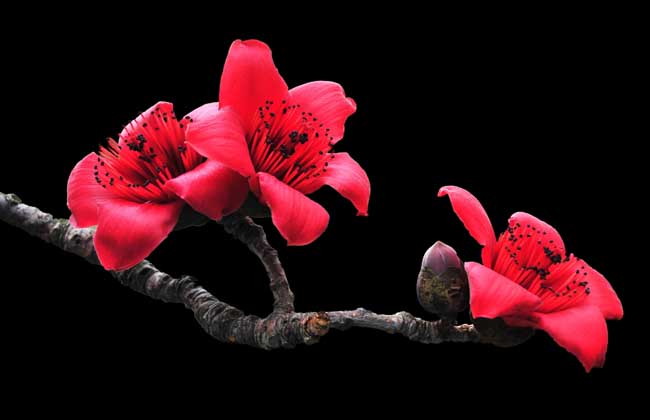
The kapok flower is a specialty of the south, and its place of origin is unknown, but it most likely came from India. In China, it is cultivated in places such as Guangzhou, Zhuhai, Kunming, Shenzhen, Quanzhou, Fuzhou and Xiamen, especially in Guangzhou and Xiamen, where kapok trees are planted all along the streets as street trees. Every year, just after the Lantern Festival, the kapok tree begins to bloom. Let us take a look below at the flower language and legends of the kapok flower!
The Flower Language of the Kapok Flower
Cherish the people around you, and cherish the happiness right before your eyes. In legend, the twelfth day of April is the day when kapok flowers are in full bloom. When the kapok flowers bloom, all the green leaves have fallen, and brilliant red blossoms burst forth, gradually filling the whole tree little by little. Seen from a distance, patch after patch of fiery red flowers are full of hope and happiness. When the fiery red kapok flowers are in full bloom, that burning passion will infect everyone and bring happiness and joy to all.
The Symbolism of the Kapok Flower
Heroes, men and love flourish vigorously, symbolizing vigorous upward striving and abundant vitality. The kapok flower is currently the city flower of Guangzhou in Guangdong Province, Chongzuo in the Guangxi Zhuang Autonomous Region, Panzhihua in Sichuan Province and Kaohsiung in Taiwan, China. The logos used by the Garden Hotel, South China University of Technology, China Southern Airlines and Guangzhou Television feature the kapok flower pattern, while Guangdong Television also used a kapok flower logo in the past.
The Legend of the Kapok Flower
Legend says that on Wuzhi Mountain there was an old Li hero named Jibei, who often led the people to defeat invasions by other ethnic groups. Once, because a traitor informed on him, the old hero was captured. The enemy tied him to a kapok tree and tortured him severely, but the old hero remained unyielding and was finally brutally killed. Later, the old hero turned into kapok trees, so the kapok tree is called “Jibei” in memory of this old ethnic hero.
So how did the name "hero tree" come about? Look at its trunk: the tall, self-standing trunk is covered with thorny growths, not allowing idlers and others to climb it at will, and the branches extend horizontally in whorls, as if declaring sovereignty to the sky. When it blooms there are no leaves, and after the flowers fall it grows leaves again. It truly has great spirit, so it also has the laudatory name of “hero tree.”
However, the first person to call the kapok a hero was Chen Gongyin of the Qing dynasty. In his "Song of the Kapok Flower," he described the kapok flower as “with thick whiskers and a broad face, a fine hero, with vigorous spirit and a high crown, how outstanding.” Since then, people have called the kapok tree the hero tree. The origin of another name for the kapok flower is more pictographic —— after the kapok flowers fade, cotton-like fluff is produced, and the fluff is tied to the large tree. The cotton on the tree is why it is called kapok flower.