What information is there about plum blossoms? A complete guide in one article
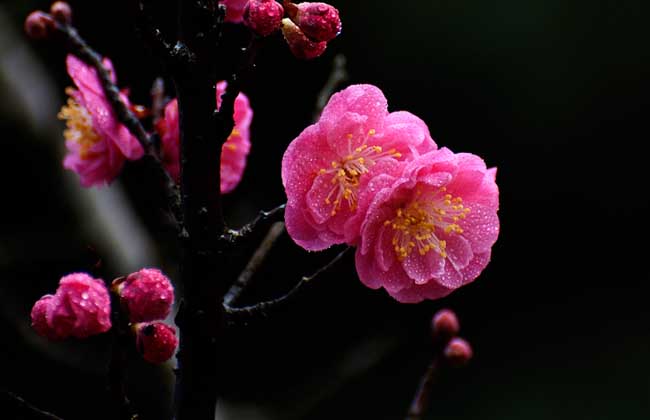
The plum blossom is a deciduous tree of the genus Prunus in the rose family, native to China, and sometimes also refers to its fruit (the plum) or flower (the plum blossom). It usually blooms in winter and spring, and thanks to its cold tolerance it has become the flower representing winter. In Chinese culture there is a saying of spring orchids, summer lotus, autumn chrysanthemums, and winter plum. It was later introduced to Korea and Japan, and it has important ornamental and medicinal value. Let us take a look below at what information there is about plum blossoms!
Morphological characteristics
The plum blossom is a small tree, rarely a shrub, 4-10 m tall, with bark that is light gray or tinged with green, green branchlets, and leaves that are ovate or elliptical, with a caudate-acuminate apex, a broadly cuneate to rounded base, and leaf margins usually bearing small sharp serrations. The flowers are solitary or sometimes 2 together in one bud, strongly fragrant, opening before the leaves, with short pedicels; the calyx is usually reddish brown, the calyx tube broadly campanulate, the sepals ovate or nearly round, and the petals obovate, white to pink. The fruit is nearly spherical, sour, with the flesh adhering to the stone, and the stone is elliptical. The flowering period is winter and spring, and the fruiting period is May-June (in North China the fruiting period extends to July-August).
Growth habits
The plum blossom likes a warm climate and is not strongly cold-tolerant. Apart from varieties of the apricot plum group, which can withstand low temperatures of -25°C, it generally withstands low temperatures of -10°C. It is relatively drought-tolerant and not waterlogging-tolerant, and it is long-lived, able to reach a thousand years. It is especially sensitive to climate change during the flowering period, likes relatively high air humidity, but dislikes torrential rain. It is heat-tolerant and can also grow at 40°C, and grows and develops best in areas with an annual average temperature of 16-23°C. It is very sensitive to temperature, flowering when the average temperature in early spring reaches -5-7°C; if low temperatures occur, the flowering period is delayed, and if low temperatures occur during flowering, the flowering period can be prolonged. During the growing season it should be placed in a sunny, well-ventilated spot; if it is in a shaded environment with insufficient light, it will grow weakly and bloom sparsely. In winter, do not move it indoors too early; moving it indoors in late November is suitable, so that flower bud differentiation can fully go through the vernalization stage. In winter it should be placed indoors in a sunny spot, with the temperature kept at around 5°C.
Origin and distribution
The plum blossom is a specialty of our country. Our country is the world's center of wild distribution of the plum blossom and also the world's center of its cultivation. It originated in the provinces of southwest China, Sichuan, Hubei, Guangxi, and others, blooms in early spring, and is cultivated throughout the country, but most abundantly in the provinces south of the Yangtze River basin. There are also a few varieties in northern Jiangsu and southern Henan, and some varieties have already been successfully introduced to North China. It is also found in Japan and Korea.
Cultivation value
The plum blossom has more than three thousand years of cultivation history in our country, and whether as an ornamental or as a fruit tree it has many varieties. Many types can not only be cultivated in the open ground for viewing, but can also be grown as potted flowers and made into plum bonsai. The fresh flowers can be used to extract essence, and the flowers, leaves, roots, and seed kernels can all be used as medicine. The fruit can be eaten, salted, dried, or smoked into dark plum for medicinal use, and has the effects of relieving cough, stopping diarrhea, promoting fluid production, and quenching thirst. Because the plum tree can resist root-knot nematode damage, it can be used as a rootstock for stone fruit trees.
Plant culture
The plum blossom, together with the orchid, bamboo, and chrysanthemum, is listed as one of the "Four Gentlemen," and together with the pine and bamboo it is also called one of the "Three Friends of Winter." Blooming unyieldingly in the cold winter, it well embodies the precious qualities of our nation: unyielding, tenacious in struggle, and unafraid of hardship. In ancient times we already had poets who sang in verse in praise of the plum blossom: "A few branches of plum by the corner of the wall, blooming alone in the cold. From afar I know it is not snow, for a subtle fragrance comes drifting in." It is also regarded as the flower species with the greatest moral integrity. In addition, although the plum blossom grows in harsh environments, it still blooms joyfully, expressing an optimistic character that welcomes hope.