Detailed Explanation of Willow Planting Techniques and Management Methods
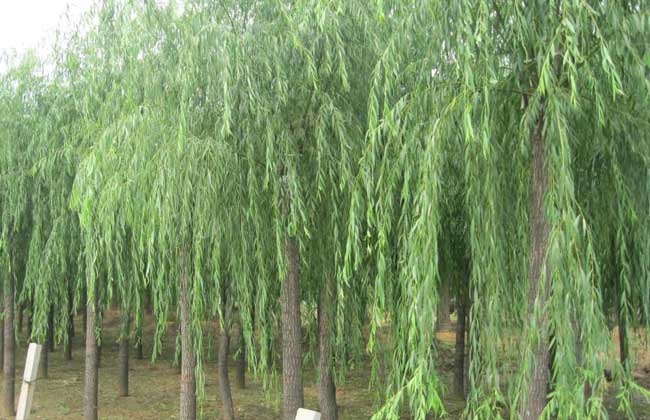
Willow is the collective name for various plants of the genus Salix in the family Salicaceae. It has a cultivation history of more than 4,000 years in China and is mainly used for ornamental landscaping in residential communities, gardens, schools, factories, hillsides, courtyards, roadsides, and in front of buildings. Its branches spread in all directions, giving courtyards patches of green, making it truly an ideal tree species for beautifying courtyards. Let us take a look at willow planting techniques together below!
Willow Growth Habits
Willow is a plant with a broad ecological amplitude and wide adaptability to the environment. It is a light-loving, moisture-loving, cold-tolerant mesophytic species leaning toward moist conditions, but some species are also relatively drought-tolerant and salt-alkali-tolerant. It can grow in places with relatively harsh ecological conditions, and grows even better on fertile plains with superior site conditions. Its general lifespan is 20-30 years, and a few species can reach more than 100 years. Its annual growth period is relatively long, it sprouts early and sheds leaves late, and a few species in the south are evergreen trees.
Willow Propagation Methods
Willow is commonly propagated by cuttings, which can maintain the excellent characteristics of the mother tree. Cutting propagation is the main method, but sowing and seedling raising can also be used. Cuttings are carried out in early spring. Select superior plants with fast growth and few pests and diseases as mother trees for collecting cuttings. Before budding, cut 2-3-year-old branches and cut them into 15-17 cm long cuttings. Insert them directly at a spacing of 20×30 cm. After insertion, water thoroughly, keep the soil moist frequently, remove buds and weeds in time, and apply topdressing 3-4 times after rooting. Young seedlings are easily damaged by weevils, aphids, and willow leaf beetles. For sowing and seedling raising, collect seeds in April and sow them immediately after collection. The 1000-seed weight is 0.4 grams, the germination rate is 70-80%, and about 0.25 kg is sown per mu. The seedling height in the same year is 80-100 cm. Transplanting is suitable from after leaf fall in winter to before buds sprout in early spring of the following year. After planting, water thoroughly and set up supports.
Willow Planting Techniques
1. After the planting stock arrives, prune the root system first, then plant immediately. Pruning should be scientific and reasonable, and the cut should be smooth. When the soil is relatively heavy and sticky, the planting hole should be no smaller than 80×80×60 cm. To reduce insect damage later, trichlorfon and similar drugs can be evenly scattered into the hole. When the willow absorbs water during growth, it takes in the medicinal components, achieving an insect-prevention effect.
2. Plant the willow into the tree pit. Do not plant too deep. Fill the area around the bag with good soil and compact it.
3. After planting the willow, immediately water thoroughly once, filling the bag with water. After the water has completely seeped down, immediately water a second time. The second watering should also completely fill the tree pit, and any fallen seedlings should be set upright. Sometimes watering washes away the soil in the pit. If this happens, add more soil and compact it around the sides. Practice has shown that two consecutive waterings every 15 days can meet the growth needs of the seedlings for four months. Extremely dry soil needs more frequent watering.
4. If encountering saline-alkali arid soil, it is also necessary to make use of the high water absorption and high water retention characteristics of superabsorbent resin. Apply superabsorbent resin to the roots before planting the willow into the tree pit to achieve the purpose of keeping the roots moist and meet the needs of growth and survival. Using vegetative propagation, growth is fast and sex can be controlled, but after multiple generations of vegetative propagation, growth vigor declines, and symptoms such as dead tips and premature aging are prone to occur.
5. Anoplophora chinensis and Anoplophora glabripennis bore into and feed on branches and trunks, while Clania variegata, nettle grubs, Li leaf beetles, willow leaf beetles, and cicadas damage branches and leaves. Willow leaf beetles can be controlled during the damage period from April to June by spraying with trichlorfon at 600 times or phoxim at 1000 times. Nettle grubs, scarab beetles, and similar pests can be sprayed with abamectin or Senle at 1500-2000 times solution or Bt at 500-800 times solution. For longhorn beetle larvae, apply poison sticks, or during the larval stage use 15% Chongxianqing at 300 times solution for high-pressure spray control.