When does the willow tree bloom?
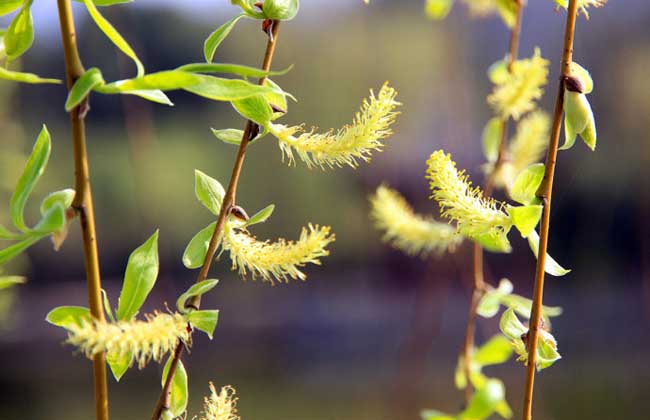
The willow tree has high ornamental value in gardens and is often planted in residential communities, gardens, schools, factories, hillsides, courtyards, roadsides, and in front of buildings. Its branches spread out in all directions, making the courtyard full of green strips, and it is an ideal tree species for beautifying courtyards. China has a history of more than 4,000 years of planting willows. Let's take a look below at when the willow tree blooms!
When do willow flowers bloom?
The willow tree blooms from April to May each year. It has catkins. The male catkin is 2 to 4 cm long. The female catkin is about 2 cm long, has a short stalk, is slightly curved, 1 to 1.5 cm long, has one gland, the ovary is hairless and stalkless, the style is extremely short, and the stigma is 2-lobed. The capsule is 3 to 4 mm long, greenish brown, and splits into 2 valves when mature. The seeds have cottony hairs. The fruiting period is April to May.
Medicinal value of willow flowers
[Nature and flavor] Bitter in taste, cold in nature.
[Meridian tropism] Liver and large intestine meridians.
[Efficacy] Disperses wind, drains dampness, stops bleeding, and dissipates blood stasis. Treats wind edema, jaundice, coughing blood, vomiting blood, blood in the stool, bloody strangury, women's amenorrhea, and toothache.
[Usage] Oral administration: pound for juice or grind into powder, 1 to 3 qian. External use: grind into powder or burn until charred and retain its nature, then sprinkle.
1. To treat fever and stopped menstruation in unmarried women: willow flowers 5 to 7 qian, zi cao (Arnebia root) 1 liang 2 qian, sheng ma (Cimicifuga rhizome) 9 qian, gui shen (angelica body) 7 qian 5 fen. Grind the above into powder. Take 7 qian per dose, mixed with grape decoction.
2. To treat noma: burn poplar flowers until charred and retain their nature, add a little musk, and apply.
Medicinal value of the willow tree
1. Willow flowers: Willow flowers are also called willow seeds. They are cool in nature and soft, and used as pillow filling they have the effect of calming the mind and inducing sleep. If willow flowers are ground finely, they can treat jaundice, coughing blood, vomiting blood, blood in the stool, and women's amenorrhea, and external use can still treat toothache.
2. Willow leaves: Willow leaves have the same effects as willow catkins. They are rich in tannins and have the effects of clearing heat and detoxifying, draining dampness, and reducing swelling. Taken as a decoction, they can treat upper respiratory tract infections, bronchitis, pneumonia, cystitis, mumps, and pharyngitis. Pounded and applied externally, they can treat heel pain.
3. Willow branches: Willow branches are a traditional bone-setting remedy in Chinese medicine. Taken as a decoction, they can treat coronary heart disease, chronic bronchitis, urinary tract infections, burns and scalds, and so on. Decocted for fumigation and washing, they have a clear effect on rheumatic and rheumatoid arthritis.
4. Willow roots: Willow roots can dispel wind and drain dampness, reduce swelling, and relieve pain. They can treat breast abscess, toothache, otitis media, jaundice, and other diseases. When boiled with wine and drunk, their wind-dispelling, swelling-reducing, and pain-relieving effects are better.
5. Willow bark: Willow bark can remove phlegm and improve eyesight, clear heat, and dispel wind. Decocted for fumigation and washing, it can also treat stubborn scabies and ringworm.
6. Willow debris: Willow debris is the bore dust in wormholes in willow trees. Decocted in water for bathing or stir-fried hot and wrapped in cloth for warm compresses, it can treat prurigo and dermatitis.