What does "The willow wind that brushes the face is not cold" mean?
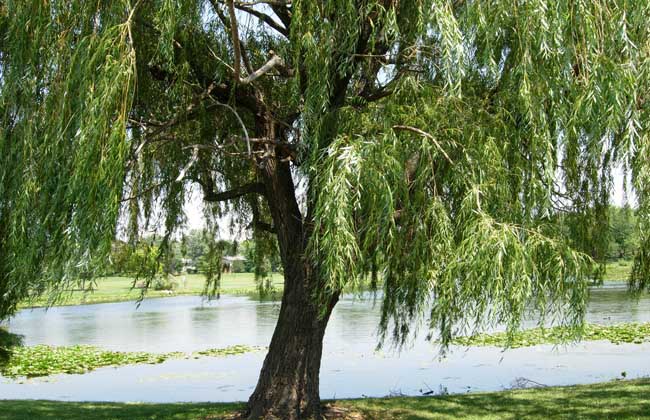
Willow is a general term for a group of plants such as dry willow, glandular willow, weeping willow, and Chinese wingnut. In spring, the willow is the most charming and most "uninhibited" of trees, and it is also one of the subjects that poets and writers have praised endlessly for thousands of years, such as "The willow wind that brushes the face is not cold" and "Who cut the slender leaves? The February spring wind is like scissors." Now let us take a look at what "The willow wind that brushes the face is not cold" means!
The original text of "The willow wind that brushes the face is not cold"
In the shade of ancient trees I moored the short-canopied boat; A staff of pigweed helped me across to the east of the bridge. The apricot-blossom rain would damp my clothes; The willow wind that brushes the face is not cold.
Translation of "The willow wind that brushes the face is not cold"
(I) tied the small boat in the deep shade of the towering ancient trees, and a staff made of pigweed supported me as I walked to the east of the bridge. In the season when apricot blossoms bloom, the misty drizzle dampened my clothes, and the wind that came toward me, stirring the willows, blew gently on my face without the slightest chill.
The meaning of "The willow wind that brushes the face is not cold"
This exquisitely beautiful little poem mainly describes the pleasure the poet takes in a spring outing with a staff in a gentle breeze and fine rain. Though he is on a spring outing with a staff, he says "the pigweed staff supports me," personifying the pigweed staff as if it were a companion he could rely on. The scenery east of the bridge and west of the bridge may not differ greatly, but for the poet on a spring outing, going east or going west makes the mood and charm quite different.
"Apricot-blossom rain" is the rain of early spring, and "willow wind" is the wind of early spring. Put this way, it has more beauty and more pictorial quality than "fine rain" and "gentle breeze." Willow branches ripple in the wind, giving the impression that the spring wind arises from the willows. Calling the rain of early spring "apricot-blossom rain" is exactly the same principle as calling the rain of early summer "yellow plum rain." "In the small tower, all night I heard the spring rain; In the deep lane, at dawn, apricot blossoms were for sale." As early as the early Southern Song dynasty, the great poet Lu You had already linked apricot blossoms with spring rain.
"Would damp my clothes" uses clothes that seem damp yet not damp to describe the fine rain of early spring as seeming to exist yet not exist, showing even more the fineness of observation and the delicacy of description. Imagine the poet walking east with his staff, along the way red apricot blossoms glowing and green willows fluttering, fine rain moistening his clothes, seeming damp yet not visibly damp, and a gentle breeze blowing toward him without the slightest chill. What a patient and delightful spring day excursion this is!
Some people cannot help but wonder: if the old monk keeps walking along so cheerfully and keeps enjoying the scenery, then when he remembers that he should return, he may not have the strength, and even the pigweed staff may no longer be able to support him, right? There is no need to worry. The first line of the poem says, "In the shade of ancient trees I moored the short-canopied boat." Is not the short canopy a small boat? The old monk originally came along the stream by small boat, and that small boat was moored by the old tree at the edge of the stream, just waiting for him to untie the rope and return to the temple. When the monk reached the old tree and felt the rain, he put on a small straw hat and continued across the bridge, enjoying the beautiful scenery ahead in the fine rain.