What information is there about willow trees?
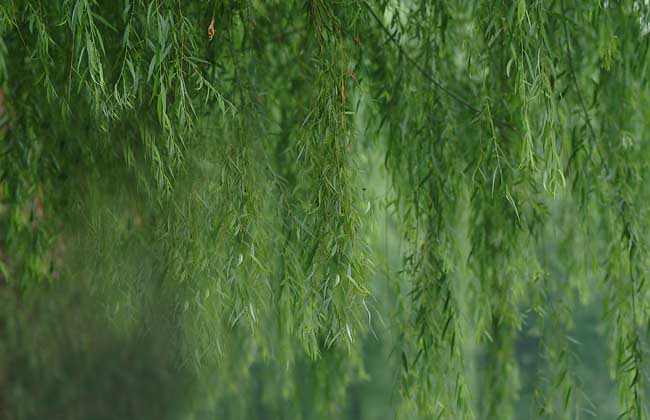
Willow is a general term for a class of plants, also known as water willow, weeping willow, Qingming willow, etc. China has a history of planting willows for more than 4,000 years, which can be traced back to the ancient Shu king Yufu who planted trees to mark boundaries. In spring it is also the most charming and most "unrestrained" of trees, and it is one of the subjects praised endlessly by poets and writers for thousands of years. Now let us take a look at what information there is about willow trees!
Morphological characteristics of willow
The branches of willow are slender and drooping, brown-green, hairless, and the winter buds are linear and closely attached to the branches. The leaves are alternate, linear-lanceolate, with glandular small serrations along the edges, dark green on the surface, green-gray-white on the underside, smooth and hairless on both sides, and with stipules. It blooms from April to May each year, with the flowers appearing after the leaves. The male inflorescence is a catkin, with a short stalk and slightly curved. The fruit is a capsule, dehiscing into 2 valves when mature, containing many seeds, and the seeds have a tuft of cottony hairs.
Growth habits of willow
Willow belongs to plants with a wide ecological amplitude and has a very broad adaptability to the environment. It is a light-loving, moisture-loving, cold-tolerant mesophytic tree species leaning toward wet conditions, but some species are also relatively drought-tolerant and salt-alkali-tolerant, and can grow in places with harsh ecological conditions. In plains and fertile fields with superior site conditions, it grows even better. Its general lifespan is 20 to 30 years, and a few species can reach more than 100 years. Its annual growth period is relatively long, it sprouts early and sheds leaves late, and a few species in the south are evergreen trees.
Geographical distribution of willow
Willow is suitable for various different ecological environments. Willows grow in mountains, plains, sand dunes, and polar regions alike, and are mainly distributed in the temperate regions of the Northern Hemisphere. Dry willow is produced in the plains of North China, Northeast China, and Northwest China. Weeping willow is found throughout China, and has been introduced in many countries in Europe, Asia, and the Americas. Korean weeping willow, round-headed willow, long-column willow, white-bark willow, large white willow, slender-column willow, Chinese willow, and others are mostly produced in Northeast China, and are also found in Korea, Japan, and the Russian Far East. Crack willow is native to Europe, and has been introduced in Northeast China. White willow is produced in **, China, Gansu, Qinghai, and Tibet, and is also distributed in Iran, Pakistan, northern India, Afghanistan, Russia, and Europe. Glandular willow is produced in the middle and lower reaches of the Yellow River basin and southern Liaoning Province, and is also found in Korea and Japan. Yunnan willow is produced in Yunnan, Guangxi, Guizhou, and Sichuan, China. Purple willow is produced in the lower reaches of the Yangtze River basin in China. Big-leaf willow is produced in Sichuan Province, China. Cotton willow has been introduced in cities such as Beijing, Shanghai, and Guangzhou in China.
Propagation methods of willow
Willow is commonly propagated by cuttings, which can maintain the superior characteristics of the mother tree. Cutting propagation is the main method, but sowing and seedling raising can also be used. Cuttings are carried out in early spring. Select superior plants with fast growth and few diseases and pests as mother trees for collecting cuttings. Before budding, cut 2- to 3-year-old branches and cut them into 15 to 17 cm long cuttings. Insert them directly at a row spacing of 20×30 cm. After insertion, water thoroughly, keep the soil moist frequently, remove buds and weeds in time, and apply topdressing 3 to 4 times after rooting. Seedlings are susceptible to damage by weevils, aphids, and willow leaf beetles. For sowing and seedling raising, collect seeds in April and sow them immediately after collection. The 1000-seed weight is 0.4 grams, the germination rate is 70 to 80%, and about 0.25 kg is sown per mu. In the same year, the seedling height is 80 to 100 cm. Transplanting is suitable from after leaf fall in winter to before buds sprout in early spring of the following year. After planting, water thoroughly and set up supports.
Medicinal value of willow
1. Willow flower: Willow flower is also called willow seed. It is cool in nature and soft, and when used as pillow filling it has the effect of calming the nerves and inducing sleep. If willow flower is ground finely, it can treat jaundice, hemoptysis, hematemesis, hemafecia, and female amenorrhea, and external use can also treat toothache.
2. Willow leaf: Willow leaf has the same effects as willow catkin. It is rich in tannins and has the effects of clearing heat and detoxifying, draining dampness and reducing swelling. Decocted in water and taken orally, it can treat upper respiratory tract infections, bronchitis, pneumonia, cystitis, mumps, and pharyngitis. Mashed and applied externally, it can treat heel pain.
3. Willow branch: Willow branch is a traditional wonderful bone-setting medicine in Chinese medicine. Decocted in water and taken orally, it can treat coronary heart disease, chronic bronchitis, urinary tract infections, burns and scalds, etc. Decocted in water for fumigation and washing, it has a marked effect on rheumatic and rheumatoid arthritis.
4. Willow root: Willow root can dispel wind and drain dampness, reduce swelling and relieve pain. It can treat breast abscess, toothache, otitis media, jaundice, and other diseases. When boiled with wine and taken orally, its effects of dispelling wind, reducing swelling, and relieving pain are even better.
5. Willow bark: Willow bark can remove phlegm and improve vision, clear heat and dispel wind. Decocted in water for fumigation and washing, it can also treat stubborn scabies and ringworm.
6. Willow debris: Willow debris is the bore dust in wormholes of willow trees. Decocted in water for bathing or stir-fried hot and wrapped in cloth for warm compress, it can treat prurigo and dermatitis.