What are the uses of willow trees? A comprehensive analysis of their main uses and value
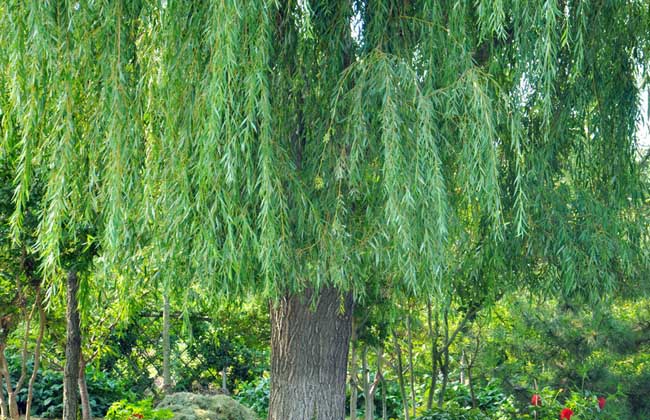
Willow is the general name for a group of plants including dry willow, glandular willow, weeping willow, and Chinese wingnut. They are mainly used for ornamental planting in residential areas, gardens, schools, factories, hillsides, courtyards, roadsides, and in front of buildings. In traditional Chinese medicine, willow also shows many medicinal effects. Let us take a look below at what the uses of willow trees are!
The craft value of willow trees
The bark of willow contains tannins. Its wood is inferior to that of dry willow and can be used for utensils and as a raw material for papermaking. Willow catkins can be used to stuff chair cushions and pillows. The fiber of river willow branch bark can be used as a raw material for textiles and ropes, and the branches can be woven into baskets, carrying baskets, wicker boxes, and safety helmets. Willow wood is light, easy to cut, does not deform after drying, and has no special odor. It can be used for construction, pit props, box boards, and matchsticks. The wood has a high fiber content and is a raw material for papermaking and artificial cotton. Willow wood and willow branches are very good fuelwood. Many kinds of willow twigs can be woven into baskets, boxes, hats, and more. Willow leaves can be used as feed for sheep, horses, and others.
The ornamental value of willow trees
Willow trees have graceful shapes, leaf out and bloom early, and are full of tender green in early spring. They are one of the main tree species in parks of the northern temperate zone. For example, weeping willow and Korean weeping willow have slender, drooping branches and willow leaves like eyebrows. Many shrub willows tolerate pruning and can be cultivated into shrub thickets of various shapes or used as hedges. For waterside landscaping in garden landscapes, willow is most suitable, such as the "Orioles Singing in the Willows" at West Lake in Hangzhou, and the "Peach Stream and Willow Bank" at Huaxi in Guiyang. There are also many beautiful willows yet to be developed. When in full bloom, their branches spread in all directions, making courtyards full of green strips and giving them high ornamental value. They are truly ideal tree species for beautifying courtyards. They are highly resistant to air pollution and dust and are suitable for growing in urban courtyards, especially beside ponds or streams.
The environmental value of willow trees
Sweden obtains bioenergy by cultivating short-rotation coppice willow. Its afforestation land is mainly agricultural land, and the biomass produced is used in district heating plants for combined heat and power production. While producing bioenergy, willow coppice can also play a role in removing pollutants and remediating the environment. Sweden has successfully used willow coppice to treat urban wastewater, landfill leachate, industrial wastewater (such as wastewater after spraying logs at sawmills), sewage sludge, and sawdust. This is mainly through plant uptake to reduce pollutants and excess nutrients in water and soil, and to promote the degradation of organic pollutants by soil microorganisms. This process is called phytoremediation.
The medicinal value of willow trees
1. Willow flower: Willow flower, also called willow seed, is cool in nature and soft. Used as a pillow filling, it has the effect of calming the nerves and inducing sleep. If willow flower is ground finely, it can treat jaundice, hemoptysis, hematemesis, bloody stool, and amenorrhea in women. For external use, it can also treat toothache.
2. Willow leaf: Willow leaf has the same effects as willow catkin. It is rich in tannins and has the effects of clearing heat and detoxifying, draining dampness, and reducing swelling. Decoction taken orally can treat upper respiratory tract infections, bronchitis, pneumonia, cystitis, mumps, and pharyngitis. Applied externally after being pounded, it can treat heel pain.
3. Willow branch: Willow branch is a traditional wonderful bone-setting medicine in traditional Chinese medicine. Taken as a decoction, it can treat coronary heart disease, chronic bronchitis, urinary tract infections, burns, and scalds. Used in decoction for fumigation and washing, it has obvious curative effects on rheumatic and rheumatoid arthritis.
4. Willow root: Willow root can dispel wind and drain dampness, reduce swelling, and relieve pain. It can treat acute mastitis, toothache, otitis media, jaundice, and other diseases. When boiled with wine and taken, its effects of dispelling wind, reducing swelling, and relieving pain are even better.
5. Willow bark: Willow bark can eliminate phlegm, improve eyesight, clear heat, and dispel wind. Decoction for fumigation and washing can also treat stubborn scabies and ringworm.
6. Willow debris: Willow debris is the frass in holes bored by insects in willow trees. Decocted in water for bathing or stir-fried hot and wrapped in cloth for warm compresses, it can treat prurigo and dermatitis.