What are the key technical points for planting Sophora japonica?
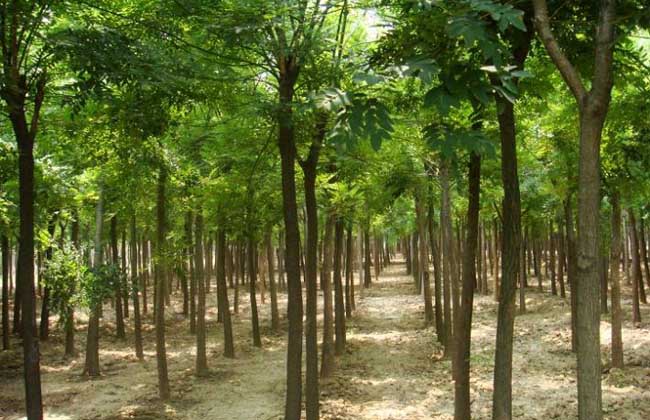
Sophora japonica, also known as the pagoda tree, sophora flower bud, bean locust, white locust and so on, is a tree of the genus Sophora in the Fabaceae family. It originated in China and is now widely cultivated across the northern and southern provinces and regions, being especially common in North China and the Loess Plateau region. It is also distributed in Japan and Vietnam, grows wild in Korea, and has been introduced in countries across Europe and the Americas. It has very high planting value, so let us take a look together at the planting techniques for Sophora japonica below!
Planting environment for Sophora japonica
Sophora japonica likes light and is slightly shade-tolerant, and can adapt to relatively cold climates. Its roots are deep and well developed, and it is not demanding about soil. It can grow normally in soils ranging from acidic to calcareous and mildly saline-alkaline, even under conditions with a salt content of around 0.15%. It is wind-resistant and also tolerant of drought and poor soil, and is especially able to adapt to adverse urban environmental conditions such as compacted soil, though it grows poorly in low-lying waterlogged spots. It has relatively strong resistance to pollution such as sulfur dioxide and smoke and dust. It grows relatively fast when young, then at a medium rate afterward, and has a very long lifespan. Old trees tend to become hollow, but the dormant buds have a long lifespan, which favors crown renewal.
Root burial propagation of Sophora japonica
1. Seed preparation: After the locust tree sheds its leaves, the root stock can be introduced. Before planting, store it buried in sandy soil, and manage the moisture of the sandy soil well - the root segments must neither dehydrate and dry out, nor be kept too moist and become moldy and rotten.
2. Land preparation: For raising seedlings, it is best to choose sandy loam with deep soil layers, flat terrain, convenient irrigation and drainage, and no sources of pest or disease infection. Apply 2500 kg of livestock and poultry manure per 667 sq m, or apply 50 kg of phosphate fertilizer and diammonium as base fertilizer, and use insecticides such as carbofuran to kill underground pests. The land should be deeply plowed, finely worked, and raked level, with beds about 1 m wide.
3. Raising seedlings: The seedling-raising time is early to mid-March in the south, and late March to early April in the north. Choose smooth root segments 1 to 2 years old, 5 to 10 mm in diameter, with no traces of pests or diseases, and cut them into 5 to 7 cm lengths for later use. Open furrows along the beds, with a furrow spacing of 50 cm and a depth of 5 cm, then lay the root segments flat in the furrows at a plant spacing of 30 cm, cover with fine sandy soil, water thoroughly to settle the roots, and cover well with plastic film. Seedlings will emerge in about one month.
Cutting propagation of Sophora japonica
1. Cutting time: The cutting time is the same as for root burial seedling raising, and can also be slightly earlier.
2. Selection of cuttings: Select lignified hard branches 8 to 20 mm in diameter, cut them into 15 cm long cuttings, cut the upper end flat, 1 to 2 cm from the bud, and cut the lower end into a 45-degree slant, 5 mm from the bud. Divide them into upper and lower ends, bind 50 cuttings into a bundle, soak the lower ends in a 50 mg/kg rooting powder solution for 3 to 4 hours, then take them out for later use.
3. Cutting method: The land preparation requirements are the same as above. Insert the branches into the soil at a 45-degree angle at a plant and row spacing of 20 cm × 40 cm, and cover along the beds with plastic film.
Seed propagation of Sophora japonica
1. Seedbed selection: The seedling-raising land for Sophora japonica should preferably be flat terrain with good irrigation and drainage conditions, fertile soil, and deep loam or sandy loam. It can adapt to neutral, calcareous and slightly acidic soils, and can grow normally in mildly saline-alkaline soil (with a salt content of around 0.15%), but grows poorly in dry, poor, and low-lying waterlogged nursery land.
2. Seed treatment
① Soaking method: First soak the seeds in 80°C water, stirring constantly until the water temperature drops below 45°C, then let stand for 24 hours and take out the swollen seeds. For seeds that have not swollen, repeat the above method 2 to 3 times until they reach the swollen state. Cover the swollen seeds with a wet cloth or straw curtain to keep them warm and promote germination. After 1.5 to 2 days, about 20% of the seeds will have sprouted and can be sown.
② Sand storage method: Generally, carry out sand storage of the seeds 10 to 15 days before sowing. Before sand storage, soak the seeds in water for 24 hours, and bring the sand's moisture content to 60%, that is, it forms a ball when squeezed in the hand and breaks apart at a touch. Mix the seeds and sand thoroughly at a volume ratio of 1:3, place them in a pit dug in advance, and then cover with plastic sheeting. During sand storage, turn the mixture once every day and keep it moist. When 50% of the seeds have germinated, they can be sown.
3. Sowing method: Spring sowing is generally used, and in Zhuozhou it is advisable to sow in early to mid-April. The sowing rate is 10 to 12 kg per mu. Ridge sowing or bed sowing can be used. For ridge sowing, the ridge spacing is 70 to 80 cm, the ridge bottom width is 40 to 50 cm, the surface width is about 30 cm, the ridge height is 15 to 20 cm, the sowing width is 10 cm, and the soil cover is 1.5 to 2 cm. Bed sowing can also be used, without ridges, with a row spacing of 60 to 70 cm and a sowing width of 5 cm. After sowing, press the soil so that the seeds and soil are closely combined, and if conditions permit, cover with film.
Planting management of Sophora japonica
1. Timely thinning and finalizing of seedlings: Generally, seedlings begin to emerge 7 to 10 days after sowing, and are fully emerged in 10 to 15 days. For plots covered with film, remove the film when the seedlings have grown 2 to 3 true leaves. When the seedlings are 15 cm tall, thin them in 2 to 3 rounds, with a final plant spacing of 10 to 15 cm, leaving about 8000 seedlings per mu.
2. Transplanting management: For landscaping seedlings, they generally can only leave the nursery after 3 to 4 years. Because the buds on the top branches of the seedlings are dense and the internodes are short, the trunk is very prone to bending. In the spring of the following year, transplant the one-year-old seedlings at a plant spacing of 40 to 50 cm and a row spacing of 70 to 80 cm, and after planting, cut the trunk back at 3 to 5 cm above the ground. Since the locust tree has sprouting ability, a large number of sprouts tend to appear after trunk cutting. When the tender sprouting branches grow to about 20 cm, select and keep 1 upright, vigorous branch as the trunk, and remove all the other branches. Afterward, pay attention at all times to removing sprouts and side branches. Temporarily keep the thin, weak side branches on the upper, middle and lower parts of the trunk, as this helps prevent the trunk from bending. In this way, the seedling height can reach more than 3 m the following year.
3. Fertilizer and water management: Watering of Sophora japonica seedlings should be determined by factors such as climatic conditions and soil texture. Under normal circumstances, water 2 to 3 times from emergence to before the rainy season, and water once with winter water before the nursery land freezes. Drain promptly in case of waterlogging. Before sowing, apply about 3000 kg of base fertilizer per mu to the seedling land (mainly organic fertilizer or barnyard manure). In early June, combined with watering, apply 8 to 10 kg of quick-acting nitrogen fertilizer per mu. In July and August, apply urea, preferably mixed with an appropriate amount of compound fertilizer, 12 to 3 times, with about 30 kg per application. After September, no more watering or fertilizing is done, in order to promote lignification of the seedlings.
4. Shaping and pruning: As needed, the trees can be shaped and pruned into 3 tree forms: natural open-center form, cup form, and natural sympodial trunk form. For the natural open-center form, when the trunk grows to more than 3 m, head it back, select and keep 3 to 4 vigorous branches with appropriate angles as the main branches, and promptly remove the side branches and sprouts below the main branches. During winter pruning, moderately shorten the main branches, leaving 50 to 60 cm, to promote secondary shoots and form a small crown. For the cup form, after heading back, keep 3 main branches as in the natural open-center form. During winter pruning, select and keep 2 side branches on each main branch and shorten them, forming 6 small branches. In summer, pinch the tips to control growth. During winter pruning the following year, select 2 branches on each small branch and shorten them, forming a cup-shaped structure of “3 limbs, 6 forks, 12 branches”. The natural sympodial trunk form means that after keeping the main branches well, subsequent pruning only needs to retain strong terminal buds and upright buds, and develop vigorous branches at all levels, so that the crown continuously expands.
5. Pest and disease control: The main diseases of Sophora japonica are powdery mildew, canker and rot, which can be controlled by spraying 70% thiophanate-methyl wettable powder at 800 to 1000 times dilution or 50% Tuzet wettable powder at 600 to 800 times dilution. The main insect pests are locust aphids, locust geometrid moths, armyworms, American white moths, and so on, which can be controlled with a compound of 10% imidacloprid wettable powder at 2000 times dilution with 4.5% beta-cypermethrin emulsifiable concentrate at 1500 times dilution, or 2.0% abamectin emulsifiable concentrate at 3000 to 4000 times dilution. Weeding in Sophora japonica nursery land is mainly carried out in the current-year seedling plots, and can be done by manual removal or chemical herbicide control. When using chemical herbicides for control, be sure not to spray the agent onto the tree trunks.