What information is there about the sensitive plant (Mimosa pudica)? A comprehensive guide to the sensitive plant in one article
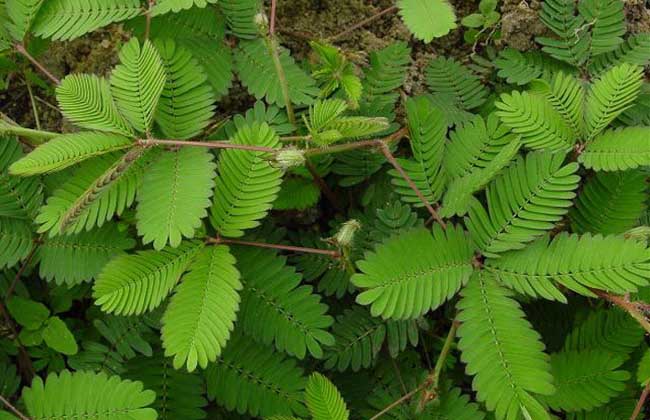
The sensitive plant (Mimosa pudica) is a perennial herb or subshrub in the Fabaceae family. Because its leaves respond to heat and light and close immediately when touched by an external force, it is named the sensitive plant. Its flowers, leaves and pods all have good ornamental value, and it is relatively easy to keep alive, making it suitable as a potted flower for balconies and indoors. Eating it or excessive contact with the sensitive plant can also cause hair loss. It can also be grown in courtyards and other places.
The sensitive plant's shape resembles a pompom. After flowering it produces pods, and the fruit is flat and round. The leaves are pinnate compound leaves arranged alternately, in a palmate arrangement. It generally blooms after midsummer; the capitulum is oblong, with 2 to 3 growing in the leaf axils. The flowers are white or pink, the calyx is bell-shaped with 8 tiny calyx teeth, the petals are split into four, there are four stamens, and the ovary is hairless. The pod is flat, with 1 seed per pod segment, and the segments fall off when mature. The flowering period is September.
The sensitive plant differs from ordinary plants: when touched by the outside world, its petioles droop and its leaflets close. People interpret this action as “shyness”, which is why it is called the sensitive plant, the shy plant, and the bashful plant. This special ability has a certain historical origin. Its original home is Brazil in tropical South America, where there are often strong winds and heavy rain. Whenever the first drop of rain hits a leaf, it immediately closes its leaves and droops its petioles to avoid the damage that storms would do to it. This is an adaptation to changes in external environmental conditions. In addition, the movement of the sensitive plant can also be seen as a form of self-defense: as soon as an animal touches it, it folds its leaves, and the animal no longer dares to eat it.
The sensitive plant is native to tropical America and has already spread widely across the world's tropical regions. It is produced in Taiwan, China, Fujian, Guangdong, Guangxi, Yunnan and other places. It grows in wild wastelands and thickets. Along the Yangtze River basin it is often cultivated for ornamental purposes. It likes a warm, humid environment with plenty of sunlight, and is suited to well-drained sandy loam rich in organic matter. The plant is robust, grows quickly, and has strong adaptability.
The sensitive plant is sweet and astringent in taste and cool in nature. It has the effects of calming the heart and soothing the nerves, and clearing heat and detoxifying. It is used for vomiting and diarrhea, insomnia, malnutrition in children, red swollen painful eyes, deep abscesses, herpes zoster and other conditions. The root of the sensitive plant is astringent and slightly bitter in taste, and is toxic. It has the effects of relieving cough and resolving phlegm, draining dampness and unblocking collaterals, and harmonizing the stomach and relieving food stagnation. It is used for cough with phlegm and asthma, rheumatic joint pain, indigestion in children and other conditions. However, the sensitive plant has an anesthetic effect, so it should not be taken internally in excess, and pregnant women should not take it.