When Do Maple Trees Lose Their Leaves? Analysis of Leaf-Fall Timing and Patterns
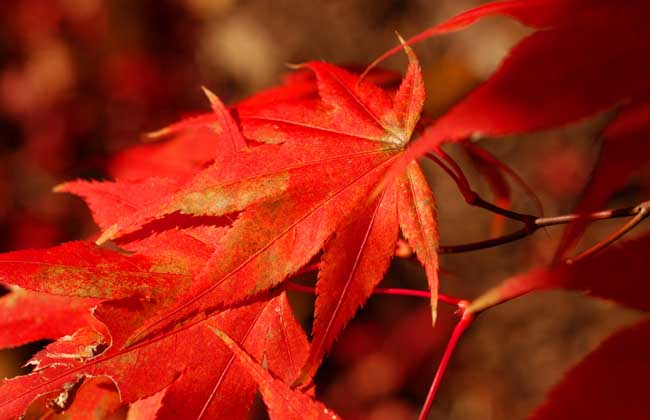
The maple is a tall tree in the genus Acer of the family Aceraceae, reaching a height of 24 m with a crown spread of up to 16 m, and many species are world-famous ornamental trees. Maple leaves are brilliant in color and uniquely beautiful in shape, and can be made into bookmarks, specimens and the like; in autumn they turn fiery red, and when they fall to the ground they become deep red. Let us take a look below at when maple trees lose their leaves!
When do maple trees lose their leaves?
Maple leaves fall in autumn. When autumn arrives, the days shorten and the nights lengthen, the weather turns cold, the soil temperature drops, rainfall decreases, the water-absorbing capacity of the roots is greatly weakened, while the transpiration rate does not weaken, and the lack of water causes leaf fall. At the same time, after a certain period of physiological activity, a large amount of metabolic products such as minerals accumulate in the cells of the leaves, causing a decline in physiological function and death (destruction of chlorophyll).
Why do maple leaves turn red?
Maple leaves turning red is in fact the result of the maple tree's response to environmental stress; the reddening actually acts as a sunscreen, allowing the leaves to stay on the tree longer and enabling the tree to absorb more nutrients. The red color of the leaves depends mainly on two substances: one is carotene, an orange-red pigment commonly present in chloroplasts; the other is anthocyanin, which is present in the cell sap within the vacuole. When the cell sap is alkaline, anthocyanin appears blue-purple; when the cell sap is acidic, anthocyanin appears red. After autumn begins, anthocyanin in maple leaves increases, while the drop in temperature destroys and eliminates chlorophyll, so the green leaves become red leaves.
What varieties of maple are there?
1. Truncate maple (Acer truncatum): Truncate maple, also known as Pingji maple, is a deciduous tree 8-10 m tall. The bark is grayish brown or dark brown, with deep vertical fissures. The branchlets are hairless; current-year branches are green, and perennial branches are grayish brown with round lenticels. The leaves are papery, 5-10 cm long and 8-12 cm wide. The flowers are yellow-green, polygamous, with male flowers and bisexual flowers on the same tree, often forming hairless corymbs. The samaras are pale green when young and pale yellow or pale brown when mature. The nutlets are flattened, 1.3-1.8 cm long and 1-1.2 cm wide. The flowering period is April, and the fruiting period is August.
2. Japanese maple (Acer palmatum): Japanese maple, also known as chicken-claw maple and green maple, is a small deciduous tree with dark gray bark and slender branchlets. The leaves are papery, round in outline, 7-10 cm in diameter, with a heart-shaped or nearly heart-shaped base, rarely truncate. The flowers are purple, polygamous, with male flowers and bisexual flowers on the same tree, borne in hairless corymbs, with the common peduncle 2-3 cm long. The samaras are purplish red when young and pale brownish yellow when mature. The nutlets are spherical, 7 mm in diameter, with prominent veins. The flowering period is May, and the fruiting period is September.
3. Amur maple (Acer ginnala): Amur maple, also known as North China tea-leaf maple, is a deciduous shrub or small tree 5-6 m tall. The bark is rough, slightly vertically fissured, gray, rarely dark gray or grayish brown. The leaves are papery, with a rounded, truncate or slightly nearly heart-shaped base; the blade is oblong-ovate or oblong-elliptic, 6-10 cm long and 4-6 cm wide. The flowers are polygamous, with male flowers and bisexual flowers on the same tree. The fruit is yellow-green or yellowish brown; the nutlets are covered with long soft hairs when young, with prominent veins, 8 mm long and 5 mm wide. The flowering period is May, and the fruiting period is October.
4. Paperbark maple (Acer griseum): Paperbark maple is a deciduous tree 10-20 m tall. The bark is ochre-brown, often peeling off in ovate, papery thin sheets. The compound leaves have 3 leaflets; the leaflets are papery, ovate, elliptic or oblong-elliptic, 5-8 cm long and 3-5 cm wide, with a bluntly pointed apex and 2-3 large blunt teeth along the margin; the terminal leaflet has a wedge-shaped or broadly wedge-shaped base and a 5-8 mm petiolule, while the lateral leaflets have an oblique base. The cymes are covered with long soft hairs and often bear only 3 flowers; the common peduncle is 6-8 mm long, and the flowers are pale yellow, polygamous, with male flowers and bisexual flowers on different plants. The nutlets are yellowish brown, convex, nearly ovate or spherical. The flowering period is April, and the fruiting period is September.