A detailed guide to red maple planting methods, teaching you step by step how to grow red maples well
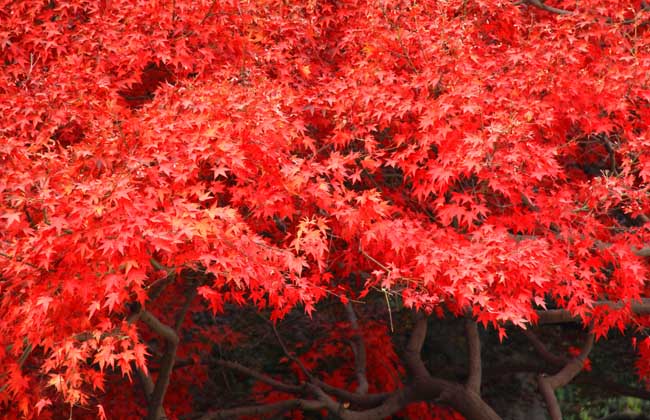
The red maple, also known as the red-leaf feather maple, is a variant of Acer palmatum in the Aceraceae family. It is a subtropical tree species that prefers humid, warm climates and cool environments. It is relatively shade-tolerant and cold-tolerant, and dislikes scorching sun exposure, but can grow in full sunlight in spring and autumn. It is not demanding about soil and is suitable for growing in fertile, humus-rich acidic or neutral sandy loam. Let's take a look at the red maple planting methods below!
The planting value of red maples
1. Ornamental value: The red maple is a very beautiful foliage tree species, with elegant leaf shapes, bright and long-lasting red color, neat branch arrangement, clear layers, well-spaced structure, and a beautiful tree form, giving it very high ornamental value.
2. Beautifying the environment: The branches and leaves of the red maple are purplish-red, brilliantly eye-catching, and highly ornamental. It is an important colored tree species in our country and is widely used as an ornamental tree in garden green spaces and courtyards, mainly planted as specimens or scattered plantings. It is suitable for placement in the center of lawns, in front of and behind tall buildings, at corners, and other locations, where red leaves and green trees set each other off beautifully. It can also be grown as a potted plant shaped into exposed-root, rock-clinging, cliff-hanging, dry-trunk and other forms, elegant and distinctive.
3. Soil and water conservation: The red maple's leaves gradually change color every autumn and winter. When planted in patches on hillsides and other places, it brings great ornamental value in autumn, and planting trees also plays a big role in preventing soil erosion and maintaining the ecological environment.
Cultivated varieties of red maples
1. Chinese red maple: Chinese red maple, also known as red-leaf feather maple, is a variant of Acer palmatum in the Aceraceae family. It is a deciduous small tree with a height of up to 9 m. It likes light but dislikes scorching sun exposure, and also likes warm, humid climates and deep, fertile soil. It is not tolerant of waterlogging, slightly drought-tolerant, and relatively cold-tolerant, and can overwinter outdoors in most areas of our country.
2. Japanese red maple: Japanese red maple, also known as Japanese red ribbon, is hailed as the "four-season flame maple". It belongs to the genus Acer in the Aceraceae family and is a deciduous small tree or shrub. Its leaves are red in all three seasons of spring, summer and autumn, and some varieties are extremely brilliantly colored. In summer, as light intensity increases, leaf photosynthesis increases accordingly, and the leaves gradually tend to turn green. The effect is already not as good as in spring. In autumn, new leaves can remain red but have already darkened, while old leaves have already turned dark green. The Japanese red maple tree is relatively small and is generally used for landscape greening.
3. American red maple: American red maple, also known by other names such as flower maple, northern red maple, North American red maple, swamp maple, Canadian red maple, red sugar maple, and scarlet maple, is a deciduous tree in the genus Acer of the Aceraceae family. In spring, new leaves take on a reddish tint, setting each other off beautifully with strings of red flowers. In summer, branches and leaves form shade. In autumn, the leaves turn a brilliant red that lasts for a long time.
Red maple propagation techniques
1. Cutting propagation: Red maples can be propagated by cuttings. This method is especially best used when making small bonsai or potted plants. Cuttings are generally taken during the plum rain period from June to July. Select vigorous current-year shoots about 20 cm long as cuttings, quickly dip them in 1000 ppm naphthaleneacetic acid powder, and insert them into a substrate of vermiculite or a half-and-half mixture of perlite and pond mud. Afterward, pay attention to shading and spraying water to maintain moisture. After about 1 month, they will gradually take root. If full-light misting conditions are available, choosing 2-year-old branches can also produce roots, with a high survival rate. After transplanting, shading is required. After half a month, they can gradually receive sunlight, and water and fertilizer management should be strengthened.
2. Seed propagation: Red maple seeds have no dormancy and can be sown in either autumn or spring. Here we mainly introduce spring sowing. The suitable sowing time is from mid-March to mid-April. Before sowing, first mix the seeds evenly with moist sand at a ratio of 1:3, and place them under conditions of 3-5°C for one month of low-temperature sand storage treatment. During stratification, regular inspection and management are required. If germinating seeds are found, sow them promptly. When sowing, first irrigate the seedbed thoroughly with bottom water, wait for the water to seep down, then sow, with about 200 seeds per sq m. After sowing, cover with 0.5 cm of fine soil. To preserve moisture, raise soil temperature, and make the seeds sprout early and evenly, cover with plastic film or a small arched shed. The arched shed should be ventilated, and appropriate shading should be provided when the temperature exceeds 30°C at noon. Generally, all seedlings emerge about 15-20 days after sowing.
3. Grafting propagation: Red maples can be propagated by grafting. Use 2-4 year old Acer palmatum seedlings as rootstock. Cut grafting is suitable from March to April, and the rootstock height can be determined as needed. Approach grafting is carried out during the plum rain season from May to June, and the scion is cut off after leaf fall in autumn. This method is only used for a few precious varieties. Bud grafting is the most commonly used, with the best times being from late May to late June each year and from late August to late September after autumn. Early summer is a period of vigorous shoot growth. Use plump buds on current-year sun-facing vigorous short branches of red maple, with a 1 cm long leaf stalk, as grafting buds. After grafting, the temperature gradually rises. Although the graft is tied with plastic tape, the buds and leaf stalks are still exposed. In addition, the red maple bark is relatively thin and the grafting buds are small, so after grafting, regular misting should be carried out to maintain moisture and improve the survival rate. The method of bud grafting after autumn is basically the same. One week after grafting, if the leaf stalk falls off at a touch, it indicates that the graft has survived; otherwise, it needs to be re-grafted.
Red maple planting methods
1. Soil selection: It is not demanding about soil and can adapt within a soil pH range of 5.5-7.5, so it can grow in slightly acidic soil, neutral soil and calcareous soil. It is suitable for growing in fertile, humus-rich acidic or neutral sandy loam.
2. Water management: Red maples like moisture during growth, but aside from sufficient watering in summer, watering at ordinary times should not be excessive. It is best to keep the potting soil moist regularly, which helps maintain a beautiful tree form.
3. Light management: Red maples like warmth and can receive full sunlight in spring and autumn. After summer begins, they should be moved to a semi-shaded place to avoid direct scorching sun at noon. During dry, high-temperature periods, water should be sprayed appropriately to lower temperature and increase humidity.
4. Temperature control: Although red maples like warmth, they are still relatively cold-tolerant. In the Yellow River basin area, even when winter temperatures drop to -20°C, they can still overwinter outdoors as long as the environment is good. As for areas north of the Yellow River, they are better grown as potted plants and brought indoors in winter.
5. Timely fertilization: From May to August each year, apply dilute cake fertilizer water once a month to red maples. From September onward, switch to liquid fertilizer mainly based on potassium fertilizer, such as a 1% potassium sulfate solution or wood ash extract, to help the leaves turn red and brilliant.
6. Pest and disease control
① Underground pests such as white grubs and mole crickets gnaw on seedlings and the base of stems, easily causing seedling death. Root drenching can be done with a 1000-fold dilution of Lorsban or a 1000-1200 fold dilution of 50% phoxim emulsifiable concentrate.
② Pests that eat branches and leaves, such as scarab beetles, stinging caterpillars, and aphids, often feed on the leaves of Japanese red maples, causing poor seedling growth. For aphids and adult scarab beetles, a 1200-1500 fold spray of 10% imidacloprid powder can be used, and for stinging caterpillars, pyrethroid pesticides can be used for control.
③ Borer pests such as longhorn beetles and heart borers damage the branches and trunks of Japanese red maples, causing large Japanese red maple trees to have dead branches and even the whole plant to die. During the peak emergence period of adult longhorn beetles (June to July), spray the tree crown with a 1500-2000 fold dilution of 4.5% beta-cypermethrin, spraying once about every half month, for 2 consecutive sprays, or inject pesticides such as dichlorvos or Lorsban into the branches and trunks from the pest tunnel openings and seal the openings with sticky mud.
④ Diseases include brown spot disease, powdery mildew, rust disease, and others. One- to two-year-old Japanese red maples rarely have pests and diseases. Japanese red maples with a trunk diameter of more than 3 cm often suffer fungal infection from May to June each year. The symptoms are leaf tips curling backward and turning white, dark red spots on the leaf surface, perforation after sun exposure, and by September to October only leaf veins and leaf stalks remain, or even the whole leaf withers, young shoots dry up, leaving only branches, and the whole plant dies in the cold seasons of winter and spring. Some also die after leafing out in spring.