How to grow a maple bonsai? Teaching you the correct cultivation methods
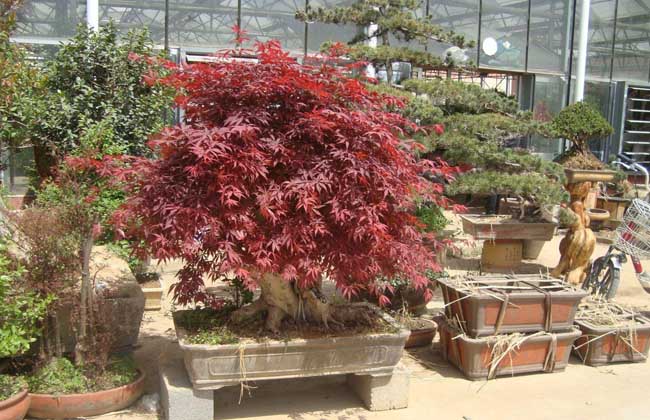
Maple is a famous landscape tree, with a graceful and beautiful form, and is an excellent material for making bonsai. In making a maple bonsai, besides the processing methods, what matters more is the choice of tree form and the original natural shape, and it takes a certain amount of time to shape it. Every maple bonsai should have its own characteristics. Let us take a look at the maple bonsai cultivation methods below!
Maple bonsai tree form creation
There are many wild maples. For making bonsai, old stumps or young trees are mostly dug up from the mountains and fields. The new branches are relatively long and soft, and can be wired and bent into many styles of bonsai. Common ones include the straight-trunk style, slanted-trunk style, curved-trunk style, double-trunk style, waterside style and forest style. The shaping is mainly by pruning, supplemented by wiring. The leaves are relatively large, so it is not suitable to make them into cloud-pad or cloud-cluster shapes; instead, the branches and leaves are often pruned into a natural style with coordinated heights and proper spacing. After frost, the maple leaves turn red, bright and eye-catching, and delightful.
Pots for planting maple bonsai
1. Planting: Maples should be planted in February to March before spring bud break. Before planting, the branches and roots should be pruned once, and at the same time half of the old soil should be removed and replaced with new soil, and decomposed bean cake should be applied at the bottom of the pot as base fertilizer. Maples like loose, fertile and moist soil, and grow poorly in barren land. For planting maples, 2/3 humus soil mixed with 1/3 sandy soil can be used.
2. Pot selection: The leaves of most maples turn from green to red after frost in late autumn, so when choosing a pot, be careful not to use purple clay pots or glazed ceramic pots in red or green. For forest-style maple bonsai, a shallow pot of white marble or marble can be used, and the pot soil can be shaped into an uneven natural mountain-and-field form. If a few pieces of turtle-vein stone or Yingde stone are placed at appropriate spots on the pot surface, dotted with a few small figurines of people or animals, the bonsai will have a stronger sense of life.
Maple bonsai care and management
1. Location: Maples like a shady and cool environment and avoid strong direct sunlight, so the bonsai should be kept under a shade shed or under other trees. If placed in strong light or on a balcony, leaf scorch often occurs. Because indoor ventilation is poor, a maple bonsai should not be kept indoors for more than one week, otherwise it is unfavorable for growth. In winter in the north, the maple bonsai should be moved into a low-temperature room, while in the south it is enough to bury the pot in wind-sheltered, sun-facing soil for it to overwinter safely.
2. Watering: Maple leaves are large and evaporate water quickly. During the growing season, water frequently. In hot weather, sprinkle water on the ground frequently to maintain the humidity of the microclimate. In winter, maples enter dormancy, so water less; as long as the pot soil is moist, it can be left unwatered.
3. Fertilizing: Before spring bud break and when the leaves unfold, apply one dilute decomposed organic liquid fertilizer each time, but do not fertilize on rainy days. In August to September, apply one dilute decomposed liquid fertilizer each time. Do not fertilize during the winter dormant period.
4. Shaping: Maples have strong sprouting ability and often produce new buds on the trunk. All buds not needed for the design and overly dense branches should be pruned in time. This not only saves nutrients but also helps ventilation and light penetration. The best viewing period for maples is when the new leaves have just unfolded. If all the leaves are removed in late summer and one dilute decomposed liquid fertilizer is applied, new leaves will grow in about 20 days, thus adding another best viewing period.
5. Disease prevention: Common diseases of maples include brown spot disease and powdery mildew. When disease occurs, spray with 800 to 1000 times dilution of 50% carbendazim wettable powder, once every 10 to 15 days, for 2 to 3 consecutive sprays. The main pests are the yellow slug moth and the glossy green longhorn beetle. For the yellow slug moth, control is generally done from late autumn to early spring by turning over the soil and digging out pupae to destroy them centrally, or by spraying 1000 times dilution of 50% fenitrothion emulsion in the early stage of larval occurrence. For the glossy green longhorn beetle, for eggs and larvae that have not yet bored into the xylem, spray the larvae on the trunk with 150 times dilution of 50% fenitrothion emulsifiable concentrate. For severely damaged young trees, cut them down at the base and burn them centrally, or inject 100 to 200 times dilution of 40% dimethoate emulsifiable concentrate into the bore holes, then seal the holes with mud; the effect is relatively good.