The Complete Guide to Maple Trees: A Comprehensive Look at Maples
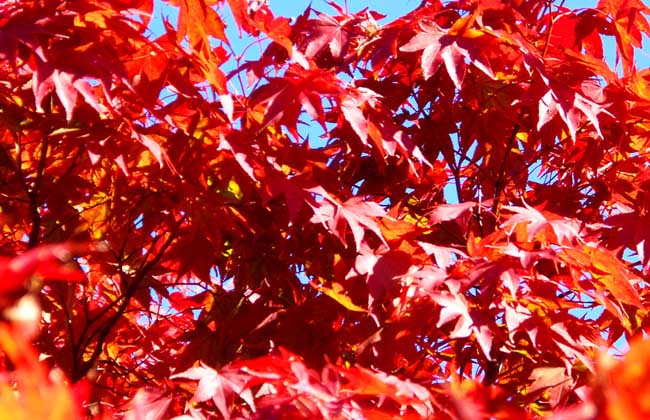
The maple tree belongs to the genus Acer in the family Aceraceae, and is the common name for certain species of Acer. There are 199 species of Aceraceae plants worldwide, and many plants in the genus Acer are world-famous ornamental trees, distributed across Asia, Europe, North America and the northern edge of Africa. China is also the country with the greatest variety of Acer species in the world, currently with 151 species, distributed throughout the country, mainly produced in the Yangtze River basin and the provinces and regions to its south, and is the modern distribution center of the world's maples.
Most maple trees are tall trees, reaching a height of 24 m, with a crown spread of up to 16 m. The flowering period is from April to May, and the fruiting period is from September to October. As the tree ages, the crown gradually opens up into a rounded shape. The branches are brownish-red to brown with small pores, and in winter the branches are dark brown or gray. Maple leaves are brilliantly colored and distinctive and elegant in form, and can be made into bookmarks, specimens, etc. In autumn they turn fiery red, and when they fall to the ground they become deep red.
Maple leaves are opposite, with a leaf rachis 9-17 cm long, pale grayish-brown, hairless, with 3 leaflets, rarely 5, papery, oblong-elliptic or long-ovate, 8-10 cm long and 3.5-4.5 cm wide, the apex long-acuminate, the base broadly cuneate, the margin slightly recurved and serrate, the upper surface dark green and hairless, the underside paler, with sparse white fine pubescence in the vein axils toward the base (on both sides of the midvein), otherwise hairless, the main vein prominent on both surfaces, the lateral veins 6-7, prominent on both surfaces together with the reticulate veins, the lateral petiolules [text unclear], the middle petiolule 2.5-3.5 cm long.
The maple's raceme is axillary, with numerous flowers, the pedicels 9-15 mm long, with small stipules, the stipules linear, the flowers 9-12 mm long, the calyx 5, linear-triangular, 7-9 mm long, about 9 mm wide at the base, hairless on both surfaces or sparsely pubescent at the base on the outside, the petals 5, inserted on the edge of the disk, spatulate, about 9 mm long, hairless on both surfaces, the stamens 5, opposite the petals, inserted at the inner base of the petals, the filaments about 7 mm long, hairless at the base, the anthers about 2 mm long, the styles 3, about 7 mm long (including the ovary), very sparsely white-pubescent at the base, the stigma capitate, the ovary 1-locular, with numerous ovules.
There are many species and cultivars of maple trees, and their habits are not all the same. In garden applications, reasonable cultivation should be adopted according to the suitable environment of each place. For example, species with red or yellow new leaves in spring should generally be planted in a relatively shady, moist and fertile place to avoid direct sunlight and leaf shrinkage, while those with red leaves in autumn should have sufficient sunlight. They grow well in full sun and are suited to full shade and moist to dry, well-drained soil. They require a soil pH of less than 7.0 (acidic). They can tolerate clay and acidic soil.