How to grow Nepenthes (pitcher plants) best? Detailed care methods and tips
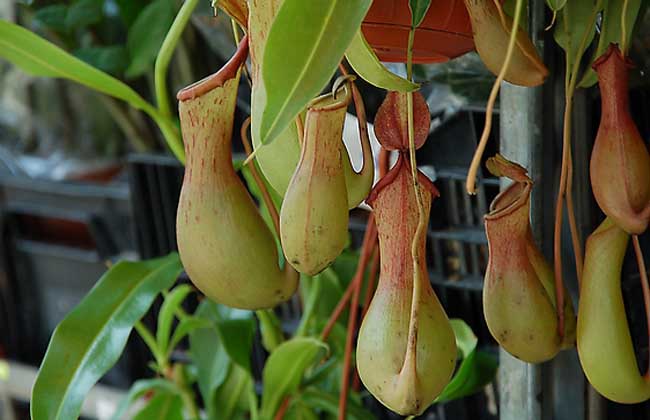
Nepenthes, also known as water-pitcher plant, monkey water bottle, piglet cage, Leigong pot and so on, is the general name for all species of the genus Nepenthes. It is a tropical carnivorous plant, native mainly to the tropical regions of the Old World. It is named for its unique nutrient-absorbing organ, the pitfall trap (cylindrical, slightly swollen in the lower half, with a lid on the mouth of the trap, shaped like a pig cage). Now let's take a look at how to grow Nepenthes!
Nepenthes propagation methods
1. Cutting propagation: Cutting propagation of Nepenthes is best done in late spring and early summer each year. Take thick, sturdy branches from well-grown plants, cut 2-3 nodes or 1 leaf with a section of stem node as the cutting, cut the leaf in half, cut the base into a 45° slant, wrap the base of the cutting with sphagnum moss, place it in a cutting pot containing sphagnum moss with small pebbles at the bottom, and cover both pot and cutting with a large plastic bag, maintaining 100% air humidity and a high temperature of 30℃. Roots will form in about 3-4 weeks, and once the new shoots grow to 2.5-4 cm and produce 1-2 leaves, they can be potted.
2. Layering propagation: Layering propagation of Nepenthes means taking thick, soft branches during the growing period, cutting into the stem section with a sharp knife, making the cut in a "V" shape, then wrapping it with wet moss or burying it in wet sphagnum moss or potting medium, pressing it firm and watering it thoroughly. If necessary, weigh down the stem section with a brick or stone to prevent the layer from lifting out of the medium. In about 1 month new roots will grow from the cut, and once the new shoots grow to about 4 cm, they can be cut from the mother plant and potted separately.
3. Seed propagation: Seed propagation of Nepenthes requires artificial pollination to obtain seeds, and they must be sown immediately after collection. Sowing is best done in seedling plug trays, placed in a greenhouse or small arch shed for growing. The substrate should be a mixed growing medium made of peat soil, vermiculite and perlite, with 1-2 seeds per cell. After sowing, cover with a layer of fine soil so the seeds are half-hidden and half-exposed, then spray water to make them thoroughly wet, and place them in a high-temperature, high-humidity environment. They will sprout in about 6-7 weeks.
Nepenthes growing conditions
1. The growing soil must be loose and breathable. You can use loose soils rich in humus such as sphagnum moss, peat soil, leaf mold and coconut coir. Nepenthes fears both drought and waterlogging, so the potting soil should always be kept moist. Nepenthes is best grown in hanging pots, which makes watering and misting easier and helps the potting soil breathe.
2. Nepenthes likes fairly acidic growing soil, requiring a soil pH between 4 and 4.5; outside this range it will not adapt. Therefore, do not water it directly with tap water from a hose; the water should be left to stand for a period before being used for watering, otherwise growth will stop or the plant may even die.
3. Nepenthes is a plant that grows in tropical rainforests, requiring relative air humidity between 75 and 85%, otherwise the plant will become smaller and smaller. If conditions are not adequate, you must mist it, 5-6 times a day. In dry weather, mist several more times.
4. In winter, be sure to do a good job of cold protection and heating. The indoor temperature must remain stable above 18℃ for the plant to survive the winter safely.
Nepenthes growing methods
1. Soil: A loose, fertile and breathable leaf mold or peat soil is best. For potted plants, a mixed substrate of peat soil, sphagnum moss, charcoal and fir bark shavings is commonly used.
2. Watering: Nepenthes is quite sensitive to moisture. It can only grow and develop normally under high-humidity conditions, and during the growing period it needs frequent misting, 4-5 times a day. If the temperature varies greatly or it is too dry, the formation of the leaf traps will be affected.
3. Sunlight: Nepenthes is an epiphytic plant, often growing under large trees or on the north side of rocks; its natural conditions are semi-shaded. Under strong direct sunlight in summer, it must be shaded, otherwise the leaves are easily scorched, directly affecting the development of the leaf traps. However, under long-term shady conditions, the leaf traps form slowly and small, and the colors on the trap surface are dull.
4. Temperature: The suitable growing temperature for Nepenthes is 25-30℃, from March to September 21-30℃, and from September to March of the following year 18-24℃. In winter the temperature should not be lower than 16℃; below 15℃ the plant stops growing, and below 10℃ the leaf edges suffer cold damage.
5. Fertilizing: Nepenthes does not need special fertilizing, because it can usually catch insects by itself and convert them into nutrients. If your Nepenthes has insects to eat, there is no need to fertilize.
6. Pests and diseases: Nepenthes often suffers from leaf spot disease and scale insect damage. For leaf spot disease, spray with a 1000-fold dilution of 50% zineb wettable powder. For scale insects, spray with a 2000-fold dilution of 40% dimethoate emulsifiable concentrate.
7. Pruning: The trap of Nepenthes is a modified leaf, so like the leaves of other plants it will also age and die. Generally speaking, under suitable conditions each trap can survive for several months. When it has withered, you can cut it off to make the whole plant look more attractive, but this is purely for appearance and has nothing to do with the health of the plant.