What are the key points of dahlia planting techniques?
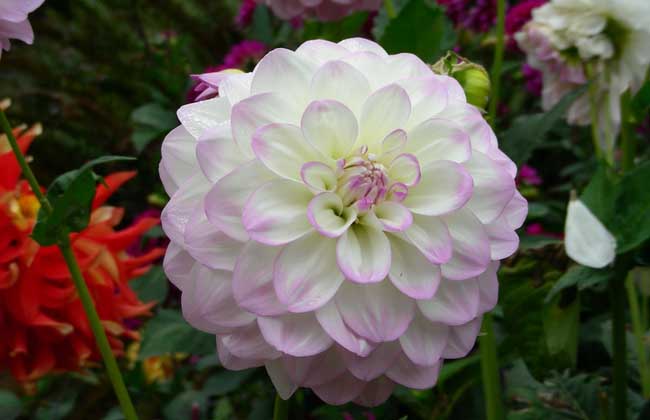
The dahlia is called one of the world's famous flowers mainly because of its long flowering period, large flower diameter and abundant blooms. In northern regions the flowering period runs from May to mid-November, and under suitable temperature conditions it can bloom continuously year-round, with the most profuse blooming after autumn. It is very suitable for flowerbeds, borders or clump planting in front of courtyards, and dwarf varieties can be grown as pot plants. Let us take a look at dahlia planting techniques below!
Dahlia Growth Habits
1. Light: Dahlia prefers partial shade; too strong sunlight affects flowering. The light duration is generally 10-12 hours, and direct sunlight should be avoided when raising seedlings.
2. Temperature: Dahlia likes a cool climate. Flowers blooming in late September are the largest, brightest and most profuse, but it is not tolerant of frost; after frost the stems and leaves wither immediately. During the growing period it is not strict about temperature and can grow at 8-35°C, with 15-25°C being optimal.
3. Water: Dahlia is not tolerant of drought or waterlogging. Generally for potted plants, water thoroughly when the soil looks dry, following the principle of "see wet, see dry." In rainy weather the pot can be tipped to drain (for ground planting, frequent watering is not necessary).
4. Soil: Dahlia is suitable for cultivation in loose, well-drained, fertile sandy soil.
Dahlia Root Division Propagation
1. Time: Dahlia root division propagation is usually carried out between March and April in spring.
2. Sprouting: Dahlia only has buds on the root crown, so each divided tuberous root must have a root crown with buds. Tuberous roots without a root crown or without bud points on the root crown will not sprout and cannot be planted. If the sprouting points on the root crown are not obvious or hard to identify, sprouting can be forced in early spring in advance: arrange the root clusters at relatively close spacing in a hotbed, then mound soil, water, and provide a certain temperature. After sprouting, divide them so that each division has at least one bud.
3. Planting: Take out the stored tuberous roots, cut off each tuberous root together with the buds attached to the root crown (apply plant ash to the cut surface for antisepsis), and plant them separately.
4. Advantages: Division propagation is simple and easy, with a high survival rate and robust plants, but the propagation coefficient is not as high as that of the cutting method.
Dahlia Cutting Propagation
1. Site selection and land preparation: Choose a field with deep topsoil, loose and fertile soil, flat terrain and good drainage. Before deep plowing, apply 125 kg of superphosphate per mu as base fertilizer, plus 0.5 kg of 50% diazinon for soil disinfection. Deep plow the soil about 15 cm, then level and rake it, and make raised beds or flat beds 2 m wide with ditches 20 cm deep. Open the inner and outer "three ditches" well to facilitate drainage.
2. Cutting method: Usually from June to August, when the side buds grow to 15-20 cm, cut and insert them promptly while removing side buds. The cutting should have 3 buds; keep the upper 2 buds, cut the 3rd bud down to the leaf base and remove the leaf blade, insert into the soil to a depth reaching the second bud, water thoroughly, set up supports and use double-layer shading with 50% shade netting. On sunny days, water once in the morning and once in the evening, watering continuously for half a month, keeping soil moisture at 90%. Roots form after 3 weeks, the survival rate is very high, and they can bloom in the autumn of the same year.
3. Post-cutting management: After the cuttings survive, in combination with intertillage and weeding, apply a saturated extract of compound fertilizer once before flowering and once after flowering. For each backpack sprayer (about 12.5 kg), add 400 ml of stock solution for foliar topdressing. After dahlia roots form, deep intertillage is not advisable, so as to avoid damaging the tuberous roots and to prevent weed damage. Because the plant is juicy and soft, supports must be set up to prevent the stems and leaves from breaking. For small-flowered varieties, pinch the top when the seedlings are 15 cm tall to make the plants short and sturdy with more flowers. Remove spent flowers promptly to prolong the flowering period.
Dahlia Seed Propagation
1. Container selection: Choose a seedling tray 50 cm long, 20 cm wide and 5 cm high. First rinse it with clean water, then disinfect it with 0.2% chlorine-free nitrobenzene.
2. Substrate preparation: Choose soil that is fine, uniform, free of stones, pollution-free, rich in nutrients and free of pests and diseases. Soil with good drainage and low salinity and alkalinity is preferable. The sowing substrate used is garden soil and peat; generally it is prepared from garden soil, humus soil and river sand in a ratio of 2:2:1, and disinfected with 2% quintozene or by high temperature.
3. Sowing time: Before sowing, wash the disinfected seedling tray clean with water, and sow immediately after the water seeps away. For hotbed sowing, sow in mid to late March; for flowerbed varieties, sow in the open field in late April. The seeds are all scattered on the soil surface. After sowing large seeds, cover them with moist fine soil, with a thickness of 3 times the seed diameter.
4. Film covering: After sowing, support and cover with agricultural film using bamboo poles, leaving gaps for ventilation, which helps raise soil temperature, reduce water loss, maintain soil moisture and reduce soil crusting. In this way the temperature and humidity needed for seed germination can be maintained. After sowing, place at 20-25°C. About 7 days after sowing, the seeds will begin to sprout. Keep the soil moist at all times. When the seedlings grow to 4-5 cm, prick them out, water thoroughly, place in a shaded spot for 3-4 days, then move them into strong light, and water timely to maintain soil moisture.
5. Post-sowing management: Water according to soil moisture conditions. Keep the soil alternately dry and moist. When the soil surface is slightly dry, use the soaking method to keep it moist. The suitable temperature for seed germination is 19-21°C. Ventilate frequently after sowing, which is beneficial for seed germination. Dahlia seed germination requires appropriate shading. After the seedlings emerge evenly, gradually remove the film and move the seedlings to a place with sufficient sunlight. Rotate the tray 180° every 2-3 days, which is beneficial for straight seedling growth.
Dahlia Planting Management
1. Pinching and pruning: First, keep a single bud to form a single plant so that it blooms early; after flowering, cut back leaving 1-2 nodes, and the new shoots that grow can continue to flower. Second, for varieties with poor branching, pinch the top at the young stage to promote branching, and cut back the plants from mid-July to early August, producing high-quality flowers in September-October.
2. Setting up flower netting: Generally, when the plant height is 20-25 cm, set up netting at 15 cm spacing. Fix the net at a height of 45 cm above the ground.
3. Temperature management: To advance flowering in early spring, cultivation in a greenhouse is possible. Keep the daytime temperature at around 25°C; when it exceeds 25°C, ventilation and cooling are necessary. When the nighttime temperature is below 10°C, the greenhouse temperature must be raised.
4. Flowering control: If blooming is needed in winter and early spring, sunlight and temperature must be controlled. Research shows that short-day conditions and low temperature are the main factors preventing dahlia flower bud differentiation. In winter, control the daylight to around 14 hours and keep the night temperature above 10°C to produce cut flowers with large blooms and bright colors.
5. Cut flower harvest: For dahlia, the suitable harvest time is when the flower is 3-4 parts open (2 parts open in summer). For the first batch of flowers in spring, cut leaving 2 nodes; for the second batch, cut leaving one node. Because dahlia cut flowers have poor water uptake, it is best to harvest in the morning or evening, and insert them into water immediately after harvest. After the tuberous roots are harvested, store them in a dry place; they can also be stored packed in wood shavings at 4.5-7.4°C.
6. Timely fertilization: Dahlia is a fertilizer-loving plant and must have a sufficient fertilizer supply, otherwise the flowers tend to become smaller, the color dull, and the ornamental value reduced. According to the growth situation, apply cake fertilizer 4-5 times as topdressing; light fertilizer is preferable. When the summer temperature exceeds 30°C, fertilization is prohibited.
7. Water management: Appropriately reduce the amount of watering, which helps control plant growth and promotes thick dahlia stems, shorter plants and larger flowers. In high summer temperatures, while basically meeting its water needs, spray water on the leaves as much as possible, at least twice a day, to make up for evaporation loss.
Dahlia Pest and Disease Control
1. Root gall disease
[Damage characteristics] Root gall disease is mainly caused by excessively wet soil, poor drainage and excessively high air humidity, which cause root rot and lead to slow plant growth, withered leaves turning from green to yellow, and even death.
[Control method] Water at the right time, loosen the soil and drain. A 1:1:100 Bordeaux mixture 2.5 kg plus 10 g of Ceresan can be used to water the potting soil for disinfection, with a dosage of 1 kg per sq m.
2. Brown spot disease
[Damage characteristics] Most affected plants are also harmed by red spider mites at the same time. The leaves have brown spots until they turn grayish-brown and die.
[Control method] Spray 0.5°Be lime sulfur mixture, or spray 65% wettable zineb 500-fold solution.
3. Powdery mildew
[Damage characteristics] Powdery mildew is a common disease of flowering plants. Powdery spots form on the underside of leaves and spread to the entire leaf; in severe cases they can cause the leaves to wither and fall.
[Control method] Remove diseased leaves promptly. Spray 0.2-0.3°Be lime sulfur mixture, or spray 40% folpet 500-fold solution.
4. Gray mold
[Damage characteristics] Gray mold, also called flower rot, is the main disease of dahlia and is most severe in the rainy season. It first develops on the leaves, and the lesions often occur at the leaf margins; in high humidity, gray mold grows. The stem lesions are brown and irregular, and in severe cases the stem softens and breaks down.
[Control method] Promptly cut off diseased flowers, leaves and stems and burn them in a centralized manner. In autumn or early spring, thoroughly remove diseased plant residues to reduce infection sources. Avoid planting too densely to facilitate ventilation and light penetration. After rain, pay attention to draining accumulated water. Spray 75% chlorothalonil wettable powder 500-fold solution, or 50% procymidone wettable powder 1000-fold solution, or 50% captan wettable powder 1000-fold solution, spraying once every 10 days or so, for 3-4 consecutive sprays.
5. Mosaic virus disease
[Damage characteristics] Dahlia mosaic virus disease is the most widespread and most severe. It mainly spreads through virus-carrying tuberous roots, aphids and leafhoppers. Affected leaves develop patterned markings, and the veins and areas nearby turn light green. Diseased leaves develop poorly and affect flowering; in severe cases the plant becomes wrinkled and stunted.
[Control method] Use virus-free propagation material to reduce infection sources. Use virus elimination and tissue culture methods to propagate virus-free seedlings, and after planting promptly control virus-transmitting insect vectors. Pay attention to field sanitation to reduce sources of virus infection. Spray 50% malathion 1000-fold solution, 40% dimethoate 1500-fold solution, or 25% carbaryl 800-fold solution.
6. Fruit-boring worm
[Damage characteristics] The fruit-boring worm mainly has larvae that bite and feed on dahlia tender leaves and flower centers, and is severe in summer. The larvae bore into the stems, gnawing them off and causing the plant to die, then move to another plant to cause damage.
[Control method] Promptly dispose of diseased plants. Spray 4% parathion 1500-fold solution.
7. Aphids
[Damage characteristics] A common pest of plants in general.
[Control method] Spray 40% dimethoate 1000-1500-fold solution or 50% menazon 1000-fold solution.
8. Red spider mites
[Damage characteristics] They harm the leaves, causing the leaves to turn yellow and fall, and even the whole plant to die.
[Control method] Spray water on the leaves, or spray 40% dimethoate 1000-1500-fold solution.
9. Dahlia borer moth
[Damage characteristics] The dahlia borer moth, also known as the corn borer or stem borer, has larval damage periods occurring from June to mid-July and from mid-August to October, and is especially severe in August and September, which happens to be the dahlia flowering period.
[Control method] When the pest damage is light, prune the affected plants and collect and destroy the larvae in a centralized manner to prevent spread. During the larval hatching period, spray 50% fenitrothion emulsion 1000-1500-fold solution for control. For older larvae that have already bored deep inside, use an injection needle to inject 200-500-fold fenitrothion solution into the bore hole.