How do succulents get through summer safely? Professional-level care tips to share
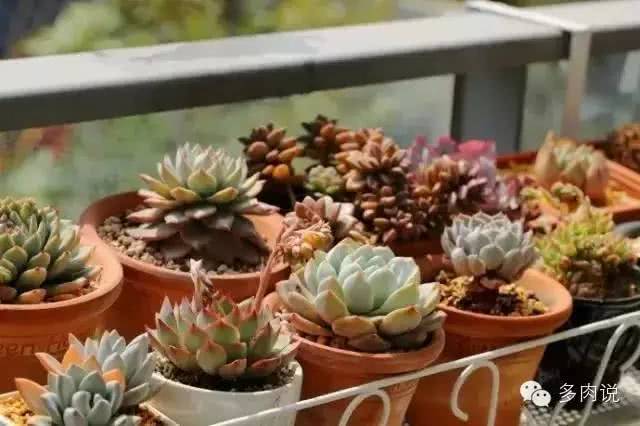
As for the issue of getting through summer, first of all everyone should take it easy and not put too much pressure on themselves internally. We all want to raise plants healthily, and of course death is unavoidable too. What we can do is simply provide environmental conditions suitable for their survival and growth.
MostCrassulaceae plants grow on the west coast of North America, South Africa, and southern and western Australia,and most sedum plants are not really afraid of heat; what they fear is high heat combined with very high humidity. So since environments differ, we can onlymake conditions as similar as possible to their native growing environment, strictly control water, strengthen ventilation, and run the air conditioner to reduce humidity -- these are the things friends in the south need to do to get through summer。
Summer survival tips
1
Purchasing
You can start buying plants in early spring, giving them ample time to develop good roots before summer. Forfolks in the northit is not much of a problem, thoughit is best to finish before mid-June.Folks in the south,temperatures get fairly high around mid-May, so it is better to make your purchase plan before then, giving the plants half a month to a month to recover and grow roots.For purchasing rootless seedlings, it is not advisable to do so later than May. Rooting takes about half a month to a month, and after rooting the roots still need to develop to supply nutrients for the plant to recover its condition. Generally speaking, southern folks should complete purchases of rootless plants before May. Try to buy small seedlings rather than old clumps; small seedlings are usually leaf-propagated or seed-grown, with newer roots and greater vitality.
2
Soil mix
Most Crassulaceae plants grow faster in spring, autumn and winter, and in summer they mainly just get through it safely,so the soil mix should take into account the characteristics of southern weather; where humidity is especially high, the soil's breathability and drainage should be enhanced. Generally choose granular soil. Common granular soils on the market include akadama, hyuga stone, kanuma soil, perlite, pumice and Oya stone, etc. Reduce the proportion of peat and vermiculite, etc. Of course, during the spring growing season you can ensure a combination of peat and compound fertilizer, and when preparing for summer you can switch to a mix dominated by granular soil media. For the date to complete the soil change, you can refer to the timing in suggestion one, which also ensures time for the plants to recover.
3
Ventilation and water control
Try to place plants in a well-ventilated spot to ensure fresh air circulation; shade netting can be used as appropriate.In early summer and late summer you can use 75% shade netting, and when the sun is especially intense you can use 50% shade rate. When the plum rain season brings days without sun at all, you can remove the shade netting and mainly strengthen ventilation. During this period you should generally control water or cut it off entirely; when air humidity is high, keeping the plant's roots dry and letting it absorb only moisture from the air is enough to keep the plant alive.For ventilation you can use an electric fan; this is easy to solve. The dehumidifying function of an air conditioner is also a lifesaver during periods of high humidity or high temperature and high humidity.
If there is continuous high temperature but dry air,you can water in the evening or at midnight; the potting soil needs to be dry, and the mix should be mainly granular.If there will be no continuous rainy weather in the coming days and good ventilation is guaranteed, you can supply a small amount of water along the pot wall; in principle, as long as the soil can dry quickly, you can provide a small amount of water. When watering in the morning and at noon, or when the potting soil is at a high temperature, be careful not to let the temperature difference be too great. Also note that in summer you should not water until it runs through, and do not let water droplets remain on the plant's leaves or the growing point at the center. According to friends in the south, terracotta pots are better for getting through summer than other materials; at most, when getting through summer you can switch to terracotta with granular soil, and after summer switch back to other materials and mixes -- it is just a bit more troublesome.
4
Old clumps
The purchase date for old clumps should be slightly earlier than the timing in suggestion one. It is not advisable to plant purchased old clumps directly without root trimming; old roots often contain a large number of fine feeder roots mixed with a lot of soil impurities and bacteria. The stems and roots of old clumps are heavily lignified, so dry old leaves should be removed promptly to keep the potting soil clean, in order to prevent rot and the breeding of pathogens. If the old roots are excessive, you should trim away the surplus fine feeder roots, remove soil impurities from the roots, and keep part of the main root. After trimming, let the wounds dry thoroughly, and replant in soil only after new roots have emerged.
5
Leaf propagation as backup
Learn to do leaf propagation yourself as a backup, so that if one dies there is still a replacement. When signs of black rot appear, promptly behead the plant and pull off leaves; the more timely and thorough, the better the result. At the same time, after black rot appears, promptly review the cause to avoid it spreading.
6
Using chemicals
Use chemicals as little as possible. Especially if there are children, elderly people or pregnant women at home -- no matter how good the plant is, it is not as important as the health of your family and friends and your own. Know what matters more.