What are the appraisal standards for cypress root carving? Explained clearly in one article
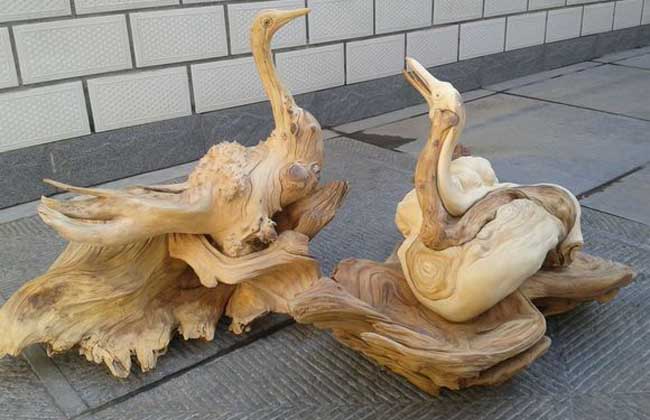
Cypress is a type of cypress tree. What is called cypress handicraft on the market is actually Chinese arborvitae (Platycladus orientalis) rather than the botanically recognized cypress. Because cypress survives in extremely small quantities and has naturally marvelous forms and beautiful natural textures, with oil content and hardness both being top choices, it is the foremost material for root carving. Therefore, cypress root carving, as the crown of root carving, enjoys great fame in the collectors' world. Now let us take a look at the appraisal standards for cypress root carving!
Artistic conception
Root carving stresses the unity of heaven and humanity, with intention preceding the knife. A piece of cypress root carving with collectible value must have been fully conceived before production, able to make good use of the characteristics of the raw material, express the creator's intent, and even elevate to a certain cultural connotation, or even a work that carries forward the essence of root carving culture. It is by no means purely a display of knife skill or a simple showcase of material, but must have a spiritual foundation originating from tradition and containing culture. Only in this way can a good-looking root carving be elevated into a root carving worth looking at again and again.
Form
Cypress forms are endlessly strange and varied. Some wind upward, some spiral and turn back, some fold and drift elegantly, some embrace the origin and hold to the one, and some stretch out in all directions. Each piece is a unique natural creation, a gift from the gods, a trace left by the years, and a witness of time.
Carving skill
Smooth cutting that does not stall on the material is the foundation for creating a fine root carving. The opening of a figure's face, the hair strands, the handling of hands and the corners of clothing, and the expression, momentum, and hair of animals all need good carving skill as a foundation.
Color
After polishing, cypress colors are roughly red and white. The white part is the part still growing, while the red is mostly the dead part, also called “wood sarira”. In terms of ornamental value, interwoven two colors should be the most pleasing visual enjoyment, but red maple like fire and white clothing like snow is also another kind of tranquil beauty. If the cypress is old enough, it will also show purple-black and deep black.
Fragrance
Cypress has a special fragrance different from other cypress woods. Breathe in slowly, and a trace of fragrance different from agarwood, sandalwood, dragon musk, and ambergris, a mellow richness precipitated by time, seeps into the heart and spleen. The fragrance of cypress feels leisurely and is closely related to age. The older it is, the more mellow and sweet-returning the fragrance becomes.
Texture
The patterns of cypress are endlessly strange and varied. Some show exaggerated beauty on a large scale, while others show peculiar patterns on a small scale. There is no duplication and no copying. The patterns are comparable to Hainan yellow rosewood, and particularly beautiful back-shaped patterns, twisted patterns, douban patterns, bodhisattva patterns, cloud-sea patterns, and so on often appear. As for S-shaped lines, they are practically a normalized feature.
Completeness
A very important point for cypress root carving is completeness. The degree to which the material is cut with knives and saws after being taken down from the cliff, and the degree of damage, will seriously affect its collectible value. Simply put, if apart from the minor carved parts, the rest of the root carving is very complete, then its value is certainly far higher than a work carved from raw material that has been cut off in many places.
Oil content
Growing on cliffs for hundreds and thousands of years, tested by wind, sun, ice, frost, snow, and rain, cypress is forced to internalize its essence and concentrate it within its body, so its density is extremely high and its oil content is also extremely high. However, improper handling during collection and production may cause part of the oil to dissipate (for example, being exposed outdoors after collection), leading to reduced oil content and lower quality.
Age
Generally, the older the better, because the greater the growing age, the more it has withstood the test of time, and the more it compresses and contracts inward, further increasing its density and oil saturation, and correspondingly the fragrance also becomes better. By looking at the cross-section, with growth rings as fine as hair strands and impossible to count clearly, one can know that it is no empty saying that cypress grows for a thousand years or even several thousand years. Otherwise, the old saying would not have the phrase “a thousand-year pine, a ten-thousand-year cypress.”
Special features
As the name suggests, these are the outstanding places that distinguish it from other cypress pieces. Usually there are several relatively distinctive types: tree burls, root embracing stone, a relatively large number of twisted rings, extremely large folding angles, and so on. Cypress tree burls are relatively rare, especially full-tree burls, which are even more precious. Tree burls include red tree burls, white tree burls, and also cases where red and white tree burls grow together. Root embracing stone is due to the special growing environment of cypress, often with much stone and little soil, so occasionally there is the phenomenon of stones mixed into the roots. Because it sometimes carries the meaning of a turn of fortune, it is often highly sought after. Materials with a relatively large number of twisted rings and extremely large folding angles naturally have a great advantage in ornamental value, and fully embody the harsh growing environment of cypress and its spirit of persistent upward striving.