How to plant clover? It's easy once you master these planting methods
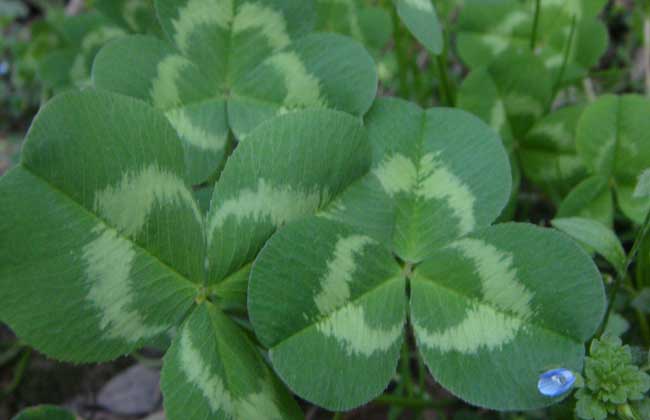
Clover (the four-leaf clover is a rare variant of plants in the genus Trifolium, symbolizing the lucky clover) is the general term for various herbaceous plants that have trifoliate palmate compound leaves. It is also called white clover, white trefoil, Dutch clover, etc. It has three leaves and is very cute and likable. Let's take a look below at how to plant clover!
Clover growing habits
Clover likes warm, sunny conditions and well-drained environmental conditions. It is not strict about soil requirements and can adapt to various soil types. It grows well in slightly acidic soil and has strong cold resistance. When the temperature drops to 0°C, some old leaves turn yellow and withered, and the small leaves on the main root cling close to the ground and stop growing, but the other leaves remain green. Under strong shading, it tends to grow leggy, causing poor growth. It has strong resistance to harmful gas pollution and strong resistance to pests and diseases.
Clover propagation by sowing
1. Sowing time: Clover can be sown in spring or autumn. In spring, it is in late March, and in autumn, it is in mid-September. In the south, autumn sowing is mainly used, while in the north, spring sowing is mainly used. It can also be sown in summer, but after sowing, the surface soil must be kept moist or covered with mulch for shade. The sowing rate of clover is preferably 8-10 grams per sq m. Each gram of clover has 1400-2000 seeds. Theoretically, 1 seed per square centimeter of soil can meet the need for forming a lawn. The actual sowing rate is larger than the theoretical sowing rate.
2. Sowing method: When sowing clover, divide the seeds equally according to the plot area and the determined sowing rate, mix the seeds evenly with dry soil or fine river sand, and broadcast by hand. If building a lawn over a large area, a cyclone seeder can be used for broadcasting. The sowing depth is 1-1.5 cm. After the seeds are broadcast onto the seedbed, a lawn rake can be used to rake the seeds into the soil, or fertile soil or substrate can be used to cover them by 1 cm.
Clover planting methods
1. Soil selection: Clover seeds are tiny, the seedlings are slender and weak in emerging from the soil, and growth at the seedling stage is extremely slow. Before planting, deep plowing and turning of the soil are needed, the ground should be leveled, and soil clods should be broken up fine so that the sowing layer soil is loose and level.
2. Timely fertilization: Clover itself has nitrogen-fixing ability, but at the seedling stage, rhizobia have not yet formed, so a small amount of nitrogen fertilizer should be supplemented to help strengthen the seedlings. Additional application of phosphorus and potassium fertilizer has a good yield-increasing effect. After clover grows larger, only phosphorus and potassium fertilizer need to be supplemented.
3. Maintenance and management: Clover has relatively high requirements for soil moisture. Where irrigation conditions are available, irrigate when the soil is dry or in combination with topdressing. For clover lawns that have grown for more than 2 years, the soil layer is compact and poor in aeration. Before turning green in spring and autumn and before regrowth after grazing and mowing, harrow and loosen the soil, and combine loosening the soil with topdressing to facilitate the growth and development of new buds and new roots.
4. Pest and disease control: Clover has few diseases, but if harvesting is not timely, brown spot and powdery mildew sometimes occur. It can be cut and used first, then controlled with Bordeaux mixture, lime sulfur mixture, or carbendazim, etc. Stems and leaves are easily harmed by scale insects, which can be sprayed and killed with a 1000-fold solution of 40% omethoate emulsifiable concentrate.