Teach you the correct method for sowing clover seeds
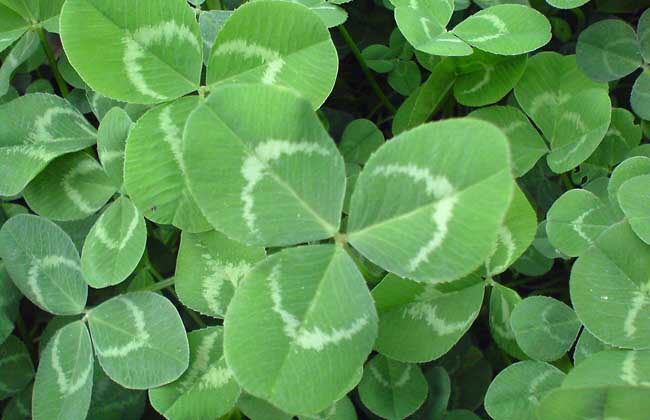
Clover (the four-leaf clover is a rare variant of plants in the genus Trifolium) is a general term for various herbaceous plants that have trifoliate palmate compound leaves, mainly including certain species in the genus Trifolium and the genus Medicago of the Fabaceae (legume) family, as well as the genus Oxalis of the Oxalidaceae family. Propagation is mainly by seed sowing. Let us take a look below at the method for sowing clover seeds!
Clover sowing time
Clover can be sown in spring or autumn, in late March for spring and mid-September for autumn. In the south, autumn sowing is predominant, while in the north, spring sowing is predominant. It can also be sown in summer, but after sowing the surface soil must be kept moist or covered with mulch for shade. The sowing rate for clover is suitably 8-10 grams per sq m. Each gram of clover has 1400-2000 seeds. Theoretically, 1 seed per square centimeter of soil is enough to meet the needs of forming a lawn, and the actual sowing rate is greater than the theoretical sowing rate.
Clover sowing method
When sowing clover, divide the seeds equally according to the plot area and the determined sowing rate, mix the seeds evenly with dry soil or fine river sand, and broadcast by hand. If establishing a lawn over a large area, a cyclone seeder can be used for broadcasting. The sowing depth is 1-1.5 cm. After the seeds are broadcast onto the lawn bed, a lawn rake can be used to rake the seeds into the soil, or fertile soil or substrate can be used to cover them by 1 cm.
Management after clover sowing
1. Management before lawn formation: Clover grows slowly at the seedling stage. After the seeds are sown onto the lawn bed, if a sprinkler irrigation system has been installed in advance, sprinkler irrigation can be used; if there is no sprinkler irrigation system, a homemade nozzle can be used for manual spraying irrigation. Spray every morning or evening, always keeping the surface of the lawn bed moist until emergence. After emergence, the number of waterings can be reduced, but careful management is still needed. Seedling-stage management lasts about 30-50 days. During this period, in addition to paying attention to watering to keep the lawn bed moist, weeds must also be removed at any time, mainly by hand pulling, to prevent weed damage.
2. Management after lawn formation: Because clover has strong invasiveness, intertillage and weeding are not needed. Since nitrogen-fixing rhizobia can absorb nitrogen from the air and convert it into a form usable by plants, fertilization should mainly be phosphorus and potassium fertilizer, with no or little nitrogen fertilizer. During the peak growth season and overwintering, sufficient water must be supplied to ensure vigorous growth and safe overwintering. Before midsummer, mowing can be carried out once, and water should be applied sufficiently to keep the plants green. Before overwintering, mow once more and apply enough winter water. In this way, when growth resumes the following year, there will be no withered yellow branches and leaves on the lawn surface. It has strong resistance to pollution and pests and diseases, and there are relatively few pests and diseases. When pests such as leafhoppers, weevils, and cutworms are found, dimethoate, dichlorvos, and similar pesticides can be used for spraying to kill them.