How to Grow Guzmania (Firecrown Bromeliad)? Detailed Guide to Care Methods and Precautions
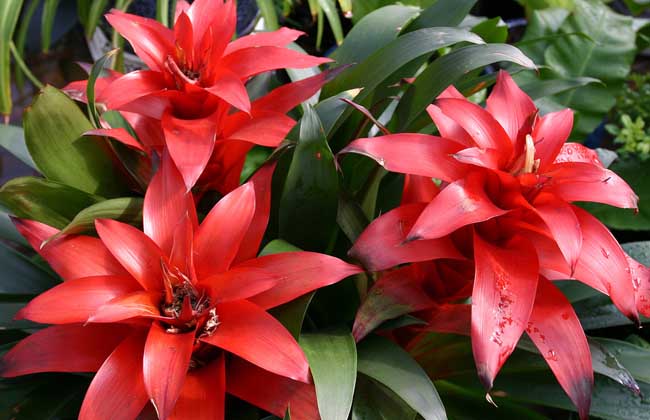
Guzmania is a flowering plant in the Bromeliaceae family, also known as Mitou, cone-shaped Guzmania, torch bromeliad, and so on. Because its flower core is bright red, it is called "Hongyun Dangtou" (Good Fortune Arrives). Its leaves are broad and strap-shaped, curving outward, dark green. The spike inflorescence is cone-shaped, with densely packed bracts, bright red with yellow tips. The flowers open at the top or middle of the plant. Let us take a look at the care methods and precautions for Guzmania below!
Propagation Methods of Guzmania
1. Division propagation: After the Guzmania plant blooms, 1 to several suckers will grow from the base of the mother plant. When the suckers grow to 1/3 to 1/2 the size of the mother plant, you can use a small knife to cut them off from the base of the shoot, remove the lower leaves, dry the cut surface, and insert them into a pot filled with an equal mix of leaf mold and plain sand. Under conditions of slightly dry potting soil, a temperature of 25 to 28°C, and a ventilated, humid environment, roots will form in about 12 to 15 days. After new leaves begin to grow, normal cultivation and management can be carried out. With division propagation, it generally takes 1 to 3 years of cultivation to bloom.
2. Seed propagation: Guzmania must undergo artificial supplementary pollination when flowering in order to set seed, and the seeds are very small. When propagating by seed, it generally requires the temperature to be stable above 16°C before sowing, and acidic potting soil should be used. After sowing, cover with chopped moss or plastic film to retain moisture. At a temperature of 25 to 30°C, seedlings will emerge 20 to 25 days after sowing. When the seedlings grow to about 4 cm, they can be divided into shallow trays, then transplanted as the seedlings grow, and finally planted into flower pots. Seed propagation generally takes 3 to 4 years to bloom.
Guzmania Care Methods
1. Light: If you want to see Guzmania with consistently bright leaf color and regular blooming, light plays an important role. In cold seasons, it needs at least 4 to 5 hours of sunlight per day. If it is cloudy, you can use artificial light instead of sunlight. It should not be exposed to strong sun, so in summer it should be placed in a shady spot.
2. Temperature: The suitable temperature for Guzmania is 15°C to 22°C. The minimum winter temperature must not fall below 10°C, otherwise the plant will suffer cold damage, the leaf color will turn yellow, and healthy growth will be affected.
3. Soil: Guzmania is suited to loose, fertile, humus-rich soil. Friends planning to grow it at home can choose 2 parts peat soil mixed with 1 part fine sand to make a growing medium. (Tip: Because many flower enthusiasts buy it with soil already, there is no need to change the soil, unless what you bought is the very small kind.)
4. Fertilizer: Guzmania's blooming period is in winter, and it requires sufficient fertilizer. Usually apply a dilute organic liquid fertilizer once every two weeks, such as soaked liquid of soybean cake or sesame paste residue (a concentration of 20% is suitable). You can also use soybean soaking liquid or fermented rice-washing water. (Tip: Flowering plants are suited to light but frequent fertilizing; avoid applying too much at once.)
5. Water: Guzmania prefers a humid environment. Keeping the potting soil moist on ordinary days is enough; generally do not water on cloudy and rainy days. For home cultivation, it is best to use purified water that has been left to stand, and do not water directly with tap water. Guzmania is a flowering plant that is enjoyed both for its flowers and its foliage. It is best to spray clean water on the leaf surface once a day to remove dust, make the leaf color bright, and at the same time help photosynthesis and promote healthy plant growth. (Tip: Although Guzmania likes a high-humidity environment, this does not mean watering heavily; spraying the leaves is enough.)
6. Pests and diseases: In environments with high temperature and humidity and poor ventilation, bromeliads are prone to pest and disease damage, such as sooty mold, red spider mites, scale insects, and so on. If disease is found, carbendazim can be sprayed promptly; for pests, omethoate can be sprayed. No matter which liquid medicine is sprayed, it must be done outdoors to prevent indoor environmental contamination. (Tip: Most flower enthusiasts' Guzmania are bought directly from flower markets and are generally one-time flowering plants, so there are not many chances of encountering pests and diseases.)
Precautions for Guzmania
1. In daily care, remember not to fertilize Guzmania while it is blooming, otherwise it will cause excessive nutrients. Also, after flowering, you can promptly cut off the flower and then fertilize. Generally, cuttings are taken during the small plant growth period.
2. Guzmania blooms only once in its life. After blooming, it should be promptly propagated by cuttings or transplanted. Blooming generally occurs in the third year after the plant matures.
3. The growing environment for Guzmania should be placed in a semi-shaded, long-term ventilated spot, always kept moist, because it is an epiphytic plant and its roots do not go deep into the soil. Too much fertilizer is instead harmful and can cause root rot. Therefore, for home cultivation, small pots are suitable.
4. Watering is generally done before noon or in the morning and evening, and it needs to be thorough. If you water again at night, photosynthesis cannot proceed, and it is instead more prone to pathogens. Also, if the temperature is too high, pests may occur, so it is recommended to control the temperature well.
Summary: The editor has introduced the care methods and precautions for Guzmania for everyone here. In fact, Guzmania can be said to be a fine among flowers, showing the owner's good taste. Grown together with home decorations, it adds a beautiful scenery. Let us now take a look at what care benefits Guzmania has!
Is Guzmania Poisonous?
Guzmania is non-toxic. Many people mistakenly say that some bromeliads are poisonous, that their floral scent can cause fainting, and that they cannot be kept indoors. In fact, this has no scientific basis. Although Guzmania belongs to semi-shade plants and its air-purifying ability is not very strong, there is no such thing as it being toxic. As an ornamental flowering plant, Guzmania has habits different from many other plants. Many plants in the Bromeliaceae family release oxygen at night, mainly through Crassulacean acid metabolism. Therefore, Guzmania, together with other plants, will purify the air in the home.
Care Benefits of Guzmania
1. Guzmania can release oxygen at night. For most plants, when the leaves carry out photosynthesis during the day, their stomata open, and at night the plant enters a sleep state and the stomata close. Bromeliads are just the opposite. In botany, this phenomenon is called Crassulacean acid metabolism. Under this effect, Guzmania absorbs a large amount of carbon dioxide and releases oxygen at night. Therefore, placing a pot of Guzmania in a room means having a home oxygen bar.
2. Guzmania is suitable for placement in the living room, carrying the meaning of gathering wealth and bringing good fortune. In addition, it also likes environments with higher humidity, so it can be placed in the bathroom to absorb foul air. Of course, if the bathroom is both spacious and bright and has air conditioning, using a gorgeous plant like Guzmania can decorate the bathroom like a mini garden, making people enjoy it. However, Guzmania should also be allowed to absorb some sunlight appropriately. So if your balcony is relatively open, you can also grow this uniquely colorful and evergreen plant, and sometimes it can have the feng shui effect of promoting prosperity and dissolving negative energy.
3. We say that growing flowers can cultivate the mind and character, eliminate worries, relax the mood, and also provide a moderate amount of physical activity. Guzmania can increase indoor humidity, beautify the environment, and also produce oxygen, relieving nervous tension and visual fatigue. When you are mentally tired, you can look at the Guzmania beside you, opening up your thoughts and relaxing tense nerves. Guzmania likes a semi-shaded environment and is suitable for placement in halls, on desks, in living rooms, offices, meeting rooms, and other places. Imagine being able to admire such a lovable flowering plant in your leisure time; your mood will naturally feel cheerful.
Guzmania Leaves Turning Yellow
1. Guzmania is a tropical flowering plant. Many flower enthusiasts' homes cannot achieve a high-temperature, high-humidity environment, so yellowing and curling leaves are unavoidable. Once this happens, you can consider throwing it away, because Guzmania blooms only once in its life. The picture below is an image of Guzmania cultivated in a greenhouse. It can be seen that the Guzmania in the greenhouse are all very robust; this is the difference made by a high-temperature, high-humidity environment.
2. Guzmania has the characteristic of blooming only once in its life. When flower enthusiasts buy it, it has already bloomed. After enjoying the flowering period for a while, the plant will gradually age and develop yellowing leaves and so on. At this time, you can consider throwing it away, or wait until there are suckers and propagate by division.
3. Improper watering causes Guzmania leaves to turn yellow. For Guzmania, watering generally only requires pouring water into the leaf core. If the air is dry, you can also spray water. If water accumulates in the pot, it will cause yellowing leaves and root rot.
Watering Methods for Guzmania
1. Guzmania likes water, but remember not to water too frequently! When watering, the water should be poured into the central cup, not directly into the flower pot. Watering Guzmania needs to be based on how much water is in the leaf cup. There should be sufficient water in the leaf cup, and the water quality should be clean. Fertilizer water can also be poured, but the clean water must be replaced about once a week.
2. Under dry, stuffy, hot, or low-temperature conditions, the leaf margins and leaf tips of Guzmania are very prone to scorching and withering. Therefore, keep the potting soil moist, spray clean water on the leaf surface 1 to 2 times a day, and the cup-shaped part in the center of the leaf rosette can be filled with clean water.
3. Guzmania likes water, but the watering time must be carefully noted. Do not water at noon; morning is best, and in summer water both morning and evening. The watering location also needs special attention: it should be poured into the leaf cup, and absolutely not only into the potting soil. Some people like to give it fertilizer water, which is also fine, but one point must be noted: after applying fertilizer water, replace with clean water after one week, otherwise the plant core will rot.