What are the cultivation methods and precautions for asparagus fern?
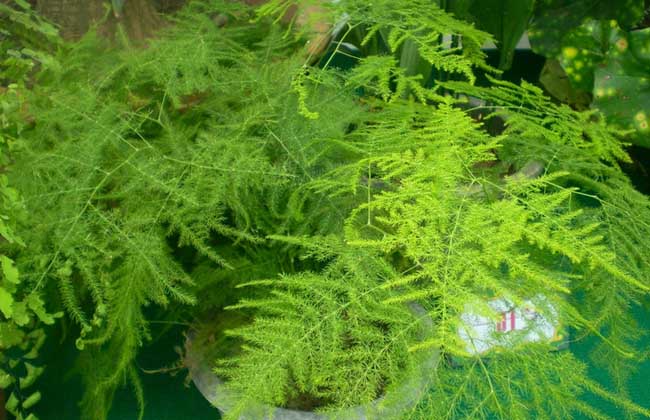
Asparagus fern, also known as cloud pine, thorny asparagus, cloud bamboo and so on, is a perennial plant of the genus Asparagus in the family Asparagaceae. It is native to South Africa and is distributed in central China, northwest China, the Yangtze River basin and various places in the south. It can reach several meters in height and has extremely high ornamental value. It can be placed in the living room or study, purifying the air while also adding a literary atmosphere. Now let us take a look at the cultivation methods and precautions for asparagus fern!
Growth habits of asparagus fern
Asparagus fern likes warm, humid and semi-shaded, ventilated environments. In winter it is not tolerant of severe cold, nor of drought. It cannot be watered too much, or the roots will rot. In summer it should avoid direct sunlight. It is best cultivated in loose, fertile, well-drained sandy loam rich in humus. It is advisable to keep room temperature between 12-18°C. When it exceeds 20°C, ventilation and heat dissipation are needed. The optimal growth temperature is 15-25°C, and the overwintering temperature is 5°C.
Propagation methods of asparagus fern
Asparagus fern is mostly propagated by division. Plants 3-5 years old grow relatively densely and can be propagated by division. Division is carried out in spring when repotting. Use a sharp knife to divide the clustered stems and roots into 2-3 clumps along their natural direction, so that each clump contains 3-5 buds, and then plant them separately in pots. When dividing, try to damage the root system as little as possible. After division and planting, water thoroughly, place in a semi-shaded place, and pay attention to moisture retention and shading. Afterwards, watering should be controlled appropriately, otherwise yellow leaves are easily caused.
Cultivation methods of asparagus fern
1. Potting soil: The potting soil for cultivating asparagus fern should preferably be fertile sandy loam. It requires warmth and moisture, rich humus, and good drainage. Generally, it can be prepared in a ratio of 4 parts garden soil, 2 parts leaf mold, 2 parts compost soil and 1 part sand, and the soil should be changed and fertilized regularly. If excessive fertilization causes "root burning", it is necessary to turn out the pot to remove the fertilizer, rinse the soil ball with clean water, and then replace it with new soil for cultivation.
2. Watering: Watering is the key point in cultivating and growing asparagus fern. Too much watering and overly wet potting soil can easily cause root rot, while too little watering will cause leaf tips to scorch and turn yellow. Therefore, during watering, it should be determined according to the weather, growth condition and the dryness or wetness of the potting soil, following the principle of not watering when dry and watering thoroughly when watering. In hot and dry weather, water can be sprayed on the leaf surface to increase humidity and lower temperature, while in winter less watering is needed.
3. Fertilizing: Asparagus fern does not like heavy fertilizer, but it cannot lack fertilizer either. Limited by the potting soil in containers, asparagus fern cultivation must supplement nutrients in time to meet growth requirements. When fertilizing asparagus fern, apply small amounts frequently, and do not apply concentrated fertilizer, otherwise yellow leaves will be caused. Generally, applying a thin, fully decomposed liquid fertilizer once a month is sufficient. After the plant grows and takes shape, fertilization can be appropriately controlled and reduced. During the growing season, apply a thin fertilizer containing nitrogen and phosphorus 1-2 times a month to promote lush branches and leaves; other liquid fertilizers may also be used. It should be noted that too much fertilizer should not be applied during the flowering period. In May-June and September-October, applying liquid fertilizer twice each is sufficient.
4. Light: Asparagus fern cultivation cannot be exposed to the blazing sun. In hot seasons, it should be placed in a cool and ventilated place. At the same time, asparagus fern during the flowering period is afraid of both wind and rain, so attention should be paid to good ventilation. In good weather, it can be appropriately placed outdoors to receive sunlight. In winter, the temperature for potted asparagus fern should be kept above 5°C to avoid freezing.
5. Placement: Asparagus fern loves a clean and air-circulating environment. If stimulated by harmful gases such as smoke, dust, coal gas and pesticides, the leaves will turn yellow, curl and even die. Therefore, asparagus fern should be placed in a clean, well-ventilated environment, away from decorative materials such as marble that release mercury gas.
Precautions for cultivating asparagus fern
1. Asparagus fern is not cold-tolerant and cannot overwinter outdoors in the north. When the temperature drops, it should be moved indoors in time. In winter, a growing environment above 15°C should be provided.
2. It should not be watered frequently; instead, water should often be sprayed on the leaf surface. In summer, spray water on the leaf surface 1-2 times a day. In winter, while keeping the soil moist, spraying water on the leaf surface once every 3-4 days is sufficient.
3. Keep the potting soil semi-dry and slightly moist. If the potting soil is too dry, the leaves of asparagus fern will turn yellow or the branches and leaves will scorch.
4. Do not use tap water directly to water the flowers. It should be left to stand for 1 to 2 days in advance, and the water temperature should not be too cold.
5. Do not apply raw fertilizer (some people directly pour child urine onto the roots of asparagus fern, and as a result the roots are burned to death). Raw fertilizer must be fully decomposed.
6. In spring and autumn, apply a thin fertilizer once a week; in winter, apply a thin fertilizer once every half month. It is best to use compound flower fertilizer.
7. Asparagus fern does not like smoke and dust. If a coal stove or charcoal fire is used for heating in winter, proper ventilation is needed every day.
8. Asparagus fern should be kept away from marble-type decoration items. Asparagus fern has a strong ability to absorb gaseous mercury. It should be noted that when asparagus fern absorbs mercury gas, it will also harm itself. Therefore, when placing asparagus fern, it should be kept away from decorative materials that release mercury gas.
9. Asparagus fern should be pruned in time. If the branches are too dense, they will affect ventilation, lighting and ornamental value, so they should be pruned in time. If the root suckers multiply too much, they should also be divided into pots in time.
10. Tying asparagus fern can make its posture more beautiful, but it is not suitable to use too thick rope or rope with too great a color difference. Bamboo strips and wooden strips should also not be too thick, otherwise the slender asparagus fern will appear too delicate and weak by contrast.
How to make an asparagus fern bonsai
1. Material selection: one asparagus fern about 20 cm tall, two asparagus ferns just over 10 cm tall, an irregular-shaped white marble shallow basin and its matching stand, several landscape stones about 10 cm tall, an appropriate amount of cultivation soil and green moss.
2. Bonsai shaping: Spread a thin layer of cultivation soil on the surface of the white marble shallow basin. Plant the tallest asparagus fern with its curved branches and leaves facing left at the right end of the basin. Plant the second tallest asparagus fern not far to the left of the first asparagus fern and appropriately near the back edge of the basin. Then plant the shortest asparagus fern at the boundary between 1/3 and 2/3 of the basin length, with its curved branches and leaves also facing left, so as to achieve coordinated and unified orientation of the three asparagus ferns. Then adjust the positions of the asparagus ferns in the basin until they are natural and beautiful.
3. Placing stones and laying moss: Place several landscape stones at an appropriate position toward the right rear of the basin surface, and cover the cultivation soil on the basin surface with green moss to achieve a greening artistic effect. Finally, spray clean water onto the asparagus fern and green moss to moisten the cultivation soil.
How best to prune asparagus fern
1. Pruning for missing leaf-like branches: When the growth position of small leaf-like branches on the main branch is not ideal or they are missing for some reason, short pruning can be carried out at an appropriate position on the main branch to force the hidden buds there to sprout. Generally, the height of the cut is the height at which the leaf-like branches sprout, and the position of the thorns on the branch is the position at which the leaf-like branches sprout. The greater the thickness of the branch, the higher the sprouting rate of the hidden buds.
2. Whole-plant renewal pruning: If the branches and leaves of the whole plant grow poorly due to strong sunlight scorching, dry potting soil, lack of fertilizer, or some unknown reason, whole-plant renewal can be carried out. During renewal pruning, all leaf-like branches can be cut off, but attention should be paid to the positions where the backward thorns on the branches grow, because they determine whether the distribution of the retained branches is even. Pruning during the growing season generally makes it easy to sprout new branches. After pruning, watering should also be appropriately reduced. Absolutely do not let the potting soil become too wet, otherwise pruning will fail.
3. Pruning of trailing branches: Trailing branches are generally weak and slender. If you do not want to keep them for propagation and want the plant shape to look good, they can be cut off from the base all at once. If you want to increase the number of leaf-like branches or fill a certain gap, they can be shortened at a certain position. During pruning, special attention should be paid to comprehensive management such as light fertilization.
Hydroponic cultivation methods for asparagus fern
1. Select healthy, well-developed asparagus fern as the mother material for hydroponics. Take the asparagus fern out of the flower pot together with the soil, carefully wash off the soil from the roots, remove rotten roots, and cut off some old roots. Clean the leaves and plant with clean water, avoiding damaging the plant. Asparagus fern roots slowly, so be careful when taking it out and do not damage the roots of the asparagus fern.
2. Fix the cleaned plant with a planting basket. When fixing, let the roots stretch fully. Then place the plant together with the planting basket into a 1‰ carbendazim solution to soak the roots for 30 minutes. Place in a cool place, and after the root system becomes soft, proceed to the next step.
3. Pour asparagus fern-specific nutrient solution into the nutrient solution pool, and plant the treated plant on a floating board (note that part of the root system should remain exposed to the air). Spray water on the leaf surface twice a day. Under a suitable temperature of 15-25°C, new roots will grow in two weeks. At this time, supplement foliar fertilizer once every week.
4. After three to four weeks, the asparagus fern root system has grown a lot of new roots. At this time, it can be placed in a bottle for static hydroponics. It is best to use ceramsite for fixing.
5. Asparagus fern likes a semi-humid environment. Generally, place it near a window with light, but not in a place with direct sunlight, and keep it ventilated. A water tray should still be placed under the container and water should be replenished frequently.
6. For hydroponic asparagus fern, it is best to use asparagus fern-specific nutrient solution. The maintenance of hydroponic asparagus fern is much easier than soil cultivation. Usually, you only need to pay attention to changing the water: about 7-10 days in summer and about 20 days in winter. Each time you change the water, replenish the nutrient solution.
Reasons for asparagus fern leaves turning yellow
1. Strong light exposure: Asparagus fern cultivation prefers semi-shade. In summer, it should not be exposed to strong direct sunlight, otherwise the branches and leaves will wither and turn yellow. The solution is to move the flower pot to a cool place and spray more water on the branches and leaves to increase humidity.
2. Improper watering: Although asparagus fern likes moisture, it can also suffer from waterlogging if too wet. Therefore, during cultivation it is best to keep the potting soil alternating between dry and wet. Generally, do not water when dry, and water thoroughly when watering, but do not allow too much standing water on the pot surface when watering. If overwatering occurs, watering can be temporarily stopped and replaced by only spraying water on the leaf surface to keep the asparagus fern moist.
3. Improper fertilizing: Applying too concentrated fertilizer or applying undecomposed fertilizer will both cause asparagus fern leaves to turn yellow and fall off. If the nutrients in the planting soil are too poor, it will likewise cause asparagus fern leaves to turn yellow. Therefore, when fertilizing, apply thin fertilizer, preferably more times with smaller amounts, and use decomposed fertilizer. For situations that have already occurred, changing the potting soil can solve the problem. It is worth noting that fertilizing is not suitable during the low-temperature period in winter and the high-temperature period in summer.
4. Gas poisoning: Asparagus fern is very afraid of smoke and dust. If it is often exposed to harmful gases such as smoke and dust, asparagus fern will show poisoning symptoms of yellow branches and leaves. When this happens, move the flower pot away from its original position in time and increase the work of sprinkling water on the leaf surface to remove dust.
5. Pest reasons: Scale insects are the most common pest in asparagus fern cultivation. When scale insects are found, they should be wiped off in time with a wet cloth strip. In severe cases, buy medicine from a pharmacy for prevention and control, and change the potting soil in time. When changing the potting soil, old and residual root hairs can be cut off to reduce nutrient consumption.
6. Management mistakes: Asparagus fern cultivation requires maintaining a certain temperature, especially in winter when it should be placed in a sunny position. If asparagus fern is kept for a long time in a place lacking light, poorly ventilated and cold, the leaves are very likely to wither and dry up. In winter, the cultivation temperature for asparagus fern generally must not be lower than 12°C, and it should be placed in a place with better light, where watering can be appropriately reduced.