How to grow night-blooming jasmine (Cestrum nocturnum) in pots? Detailed care methods and tips
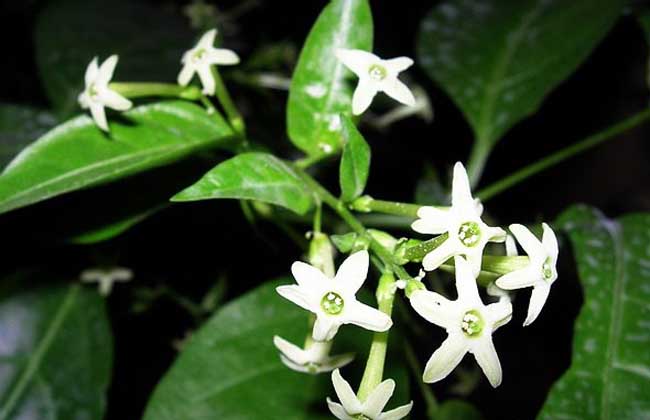
Night-blooming jasmine (Cestrum nocturnum) originates from South China, growing in hillside thickets, and is now cultivated in provinces and regions across the south. It likes a warm, humid, sunny, well-ventilated and dry climate, and a well-drained, loose and fertile soil environment. It is drought-tolerant and poor-soil-tolerant, but not waterlogging-tolerant or cold-tolerant. Let's take a look at how to grow night-blooming jasmine in pots!
Potting soil preparation
Night-blooming jasmine likes loose, well-drained, organic-rich, slightly acidic soil. The potting soil is generally made up of 3 parts peat soil or leaf mold plus 2 parts coarse river mud and a small amount of farmyard manure. When potting, fill about 1/5 of the depth at the bottom with granular broken brick pieces to facilitate pot drainage, and use the prepared potting soil for cultivation in the upper part.
Growing environment
Potted night-blooming jasmine requires well-ventilated environmental conditions. From early May to the end of September, it is suitable to place it in a sunny spot in the yard or on a balcony for care. Although it likes plenty of sunlight, it should avoid scorching sun exposure at noon in summer.
Fertilizing potted plants
During the growth process of night-blooming jasmine, liquid fertilizer should be applied once every 10 to 15 days. Starting in late April, apply a dilute liquid fertilizer once every half month. From mid-May onward, continuous flowering can be ensured. If high-efficiency humic acid liquid fertilizers such as Chunquan 883 or Huimanfeng are applied, the effect will be even better.
Watering potted plants
Summer is the peak growing season for night-blooming jasmine. In addition to applying sufficient fertilizer, the potting soil must be kept constantly moist, and if necessary, water twice a day. If it is a seedling, spray water on the leaf surface 1 to 2 times a day.
Temperature management
For potted night-blooming jasmine, it should be moved into a shed or greenhouse in mid-to-late October each year. The temperature in the shed or greenhouse should be kept at 8°C to 12°C. If the temperature is lower than 5°C, the leaves will turn yellow and fall off until the plant dies.
Repotting at the right time
Repotting potted night-blooming jasmine is best done in early April in spring before it is moved outdoors. When repotting, remove part of the old soil and old roots, replace with new culture soil, and carry out heavy pruning to promote new branches. After repotting, keep the potting soil moist, but there must be no standing water in the pot. If the young leaves are found to droop slightly after repotting, water promptly.
Plant shaping
In the pot cultivation management of night-blooming jasmine, a trellis needs to be set up. After the plant climbs onto the trellis, pinch the tips promptly to encourage more branching. After flowering, promptly cut off the residual flower stalks and apply additional fertilizer. After the flowers fade, cut off the dried branches and leaves and overly dense branches, and shorten leggy growth.
Pest and disease control
The main insect pests of night-blooming jasmine are mites and scale insects, and the disease is fusarium wilt. For mite control, 800-fold dilution of Kangman 23 emulsifiable concentrate, 2000-fold dilution of 73% propargite, etc. can be used. For scale insect control, 600-800-fold dilution of 40% dimethoate emulsion can be used. For fusarium wilt control, 600-800-fold dilution of Kuwei Like, 600-fold dilution of 50% carbendazim, etc. can be used. If diseased plants with fusarium wilt are found, they should be removed promptly, taken outside the garden and burned, and the soil around the diseased plants should be turned over and sprinkled with quicklime, then replanted after 1 month.