Can night-blooming jasmine be kept in the bedroom?
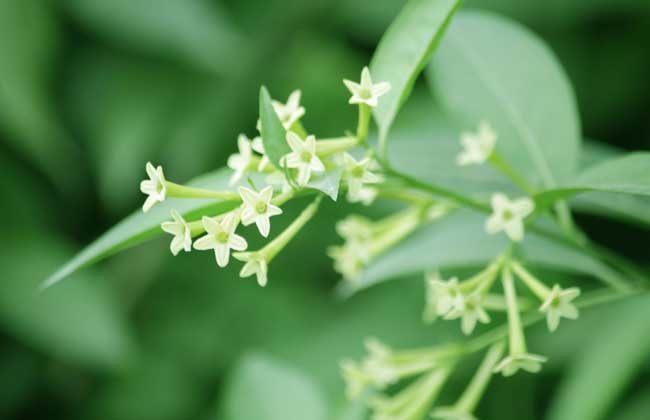
Night-blooming jasmine (Cestrum nocturnum) is a fairly common flowering ornamental plant, often grown in home courtyards and similar places. It mainly blooms at night, and its flowers are very small, but the fragrance is very strong, so it is generally planted in courtyards for viewing. Many people cannot help but ask, so can night-blooming jasmine be placed in the bedroom? Below let us take a look at whether night-blooming jasmine can really be placed in the bedroom!
Can night-blooming jasmine be placed in the bedroom?
Night-blooming jasmine cannot be placed in the bedroom. If night-blooming jasmine is kept indoors for a long time, it can cause dizziness, coughing, and even asthma and insomnia. Its fragrance can make patients with high blood pressure and heart disease feel dizzy, depressed and uncomfortable, and cause symptoms such as chest tightness and difficulty breathing. Therefore, night-blooming jasmine is not suitable for placement in the bedroom. It is best placed outdoors as an ornamental plant.
The cultivation value of night-blooming jasmine
1. Ornamental value: Night-blooming jasmine can be cultivated for ornamental use. This is because its branches are slender, and it blooms in both summer and autumn. The yellow-green flowers of night-blooming jasmine are elegant in color and rich in fragrance, often drifting through the air in waves, bringing a natural atmosphere. In many areas of southern China, night-blooming jasmine is often used to decorate homes and courtyards.
2. Medicinal value: Night-blooming jasmine is sweet and neutral in taste and mild in nature. It is a medicinal plant, a fresh flower, and also an edible wild vegetable. Eating night-blooming jasmine has the effect of clearing the liver and brightening the eyes, and can effectively treat red and swollen eyes, measles dermatitis, corneal inflammation and other conditions. Night-blooming jasmine can also be used externally to treat inflammation and erosion at the affected area, providing effective targeted treatment.
How to grow night-blooming jasmine
1. Soil: Night-blooming jasmine prefers loose, well-drained, organic-rich, slightly acidic soil. Use peat soil, leaf mold and sand mixed at a ratio of 3:3:4 respectively. The bed soil prepared this way has the characteristics of raising bed temperature, retaining water, allowing air circulation, being fertile and slightly acidic, and is suitable for branches to take root and sprout.
2. Watering: Summer is the peak growing season. In addition to applying sufficient fertilizer, the potting soil must be kept constantly moist, and if necessary, water twice a day. If it is a seedling, spray water on the leaves once to twice a day.
3. Temperature: In mid-to-late October each year, it should be moved into a greenhouse or indoor shed, and the temperature in the shed should be kept at 8°C to 12°C. If the temperature is below 5°C, the leaves will turn yellow and fall off until the plant dies.
4. Fertilizing: During the growth process, apply a thin, fully decomposed liquid fertilizer once every 10 to 15 days. From mid-May onward, this can ensure continuous production of fragrant flowers, improving its ornamental value. If a compound fertilizer of nitrogen, phosphorus and potassium can be applied, the effect is even better.
5. Pests and diseases: Sooty mold and ring spot disease often occur, and can be sprayed with a 500-fold dilution of 50% thiophanate-methyl wettable powder.
6. Pruning: The branches of night-blooming jasmine grow quickly. If allowed to grow naturally, they can grow about 1 m within 1 year. Therefore, it needs to be pruned every year to sprout more side branches and bloom more. Pruning is generally carried out in autumn, with each side branch kept 10 to 12 cm long. After the flowers fade, dead branches and overly dense branches should be cut off.