Where are the main places of origin of snapdragon distributed?
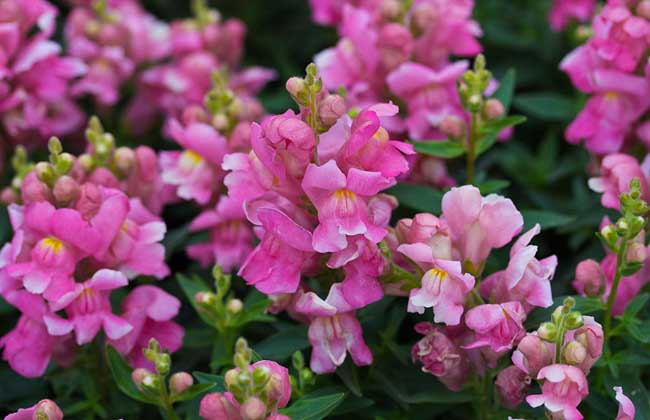
Snapdragon is a flower that blooms in summer and autumn. It is widely planted in Chinese gardens and is suitable for group planting in flower beds and flower borders. It works especially well when combined with zinnia, petunia, marigold, scarlet sage, and others. Tall varieties can be used as background plantings, while dwarf varieties are suitable for rock gardens or windowsill flower boxes, or for edge planting. Now let us take a look at the places of origin and distribution of snapdragon!
Snapdragon places of origin and distribution
Snapdragon originates from the Mediterranean coastal region, north to Morocco and Portugal, south to France, and east to Turkey and Syria. It is cultivated in gardens in various places and sometimes escapes to the wild.
Snapdragon growth habits
Snapdragon likes sunlight and can also tolerate semi-shade. It is relatively cold-tolerant and not tolerant of intense heat. It is suitable for growing in loose, fertile, well-drained soil, and can also grow normally in calcareous soil. Snapdragon is a light-loving herbaceous plant. Under conditions of sufficient sunlight, the plants are dwarf, compact in clumps, neat in growth, uniform in height, neat in flowering, and bright in flower color. Under semi-shade conditions, the plants grow taller, the inflorescences elongate, and the flower color is lighter. It is not sensitive to photoperiod, for example, the Huayu series of snapdragon is almost insensitive to day length.
Snapdragon cultivation methods
1. Soil: Snapdragon does not have very high requirements for soil, but it grows best in fertile, loose, well-drained, slightly acidic sandy loam.
2. Watering: Snapdragon is very sensitive to moisture. The potting soil must remain moist. When raising seedlings in pots, it must also be watered sufficiently, but the potting soil must have good drainage and must not accumulate water, otherwise it will easily cause root rot as well as yellowing and wilting of stems and leaves.
3. Sunlight: Snapdragon is a light-loving herbaceous plant and needs to grow under conditions of sufficient sunlight. The plants are dwarf and compact in clumps, grow neatly, remain uniform in height, flower neatly, and have bright flower color. If under semi-shade conditions, the plants will grow taller, the inflorescences will elongate, and the flower color will be dull.
4. Temperature: Snapdragon is relatively cold-tolerant but not heat-tolerant. The most suitable temperature for growth is 7-10 degrees. High temperatures are unfavorable for growth and development, while the most suitable temperature for flowering is around 15-16 degrees. For some varieties, if the temperature exceeds 15 degrees, they will not branch and the plant form will be affected.
5. Fertilizing: It is necessary to strengthen the management of fertilizer and water. When fertilizing, even more attention should be paid to the coordination of phosphorus, potassium, and so on, because it itself has root nodules and therefore also has the function of nitrogen fixation, so under normal circumstances there is no need to apply nitrogen fertilizer. During the growing period, combined with watering, apply fermented oil residue water once every half month, and before fertilizing, also loosen the soil and weed appropriately.
6. Pruning: For snapdragon, only after each flowering ends, cut off the branches that have already flowered, so as to better promote the sprouting of new branches and continued flowering.