What is the flower language of the dwarf snapdragon? A detailed explanation of its symbolism
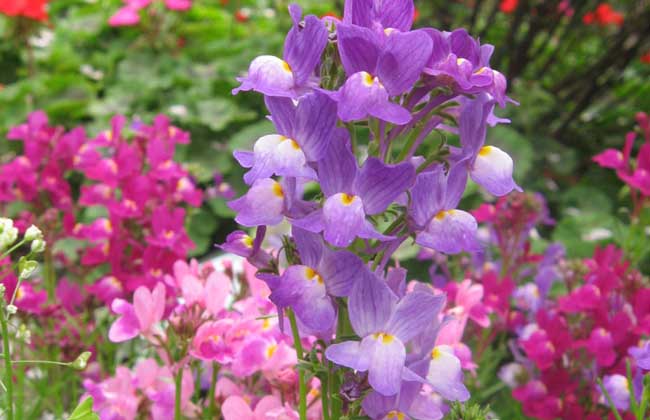
The dwarf snapdragon, also known as striped toadflax, little snapdragon, Moroccan toadflax and so on, is a biennial herbaceous plant of the genus Antirrhinum in the family Scrophulariaceae, order Tubiflorae, class Dicotyledoneae. Its flowering period is from April to June. It can be used as edging material for flower beds and flower borders, and can also be grown in pots for ornamental display. Now let us take a look at what the flower language of the dwarf snapdragon is!
The flower language of the dwarf snapdragon
The flower language of the dwarf snapdragon isPlease notice my love。
Morphological characteristics of the dwarf snapdragon
The dwarf snapdragon has a raceme inflorescence, with a short flowering period and dense flowers, and the fruiting period elongates with fruits spaced apart. The inflorescence axis and pedicels are hairless or have a few short glandular hairs. The bracts are linear to narrowly lanceolate, longer than the pedicels. The pedicels are 2-8 mm long. The calyx lobes are lanceolate, about 4 mm long and 1-1.5 mm wide, hairless on the outside and more or less glandular-hairy on the inside. The corolla is yellow, 10-15 mm long excluding the spur. The upper lip is longer than the lower lip, with lobes 2 mm long, ovate. The lateral lobes of the lower lip are ovate-round, 3-4 mm wide, and the middle lobe is ligulate. The spur is slightly curved, 10-15 mm long. The capsule is ovoid-globose, about 8 mm long. The seeds are disc-shaped, with broad wings along the edges, and often have tuberculate protrusions in the center when mature. The flowering period is from June to September.
How to grow the dwarf snapdragon
1. Humidity: It prefers a relatively dry air environment. If rainy days last too long, it is susceptible to infection by pathogens. It is afraid of rain, so keep the leaves dry at night. The optimal relative air humidity is 40-60%.
2. Temperature: It prefers a cool climate, dislikes extreme heat, and is tolerant of frost and cold. It is not very demanding about winter temperatures; as long as it is not exposed to frost, it can overwinter safely. It dies when the temperature rises above 30°C in late spring and early summer. The most suitable growing temperature is 15-25°C. Try to sow in autumn or winter to avoid the high temperatures of summer.
3. Light: In the three seasons of late autumn, winter and early spring, since the temperature is not very high, it should be given direct sunlight to help it carry out photosynthesis and form flower buds, bloom and set seed. If high-temperature weather occurs in summer, it needs to be shaded from about 50% of the sunlight. If it is kept indoors for ornamental display after flowering, place it near southeast-facing doors and windows to extend the flowering period and increase the number of flowers as much as possible.
4. Fertilizer and water: Like other herbaceous flowers, it has a relatively high demand for fertilizer and water, but it is most afraid of improper fertilization, concentrated fertilizer and one-sided application of nitrogen, phosphorus and potassium fertilizers. It is required to follow the two fertilization (watering) principles of "apply dilute fertilizer frequently, use small amounts with more applications, and complete nutrition" and "alternate dry and wet, dry thoroughly when dry, do not water when not dry, and water thoroughly when watering", and after fertilizing, keep the leaves and flowers dry at night:
5. Autumn: After the sown seedlings are potted and have recovered for a period of time, fertilizer and water management should be stepped up quickly. Fertilizer and water management follows the cycle of Hyponex → Hyponex → clear water → Hyponex → Hyponex → clear water, with an interval of about 1-3 days.
6. Winter: Although it is still growing, the relatively low temperature will slow its growth rate, and it has little demand for fertilizer and water, so fertilizer and water may even need to be restricted. Fertilizer and water management follows the cycle of Hyponex → clear water → clear water → Hyponex → clear water → clear water, with an interval of about 4-7 days. Watering should be done at noon on sunny days when the temperature is relatively high.
7. Spring: After the temperature rises, growth recovers rapidly and gradually enters the flower bud differentiation stage and flowering stage, with a very high demand for fertilizer and water. Fertilizer and water management follows the cycle of Hyponex → clear water → Hyponex → clear water, with an interval of about 2-4 days. The interval is shorter on sunny days or during high temperatures, and longer or no watering on rainy days or during low temperatures. After entering the seed-setting stage, stop fertilizer application.