Detailed Guide to Cockscomb Cultivation Methods and Care Points
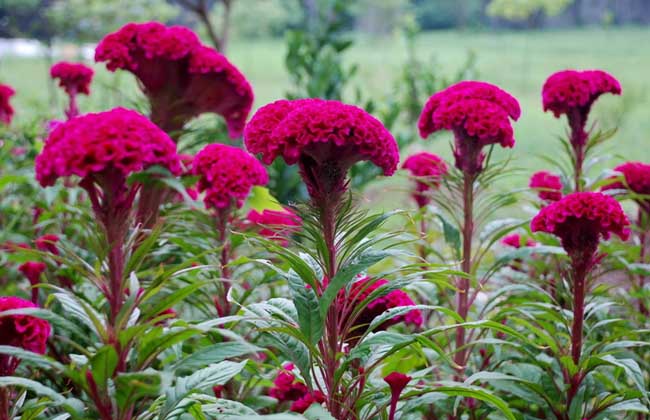
Cockscomb is also known as cockscomb flower, laolaihong, reed cockscomb, brush cockscomb, small-head cockscomb, phoenix-tail cockscomb, etc. It is an annual herbaceous plant of the genus Celosia in the Amaranthaceae family. It blooms in summer and autumn, and the flowers are mostly red and shaped like a cockscomb, hence the name cockscomb. It is a commonly used flowerbed plant in summer and autumn and also has high medicinal value. Let us take a look together at the cultivation methods of cockscomb!
Growth Habits of Cockscomb
Cockscomb prefers a hot and dry climate and is afraid of waterlogging. It grows well in sunny, fertile sandy soil and avoids clay soil. In poor, poorly aerated soil it grows poorly and the inflorescence becomes smaller. It can reproduce by self-sowing. Sow in spring from March to April in an open-field seedbed. Before sowing, mix the seeds with New High-Fat Film (to increase the germination rate). After sowing, do not cover with soil; cover with grass and then water, keeping the soil moist.
How to Plant Cockscomb Seeds
1. Seed sowing: Cockscomb propagation commonly uses the seed propagation method. Around Qingming, choose a good plot, apply sufficient base fertilizer, plow finely and harrow evenly, level and make beds, evenly scatter the seeds on the bed surface, lightly cover the seeds strictly, firm the soil and water thoroughly. Generally, at a temperature of 15-20°C, seedlings can emerge in 10-15 days. For summer sowing after Mangzhong, seize the dry period to clear stubble, and it can also be intercropped with white peony, tree peony, or other crops, using 1 jin of seed per mu.
2. Seedling management: When seedlings are 2 cun tall, thin them according to a row spacing of 1 chi and a plant spacing of 8 cun. The thinned seedlings can be transplanted to other fields, and after transplanting they must be watered. During the seedling stage, be sure to weed and loosen the soil. When it is not too dry, water as little as possible. When seedlings are about 1 chi tall, apply a topdressing once. After the rows close, appropriately remove old leaves. When flowering and heading, if the weather is dry, water appropriately. In the rainy season, strictly prevent water accumulation in low-lying areas. After heading, the flower buds in the leaf axils of the lower part can be removed to help nutrients concentrate on the growth of the top main spike.
Cockscomb Cultivation Methods
1. Soil: Cockscomb has certain requirements for soil and is suitable for planting in well-drained, loose and fertile sandy loam. If drainage is poor, it is prone to root rot.
2. Watering: Although cockscomb likes dry air and avoids waterlogging, it has thick branches and lush leaves and consumes a large amount of water during the growing period, so in hot summer it must be watered fully. At the same time, excess water must also be prevented. During continuous rainy days, potted flowers should be moved indoors, and field-planted flowers should be drained. Watering should be moderate, otherwise root rot is likely.
3. Sunlight: It likes warmth and avoids cold. During the growing period, it needs sufficient light, at least 4 hours of light per day. If grown in a shaded place, the inflorescence will be small and its ornamental value will decrease. The most suitable growth temperature is 18-28°C. When the temperature is low, growth is slow, and after winter begins the plants die.
4. Pruning: For dwarf varieties, pinching should be carried out after planting to promote branching. When used as cut flowers, pinching can be done when the plant height is 20-30 cm.
5. Fertilization: Apply sufficient base fertilizer when sowing, and apply compound fertilizer 1-2 times before flowering and during the flowering period. The amount of nitrogen fertilizer should not be too much to prevent excessive growth and lodging.
6. Pests and diseases: Cockscomb has relatively few pests and diseases. Damping-off is likely to occur at the seedling stage, and aphids are harmful during the growing period, so attention should be paid to prevention and control. If root rot is found, remove the diseased plants and spray copper sulfate for control.