How to Grow Conophytum burgeri: Detailed Care Methods and Tips
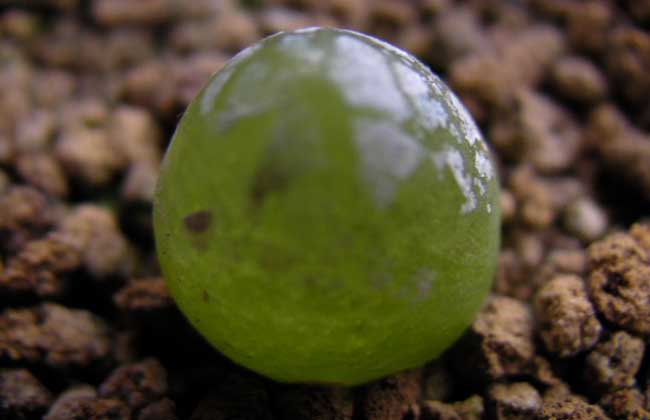
Conophytum burgeri is a succulent plant in the genus Conophytum, family Aizoaceae. It is semi-transparent, and in direct light you can see that it is semi-transparent, with a faint reddish sheen. Because the plant is crystal clear and looks sparkling, it resembles a light bulb, which is how it got its name. Also, because the plant's shape closely resembles Mount Fuji in Japan, it has the alias "Mount Fuji." It is very charming and is suitable for growing in a small pot, to be admired carefully in leisure time and to appreciate its unique charm.
Morphological Characteristics of Conophytum burgeri
The epidermis of Conophytum burgeri is bright green and semi-transparent. During the summer dormancy period, in an environment with sufficient light, the epidermis turns red. The flowers are large, pale purplish-red, with a white center, and bloom in spring or autumn. The flowers usually open during the day when the weather is clear and close at night. If the growing environment has insufficient light or it is cloudy and rainy, it is difficult for the plant to bloom. The plant has no stem and is generally single-headed, occasionally double-headed, and even 3-headed or 4-headed clustered plants. The fleshy leaves are hemispherical, with a single head 2.5-4 cm in diameter or larger.
Growth Habits of Conophytum burgeri
The growth habits of Conophytum burgeri are very peculiar. Each year in autumn the plant begins to grow, and in winter and spring the plant develops a new plant inside its body. Generally, each plant can only develop 1 new head inside, and occasionally it can also divide, turning from 1 head into two heads. Later, as the plant grows, the new head inside gradually swells, and the old leaves gradually become thinner and shrink, wrapping around the outside of the new head like a layer of kraft paper. In the hot summer, Conophytum burgeri enters dormancy. Although the dried old leaves wrapped outside look unattractive, they can block the damage to the young plant from the strong ultraviolet rays of summer and absorb moisture from the humid air, playing an important protective role for the new head, so do not easily peel them off. In autumn, as the new head grows further, the kraft-paper-like old leaves gradually shed, restoring its crystal-clear state.
Propagation Methods of Conophytum burgeri
Conophytum burgeri is commonly propagated by sowing, carried out in autumn. Because the seeds are very small, after sowing they must be covered with a piece of glass. When watering, the "soaking" method should be used: place the flower pot in a basin filled with water so that water slowly soaks the soil from the drainage holes at the bottom of the pot. This method is also used for watering during the seedling stage. Newly emerged Conophytum burgeri seedlings often lean crookedly, with their roots also exposed outside the soil. A toothpick, tweezers or other small tool can be used to cover the exposed roots with soil and straighten the fallen seedlings.
How to Grow Conophytum burgeri
1. Temperature and light: Although Conophytum burgeri likes a sunny, cool and dry environment, it is not tolerant of strong sunlight, so it must be shaded in summer.
2. Water management: It is drought-tolerant and afraid of waterlogging. Because the entire summer is the dormancy period, give only a small amount of water; too much will cause rot.
3. Growing medium: For potting soil, generally use coal cinder mixed with a small amount of peat, also mixed with a small amount of akadama soil and orchid stone, with granular river sand spread on the surface. The growing medium should mainly be permeable and airy.
Note: Although the outer old leaves are not very attractive, the old leaves effectively block the damage to the young plant from the scorching sun and can absorb moisture from the humid air, providing a moist environment for the young plant. They must not be peeled off at will. Because the seeds of Conophytum burgeri are too small, after sowing they should be covered with a piece of glass, and when watering, soak-water lightly.