Why does the epiphyllum bloom at night?
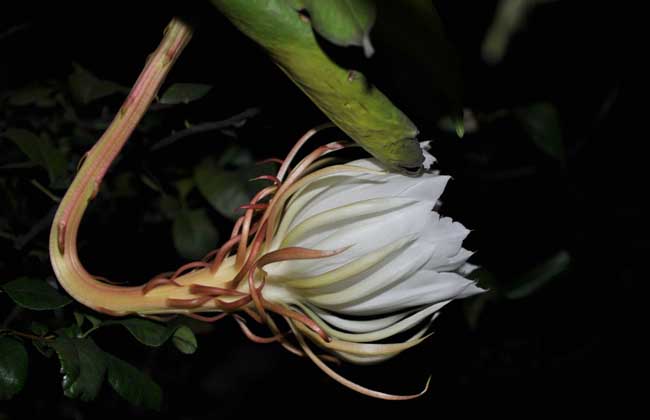
The epiphyllum is a perennial evergreen succulent herb belonging to the cactus family. It prefers a mild, humid, semi-shaded environment. In the hot summer, when the cool breeze of nightfall arrives, the epiphyllum, known as the "fairy flower", will bloom. When it blooms, its fragrance fills the air and refreshes the heart, with white flowers and green stems setting each other off, beautiful for a time. But why does the epiphyllum bloom at night? Let's take a look together below!
Why does the epiphyllum bloom at night?
The epiphyllum originated in the tropical deserts from Mexico to Brazil in the Americas. The climate there is dry and hot, but it becomes much cooler at night. Blooming at night can avoid intense sunlight exposure, shorten the blooming time, and greatly reduce water loss, which is beneficial to its survival. It allows its life to continue. Thus, over a long period of time, the characteristic of the epiphyllum blooming briefly at night gradually formed and has been passed down from generation to generation to this day.
When does the epiphyllum bloom?
The blooming season of the epiphyllum is generally from June to October, and the blooming time is generally after 8 to 9 o'clock at night. The full bloom lasts only 5 to 10 minutes, very brief. When the epiphyllum blooms, the floral tube slowly tilts up, slowly opening its purple outer covering, and then the large snow-white flower composed of more than 20 petals opens. But only 3 to 4 hours later, the corolla closes, and the flower soon withers. It truly can be called “a fleeting epiphyllum bloom”.
How is the epiphyllum best cultivated?
1. Soil: For pot cultivation, well-drained, fertile leaf mold is commonly used. The potting soil should not be too wet, and higher air humidity should be maintained in summer. Avoid being washed by rain showers, so as to prevent waterlogging and root rot. During the growing season, fertilize once every half month. In early summer during the budding and blooming period, apply phosphorus fertilizer once additionally. Reasonable application of fertilizer and water can extend the flowering period. Too much fertilizer and water, or excessive shading, can easily cause excessive stem and node growth and, on the contrary, affect blooming.
2. Light: It prefers a semi-shaded, warm environment. In summer, it should be placed under a shade screen for care, or cultivated in a place without direct light. The suitable growing temperature in spring and summer is 21-24°C during the day and 16-18°C at night. In winter, it should be moved into a greenhouse and placed in a sunny spot, requiring sufficient light. The overwintering temperature should preferably be kept at 10-13°C.
3. Watering: In summer, the potting soil should be kept moist, but not waterlogged, so as to avoid root rot. Provide shade to avoid direct sunlight. Water more in summer, and spray water 1-2 times in the morning and evening to increase air humidity. Avoid being washed by rain showers, so as to prevent waterlogging and root rot. Watering should be reduced in spring and autumn. In winter, watering must be strictly controlled, and it is enough to keep the potting soil not too dry.
4. Fertilization
① In autumn, decomposed liquid fertilizer can be applied as a top dressing. Without sufficient nutrients, it is not easy to bloom or it blooms less. In autumn, remove the shading equipment and increase light. In spring and autumn, apply nitrogen fertilizer once a month, with appropriate concentration. In winter, move it indoors, water frequently, stop fertilizing, place it in a bright spot, and control its growth. When the indoor temperature is too high in winter, dense new shoots often sprout from the base and should be removed in time, so as not to consume nutrients and affect blooming after spring. In spring, as the temperature rises, too much watering and fertilizing should be avoided, so as to prevent bud drop.
② During the growing season, apply decomposed cake fertilizer water once every half month, and ferrous sulfate can also be added and applied at the same time. During the budding and blooming period, apply bone meal or superphosphate once additionally. Proper application of fertilizer and water can extend the blooming time. Too much fertilizer and water, or too much shading, will cause excessive stem and node growth and affect blooming. Exposure to the sun or too strong sunlight, on the other hand, will cause the modified stems to shrink and turn yellow.
5. Support and protection: Because the modified stems of potted epiphyllum are weak, they should be tied up or given support in time. The epiphyllum is a shade-loving plant. In summer, potted epiphyllum can be placed under tree shade or under the eaves, but should avoid being washed by rainwater, so as to prevent the plant from exposing its roots and toppling over, which would affect growth. In winter, it needs to be moved indoors to overwinter.
6. Flowering period: In order to change the habit of the epiphyllum blooming at night, the method of “reversing day and night” can be used to make the epiphyllum bloom during the day. When the epiphyllum flower buds swell, move the epiphyllum to a dark room during the day, or cover it with a black shade cover made of black plastic film, without letting any light through. At night, from 8 o'clock to 6 o'clock the next morning, use light to illuminate it. After treating it this way for 7 to 8 days, the epiphyllum can bloom during the day according to people's wishes.