What is the flower language of the epiphyllum? An analysis of the legend of the epiphyllum
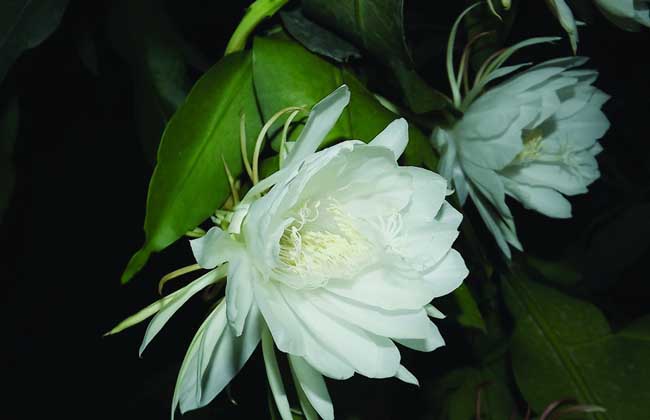
The epiphyllum is a famous ornamental flower, commonly known as the "Beauty Under the Moon", "Qionghua" and so on. It is an epiphytic succulent shrub plant of the genus Epiphyllum in the cactus family. Whenever summer and autumn come, when the sky is full of stars and the night is deep and quiet, the epiphyllum will bloom, revealing its beautiful posture and elegant colors, but the blooming time is very short, fleeting, and it often wins the deep interest of flower lovers. Let's take a look at the flower language and legends of the epiphyllum together!
The flower language of the epiphyllum
Beauty of an instant、Eternity of a moment. Because the epiphyllum's blooming time is very short, there is the saying "a fleeting epiphyllum bloom". People use "a fleeting epiphyllum bloom" to describe beautiful things that do not last, and similar idioms include "in the snap of a finger", "a flash of lightning", "a white horse passing a crack", "fleeting", and so on.
The life of the epiphyllum
The blooming season of the epiphyllum is generally from June to October, and the blooming time is generally after 8 to 9 o'clock at night. The full bloom lasts only 5 to 10 minutes, very brief. When the epiphyllum blooms, the floral tube slowly curls upward, slowly opening its purple outer garment, and then the large snow-white flower composed of more than 20 petals opens. But only 3 to 4 hours later, the corolla closes, and the flower quickly withers. It can truly be called "a fleeting epiphyllum bloom".
The legend of the epiphyllum
The epiphyllum was originally a flower goddess. She bloomed every day and was radiant in all four seasons. She also fell in love with the young man who watered and weeded her every day. Later, the Jade Emperor learned of this, and the Jade Emperor flew into a rage and wanted to break the couple apart. The Jade Emperor seized the flower goddess, demoted her to an epiphyllum that could bloom only for an instant each year, refused to let her see her lover again, and also sent that young man to Lingjiu Mountain to become a monk, giving him the name Weituo, making him forget his past and forget the flower goddess.
Many years passed, and Weituo indeed forgot the flower goddess, devoted himself to studying Buddhism, and gradually achieved something. But the flower goddess could never forget the young man who had once cared for her. She knew that every year in late spring, Weituo always had to come down the mountain to collect morning dew to brew tea for the Buddha. So the epiphyllum chose to bloom at that time. She displayed in that instant the vital essence she had gathered for a whole year. She hoped Weituo could turn back and look at her once, and could remember her.
But thousands of years passed, and year after year Weituo came down the mountain to collect morning dew. Year after year the epiphyllum silently bloomed. Weituo never remembered her. Until one day a gaunt man passed by the epiphyllum, saw the flower goddess's melancholy and lonely suffering, and stopped to ask the flower goddess, "Why are you sad?" The flower goddess was astonished, because ordinary people cannot see the true body of a flower goddess. If it were a great golden immortal, there would be golden light above his head, but the one who had just passed by was clearly an ordinary person, so how could he see her true body? The flower goddess hesitated for a moment and only answered, "You cannot help me." Then she silently continued waiting for Weituo and did not answer the man's words again.
Forty years later, that gaunt man passed by the epiphyllum again and repeated the same words from 40 years earlier, "Why are you sad?" The flower goddess hesitated for a moment again and only answered, "Perhaps you cannot help me." The gaunt man smiled and left. Another 40 years later, a gaunt old man appeared again where the flower goddess was, and the originally gaunt old man looked even more like he was at his last breath. The man of that year had already become an old man, but he still asked the same words as 80 years before, "Why are you sad?" The epiphyllum answered, "Thank you, mortal, for asking me 3 times in your life, but after all you are a mortal and already at your last breath, so how can you help me? I am a flower goddess punished by heaven because of love." The old man smiled and said, "I am of the Yuming clan. I have only come to settle that fruitless fate from 80 years ago. Flower goddess, I have come to send you one line: when fate rises and fate ends, fate finally ends; when flowers bloom and flowers fall, flowers return to dust." After saying this, the old man closed his eyes and sat down.
As time gradually passed, the last ray of the setting sun began to sweep from the old man's hair toward his eyes. The old man laughed and said, "The epiphyllum blooms for an instant for Weituo; how could such love be wrong? If heaven punishes and earth executes, I will bear it; if heaven is blind, I will open its eyes." With that, the old man grabbed the flower goddess. At that moment the setting sun slid to the old man's eyes. The old man then passed away in meditation, holding the flower goddess and going together to the Buddha land. In the Buddha land the flower goddess saw Weituo. Weituo also finally remembered the causes and conditions of his past life. After the Buddha learned of this, he permitted Weituo to descend to the mortal world to settle the unfinished causes and conditions. Because the old man of the Yuming clan violated heavenly rules, his soul wandered for a lifetime. He could neither ride the crane to the western paradise nor enter the pure land of the eastern Buddha land, and in the end he received heavenly punishment and would never reincarnate.
The epiphyllum blooms for an instant only for Weituo. Therefore the epiphyllum is also called Weituo flower. Also because the epiphyllum sees Weituo after the setting sun, the epiphyllum always blooms at night.