How to prune a bonsai ficus? Teaching you the correct pruning method
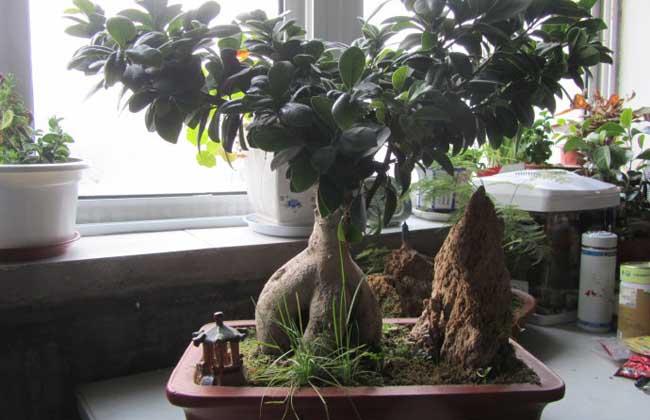
In ficus styling, pruning is the most important means, and through pruning the goal of achieving a graceful ficus form can be reached. Generally, pruning can be done in all four seasons. In actual care and styling, cutting is primary and tying is secondary. Cutting once a year is appropriate; for vigorous growers, cutting twice is possible. After the shortened branches grow stout forked branches, cut again. There are several methods: pinching, bud thinning, leaf removal, heading back, and renewal pruning.
Pinching
Pinching can promote the sprouting of axillary buds, grow more branches, expand the crown, and at the same time inhibit leggy branch growth. The timing and frequency of pinching have a great deal to do with the tree species. For example, for pine trees, it is best to pinch off about 2/3 of the bud core when the new buds sprout but before the needles have extended, leaving only a small section at the base. In the future, two lateral buds will sprout here, sending out new branches in two directions. For evergreen broadleaf trees and deciduous trees that easily send out new shoots, generally when the new shoots sprout and grow 2 to 3 leaves, pinch off the leaf core. When new branches and leaves sprout again, pinch in the same way. Repeated operation in this way can achieve the goal of making the crown full.
Bud thinning
Bud thinning means that when a tree sprouts, often many buds sprout at the same time. To ensure concentrated supply of water and nutrients, keep the well-positioned buds and remove unnecessary buds, so as to form a more ideal tree shape. For tree species with strong sprouting ability such as Chinese elm and snowbush, even more attention should be paid to wiping off buds unfavorable to the styling at any time.
Leaf removal
Leaf removal can promote the tree to sprout new leaves. For some tree species such as Chinese elm and Chinese chaste tree, leaf removal can make the originally large leaves become smaller and more delicate. For some colored-leaf tree species, such as maple and pomegranate, leaf removal can make the leaf color more vivid. However, since removing leaves eliminates the photosynthesis of these leaves, it will make the tree stump lose a great opportunity to accumulate nutrients, and for some weak stumps it may cause the plant to weaken or even die. Therefore, it is best to carry out leaf removal on relatively vigorous stumps.
Heading back
The method of cutting off part of a one-year-old branch is called heading back, which can rapidly increase the branching levels of the branch. Generally speaking, it is pruning the top layer of the tree's branches, which can make the tree's appearance and outline fuller. According to how much is cut off, heading back can be divided into light heading, moderate heading, and heavy heading. Light heading generally cuts off 1/5 of the branch tip, removing the branch's apical dominance, forming more medium and short branches, making the tree shape fuller and thickening the mother branch. Moderate heading generally refers to cutting off 1/2 to 3/5 of the branch tip, forming more medium and long branches and possibly promoting branch growth. Heavy heading refers to retaining 1/5 of the branch, which can promote the growth of 1 to 2 vigorous branches below the cut, and is generally used to cultivate the main trunk branch.
Renewal pruning
Cutting off a section of a perennial branch is called renewal pruning. It is the main pruning technique of the Lingnan school's "bud accumulation and trunk truncation" method, creating various winding, varied, vigorous and sturdy forms such as "chicken-claw branches" and "deer-horn branches". Renewal pruning can not only dwarf the tree shape but also enhance the expressive power of the tree's branches. Continuously carrying out renewal pruning on branches can increase the layers of the bonsai.