When is the blooming season of Canna? An introduction to its flowering time
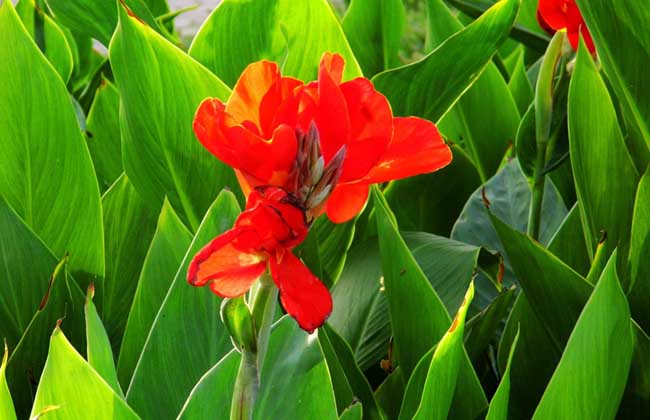
Canna has large, brilliantly colored flowers, rich colors, a good plant shape, is easy to cultivate, and has very high ornamental value. It can be grown in pots or in the ground, and many people like to keep them in their courtyards. They help purify the air and protect the environment, making them an ideal flower for greening, beautifying, and purifying the environment. Now let us take a look at when the blooming season of Canna is!
When does Canna bloom
Canna is a perennial bulbous herbaceous flower. Its flower colors include creamy white, bright yellow, orange-yellow, tangerine, pink, bright red, purple-red, and variegated spots, with more than 50 varieties. In the north, the blooming season is usually from June to October, while in the south it blooms all year round.
How to extend the blooming season of Canna
1. Move it indoors in time: Canna is a subtropical flower and likes a warm climate and plenty of sunlight. At a temperature of 25°C-28°C, it blooms quickly, and it usually takes about 7 days from bud appearance to flowering. In the north, if you want Canna to bloom in winter, it must be moved indoors before October 15.
2. Keep the room warm: Keep the indoor temperature at 15°C-18°C, and the blooming season can be extended to the New Year.
3. Ensure sufficient sunlight: After moving it indoors, the daily sunlight time should not be less than 4 hours. If there is not enough sunlight, a 60-watt light bulb or a 40-watt fluorescent lamp can be used for supplemental lighting. With 4-6 hours of sunlight per day, you can ensure bright flowers and tender leaves.
4. Fertilizer and water should be appropriate: After moving Canna indoors, the soil moisture content must be kept at 40%-50%. Apply a dilute liquid fertilizer once every half month, adding soybean cake water, livestock hoof water, or apply a 500-fold potassium dihydrogen phosphate solution. However, water and fertilizer should not be excessive; water frequently but lightly to prevent root rot.
How to grow Canna
1. Soil: It has low requirements for soil and grows best in loose, fertile, well-drained sandy soil, and it also adapts to fertile clayey soil.
2. Sunlight: During the growing period, it requires sufficient light and should receive at least 5 hours of direct sunlight every day. If the environment is too dark and the light is insufficient, the flowering period will be delayed.
3. Temperature: It likes warmth and avoids severe cold. The suitable growing temperature is 16-30°C. Growth stops at 5-10°C, and frost damage occurs below 0°C. When flowering, to extend the blooming season, it can be placed in a low-temperature place without sunlight, and the ambient temperature should not be lower than 10°C.
4. Watering: After planting, before the rhizome has grown new roots, water less. The potting soil should be kept moist. Soil that is too wet easily causes root rot. After the flower stalk grows, water frequently to keep the potting soil moist. If water is lacking, the phenomenon of “flowers hidden among the leaves” is likely to appear after flowering. In winter, watering should be reduced, following the principle of “see dry and see wet”.
5. Fertilizing: In addition to applying sufficient base fertilizer before planting, during the peak growing season a dilute cake liquid fertilizer should be applied 3-4 times a month. If the flower stalk has not yet emerged 20-30 days before the scheduled flowering date, a 0.2% potassium dihydrogen phosphate aqueous solution can be sprayed on the leaves once to promote flowering.
6. Pests: Canna has strong adaptability and is relatively easy to manage. It is not delicate, and there are very few pests. From May to August each year, watch out for leaf-rolling pests to avoid damaging its tender leaves and inflorescences. It can be controlled by spraying with 50% dichlorvos 800-fold solution or 50% fenitrothion emulsifiable concentrate 1000-fold solution.